Crypto : A senator wants to postpone the CLARITY Act until May
The crypto file is still progressing, but not as fast as expected in Washington. A Republican senator wants to postpone the next step of the CLARITY Act, a crucial text to regulate the digital asset market in the United States, until May.
In brief
- The CLARITY Act could wait until May.
- Stablecoin yield is blocking the Senate.
- Crypto wants to move forward before the electoral battle.
A postponement that cools the schedule
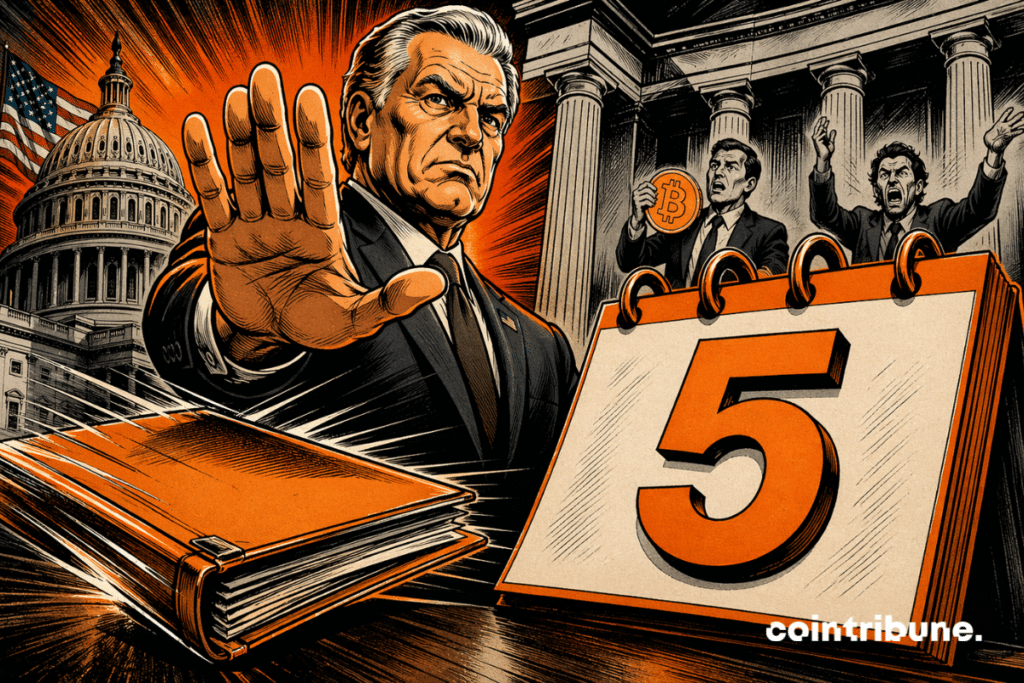
Thom Tillis is now pushing for a postponement of the CLARITY Act to May. The Republican representative from North Carolina asked the chairman of the banking committee, Tim Scott, not to rush the passage of the text in April.
The message is simple. For Tillis, representatives from the crypto sector and the banking sector have not yet had enough time to be heard, especially on a question that has become explosive: the yield paid on stablecoins. So this is not an abandonment of the text, but a political slowdown on a very specific point
This setback matters, because the CLARITY Act remains one of the major regulatory projects for crypto in the United States. The House of Representatives did adopt its version in July 2025, with a bipartisan vote of 294 to 134. But in the Senate, political time is becoming tighter as the November 2026 election deadline approaches.
The real blockage comes from stablecoins
The heart of the problem is not the definition of crypto itself. The real knot today concerns the possibility of offering a yield to stablecoin holders. Traditional banks fear that such a mechanism would draw some deposits out of the traditional banking system, especially in small community banks.
Their argument is quite clear. If individuals can get attractive compensation on tokenized dollars, part of the savings could leave ordinary bank accounts. For community banks, this would mean a more fragile deposit base and more frequent recourse to more expensive funding.
On the other side, crypto players do not want a text that is too restrictive. A compromise was even discussed: allowing rewards linked to crypto activity on third-party platforms, while excluding passive remuneration on simple dormant balances. In other words, Washington is not blocking on crypto in general. It blocks on the boundary between financial innovation and disguised savings product.
The crypto camp refuses to wait any longer
This shift to May obviously does not please the sector. The same day, The Digital Chamber asked the Senate banking committee to advance the text “as soon as the schedule allows.” Its argument is as political as it is economic: the industry believes that the market can no longer wait for a regulatory clarity promised for months.
The group also reminds that more than 270 days have passed since the adoption of the text in the House. This duration is starting to weigh in the public debate, as American crypto sees a legislative window that could close quickly approaching. The further the schedule slips, the greater the risk that the text will be sucked up by the midterm election campaign.
Scott Bessent, Treasury Secretary, himself recently put this pressure forward. He warned that a political shift in the House could break the current momentum around the CLARITY Act. This remark speaks volumes: in the United States, the battle over crypto is no longer just regulatory. It is also becoming electoral, strategic and even ideological.
A key text, but already caught up by reality
Substantively, the CLARITY Act was mainly supposed to address an old American weakness: the absence of stable rules to know when a digital asset falls under the stock market regulator or the commodity regulator. It is precisely this lack of clarity that the text seeks to correct, in order to prevent innovation from continuing to move to other better-defined jurisdictions.
But the paradox is striking. A project designed to bring clarity is now slowed by a very concrete debate on yield distribution. It is almost a brutal reminder of what crypto has become in Washington: no longer a marginal subject, but a file that directly affects bank deposits, platform power, and value sharing in digital finance.
The postponement requested by Thom Tillis does not bury the CLARITY Act. It rather highlights what is really at stake behind this text. The debate is no longer limited to a simple legal framework. It now concerns a far more strategic issue: who will profit tomorrow from the profitability of the digital dollar, traditional banks or crypto players? And while the Senate hesitates, the market, itself, does not stop. Polymarket is reportedly in talks for a $400 million raise.
Maximize your Cointribune experience with our "Read to Earn" program! For every article you read, earn points and access exclusive rewards. Sign up now and start earning benefits.

Fascinated by Bitcoin since 2017, Evariste has continuously researched the subject. While his initial interest was in trading, he now actively seeks to understand all advances centered on cryptocurrencies. As an editor, he strives to consistently deliver high-quality work that reflects the state of the sector as a whole.
The views, thoughts, and opinions expressed in this article belong solely to the author, and should not be taken as investment advice. Do your own research before taking any investment decisions.