Crypto: JPMorgan Warns About Growing Competition Around Hyperliquid
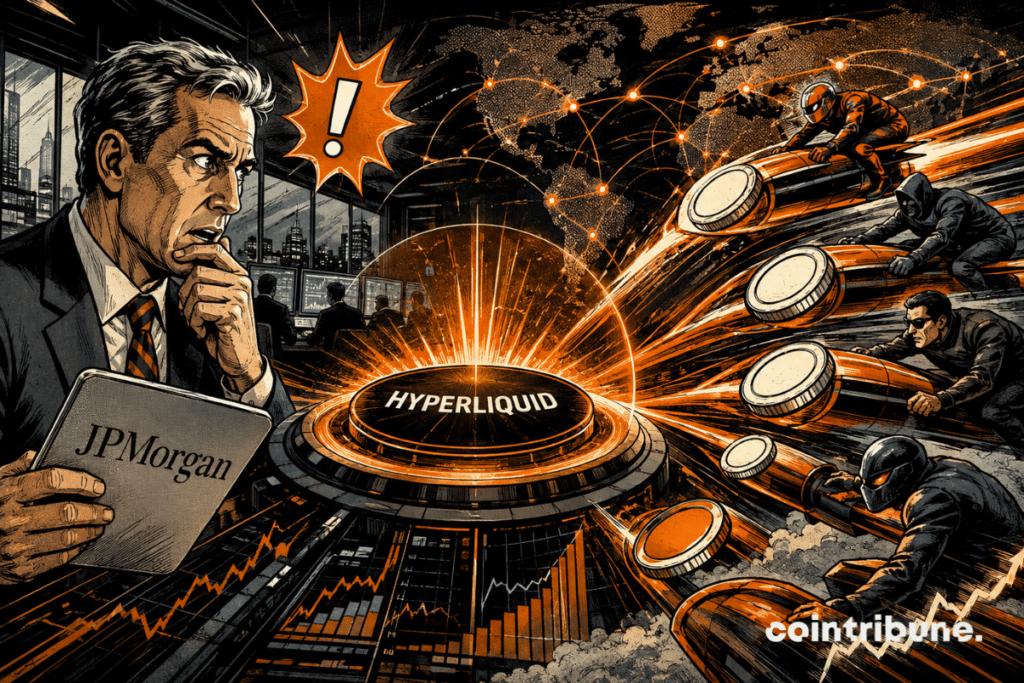
The crypto market becomes less comfortable for Hyperliquid. JPMorgan believes the decentralized platform could lose some of its lead to regulated derivatives and new competitors. At the same time, interest in crypto-related HYPE ETFs slows after several weeks of strong inflows.
In brief
- JPMorgan anticipates stronger crypto competition around Hyperliquid.
- Flows to HYPE ETFs slow after record highs in May and June.
- Future growth will depend on volumes, compliance, and liquidity.
Hyperliquid sees its advantage shrink
Hyperliquid has established itself as one of the main decentralized crypto perpetual contracts platforms. Its speed, liquidity, and experience close to centralized exchanges have attracted traders. But the risks already mentioned when Hyperliquid sought to avoid a deeper crisis return to the center of discussions.
According to JPMorgan, the expansion of regulated crypto perpetual contracts in the United States now poses a direct threat. These products could attract institutional investors who still hesitate to use decentralized or offshore platforms. Compliance, fund custody, and legal clarity become strong arguments.
Hyperliquid maintains a performant infrastructure. However, it remains exposed to criticisms related to decentralized finance. Analysts notably cite limited anti-money laundering controls, risks of manipulation, cyberattacks, and possible oracle failures.
The platform is also expanding its activity with Outcomes contracts, close to prediction markets. This diversification can attract new users. However, it places Hyperliquid facing competitors already well established. The growth in the number of products therefore increases its possibilities but also its areas of vulnerability.
Crypto flows to HYPE ETFs slow down
The second warning signal concerns investment products linked to HYPE. After large inflows in May and June, capital inflows stalled in July and early August. The initial enthusiasm for the crypto asset therefore seems to lose momentum.
Some weeks earlier, HYPE was among the few tokens capable of attracting capital while Bitcoin and Ethereum funds were experiencing outflows. This rotation was visible when XRP and HYPE ETFs captured crypto market flows.
The situation has changed. More traditional crypto ETFs have seen slight inflows again, while products related to Hyperliquid have stopped accelerating. Investors do not seem to completely abandon HYPE. They rather wait for new drivers before increasing their exposure.
This slowdown can directly impact the token. The value of HYPE remains closely linked to the volumes processed on Hyperliquid and the revenues generated by the platform. If market share declines, fees decrease. Demand for the token can then lose part of its support.
This mechanism works both ways. When activity grows, HYPE benefits from the success of the ecosystem. When volumes slow down, the crypto market quickly re-evaluates its valuation. JPMorgan therefore focuses less on an immediate drop than on growth becoming harder to maintain.
Institutional interest remains real. The Hyperliquid crypto ETF project supported by Grayscale shows that HYPE maintains an attraction capacity. But the competition changes the nature of the challenge. Hyperliquid must now transform its initial lead into a lasting advantage before regulated actors recover part of its liquidity.
Maximize your Cointribune experience with our "Read to Earn" program! For every article you read, earn points and access exclusive rewards. Sign up now and start earning benefits.

Enseignante et ingénieure IT, Lydie découvre le Bitcoin en 2022 et plonge dans l’univers des cryptomonnaies. Elle vulgarise des sujets complexes, décrypte les enjeux du Web3 et défend une vision d’un futur numérique ouvert, inclusif et décentralisé.
The views, thoughts, and opinions expressed in this article belong solely to the author, and should not be taken as investment advice. Do your own research before taking any investment decisions.