.@BitcoinJesusETH: Institutions are going all-in on crypto. Retail is completely checked out.
— Milk Road (@MilkRoad) April 21, 2026
The result?
"The digital asset ecosystem is just littered with projects like Aave that represent a huge amount of value that is completely mispriced and misunderstood by the overall… https://t.co/Fb7klBCPog pic.twitter.com/H52nNCUVoJ
A
A
Crypto whales accumulate AAVE despite the crisis: Here’s why
Wed 22 Apr 2026 ▪
3
min read ▪ by
Getting informed
▪
Crypto regulation
Summarize this article with:
On April 18, 2026, the KelpDAO bridge exploit triggered a major crisis on Aave, with 292 million dollars worth of rsETH stolen and a sharp fall in TVL. Yet, whales are massively accumulating AAVE within a key range. Breaking down a paradox that divides investors and reveals the hidden dynamics of the crypto market.
In brief
- 292 million $ stolen via a failing KelpDAO bridge, causing a 10 billion TVL drop on Aave and withdrawal freezes.
- Despite the crisis, major crypto investors are massively buying AAVE in the $85–95 range, suggesting anticipation of a rebound.
- Whale order clusters often coincide with local bottoms, as in 2022 or 2024, reinforcing the hypothesis of a buying opportunity.
KelpDAO: 292 million dollars stolen and a shock for Aave
On April 18, 2026, the KelpDAO bridge was exploited, allowing an attacker to drain 116,500 rsETH! That is, 292 million dollars, representing 18% of the circulating supply. These crypto tokens, lacking any real guarantee after the exploit, were deposited as collateral on Aave to borrow real assets, notably ETH and wETH. This manipulation created an irrecoverable debt estimated between 177 and 230 million dollars for Aave.
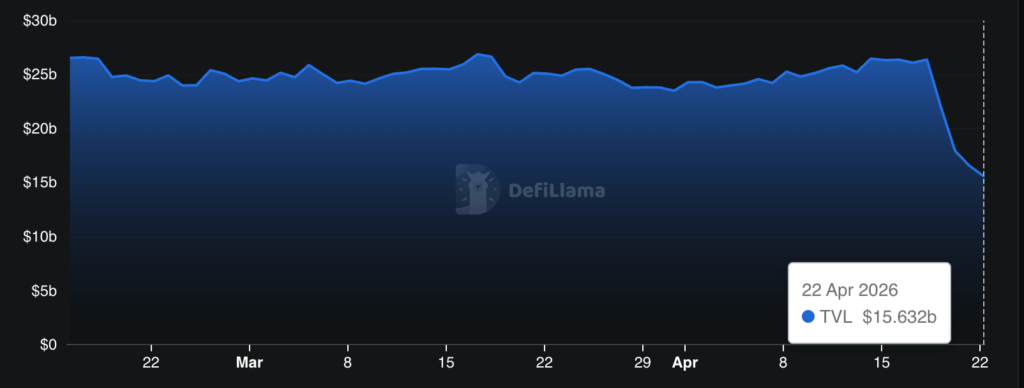
The immediate consequence was the dizzying fall of Aave’s TVL, dropping from 26.4 to 15.6 billion dollars in less than 24 hours. Moreover, the main pools (ETH, USDT, USDC) reached 100% utilization. Thus blocking withdrawals and forcing some crypto users to borrow against their own deposits to recover liquidity. This incident exposed the vulnerability of interconnected DeFi protocols, where a single flaw can trigger a systemic crisis. As shown by the 6.6 billion dollar bank run in one day.
Crypto: why are AAVE whales accumulating despite the crisis?
Despite the widespread panic, on-chain data reveals a massive accumulation of AAVE by crypto whales, particularly in the $85–95 price range. Furthermore, expert analyses show a significant increase in the average order size. This is a historical indicator of strategic positioning before a potential rebound. Especially since massive whale orders often coincide with local bottoms, as observed during the corrections in 2022 or 2024.
Therefore, with social sentiment at its lowest since the 2022 bear market and order sizes increasing, whales could be anticipating a recovery after the resolution of the debt related to KelpDAO. This dynamic suggests that despite the apparent crisis, some major players in the crypto market see AAVE as a discounted buying opportunity! Or alternatively, a strategic hedge in anticipation of a return to normal.
The KelpDAO exploit put Aave to the test, but the whale accumulation suggests underlying confidence. What follows will depend on debt management and the stability of the crypto market. In your opinion, is AAVE an opportunistic buy, or is the crisis deeper than expected? The coming days will be decisive for investors.
Maximize your Cointribune experience with our "Read to Earn" program! For every article you read, earn points and access exclusive rewards. Sign up now and start earning benefits.
A
A

The world is evolving and adaptation is the best weapon to survive in this undulating universe. Originally a crypto community manager, I am interested in anything that is directly or indirectly related to blockchain and its derivatives. To share my experience and promote a field that I am passionate about, nothing is better than writing informative and relaxed articles.
DISCLAIMER
The views, thoughts, and opinions expressed in this article belong solely to the author, and should not be taken as investment advice. Do your own research before taking any investment decisions.