Ethereum Delays Upgrade Amid Sharp Rise in Costs
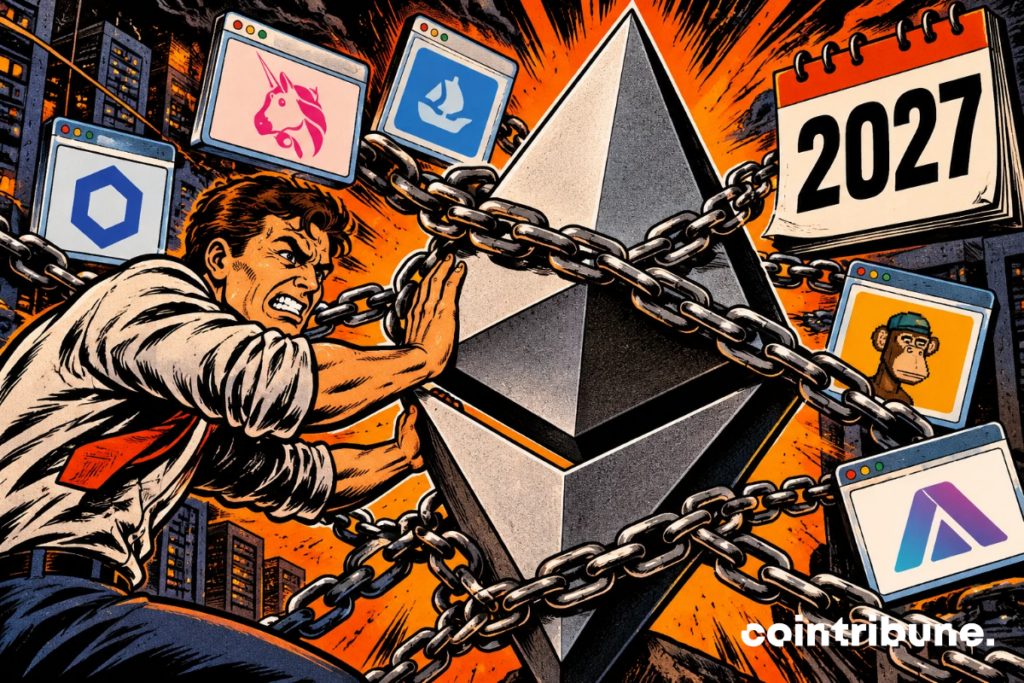
Ethereum will have to wait a few more weeks before welcoming Glamsterdam. Developers have decided to postpone this update to January 2027, probably towards the end of the month. The reason: an increase in the cost of creating smart contracts that could cause thousands of applications designed under the old rules to crash. Ethereum wants to increase capacity, but not at the price of a half-functioning network.
In brief
- The Ethereum Foundation and external researchers have contacted more than 50 companies potentially affected by this change.
- Deploying a 24-kilobyte contract could increase from 4.95 to 37.8 million gas, nearly eight times more.
- The four client teams, Geth, Nethermind, Reth, and ethrex, wish to maintain the new rules.
Ethereum wants to accelerate without blowing up its database
Glamsterdam should allow Ethereum to handle more operations simultaneously. The goal is notably to support growth in onchain trading and lending services. However, this scaling comes at a cost: the amount of data nodes must store is rapidly increasing.
In January 2026, the state database of a Geth node, which collects the data necessary for the network’s operation, weighed about 390 gibibytes. Since the gas limit doubled from 30 to 60 million, its daily growth has more than tripled, rising from 105 to 326 mebibytes.
At a 200 million gas limit, this database could grow by 387 gibibytes per year. In other words, nodes might have to store increasingly more data.
To limit this accumulation, EIP-8037 introduces a fee of 1,530 gas units per byte of new state. This mechanism increases the cost of operations that add permanent data to the blockchain.
Contract deployment could cost eight times more
This cost increase is already controversial. With the new rules, the base cost for deploying a contract rises from 32,000 to 183,600 gas units. Creating an empty account jumps from 25,000 to 183,600 gas, while a new storage slot increases from 20,000 to 97,920 gas.
The change is even more striking with large contracts. A 24-kilobyte program will now require 37.8 million gas, up from just 4.95 million before. At a base price of 0.08 gwei, deploying it would cost about 0.003 ETH.
However, the issue is not just the cost. Many applications were programmed with gas budgets calculated according to the old fees. If an operation now consumes more gas than expected, the transaction might simply fail. And an application that can no longer execute its operations hasn’t truly gained scalability.
Researchers identified around 200 potential issues. A developer from the Ethereum Foundation estimates that 15,000 programs could be affected. Among contacted companies, most believe they can adapt their applications before mid-January, provided the rules remain unchanged.
Client teams maintain pressure on the timeline
Despite these challenges, the four main teams developing Ethereum clients – Geth, Nethermind, Reth, and ethrex – do not wish to reverse the new rules.
The schedule includes a final rehearsal on Hoodi, a public testnet, during the week of December 14. Developers must make a decision at their meeting on November 26.
Applications facing the most serious problems should receive their fixes by mid-December. Others will have until January 10 to adapt. If tests go well, Ethereum can consider deploying on its main network by late January 2027.
One question remains: what will happen to applications that don’t complete their update in time? Their transactions could fail without an immediate solution.
Ultimately, Glamsterdam illustrates a well-known paradox in blockchain evolution: improving performance is not enough; it is also necessary to avoid penalizing those already using the network. Ethereum is therefore postponing its timeline to give developers time to adapt. Scalability advances, but it also carries its cost.
Maximize your Cointribune experience with our "Read to Earn" program! For every article you read, earn points and access exclusive rewards. Sign up now and start earning benefits.

Passionné par le Bitcoin, j'aime explorer les méandres de la blockchain et des cryptos et je partage mes découvertes avec la communauté. Mon rêve est de vivre dans un monde où la vie privée et la liberté financière sont garanties pour tous, et je crois fermement que Bitcoin est l'outil qui peut rendre cela possible.
The views, thoughts, and opinions expressed in this article belong solely to the author, and should not be taken as investment advice. Do your own research before taking any investment decisions.