Stablecoins : The Bank of France demands a tightening of MiCA rules
Europe is under pressure: 98% of stablecoins are backed by the dollar, and Tether’s USDT dominates the market. Faced with this dependence, the Bank of France demands urgent tightening of MiCA rules. Why is this threat so serious?
In brief
- Dollar-linked stablecoins threaten European financial sovereignty and require enhanced regulation through MiCA, according to the Bank of France.
- Current MiCA rules do not sufficiently cover systemic risks, pushing regulators to propose restrictions on payments and reserves.
- It would be necessary to limit the use of non-European stablecoins, impose euro reserves, and strengthen transparency to reduce dependence on the dollar.
Bank of France vs. Stablecoins: The limits of MiCA exposed
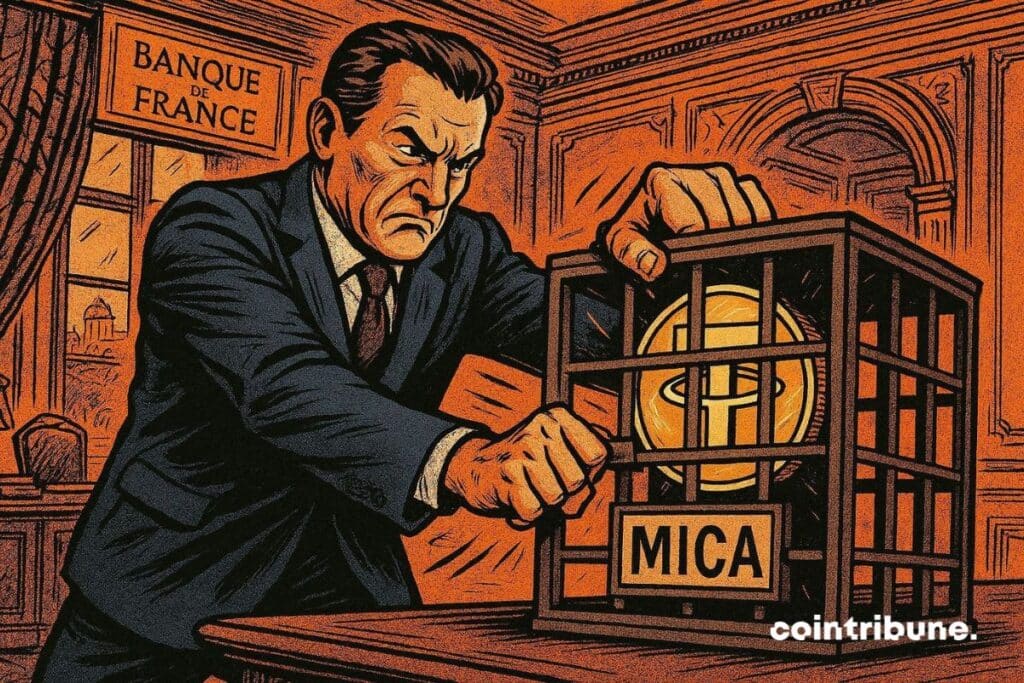
Denis Beau, first Deputy Governor of the Bank of France, recently pointed out the shortcomings of MiCA, already weakened. According to him, current rules do not sufficiently cover risks related to foreign stablecoins, especially their massive use in cross-border payments. To this end, the Bank of France proposes radical measures, namely:
- Restrictions on non-European stablecoins for critical transactions;
- Reserve requirements in euros for issuers, to reduce dependence on the dollar;
- Enhanced monitoring of use cases, particularly for large payments.
However, these proposals raise concerns about data security risks, technical feasibility, and potential hindrance to innovation in an already highly competitive crypto sector. Especially since stablecoins like USDT are very often used by states to circumvent international sanctions.
USDT: The systemic threat weighing on Europe
USDT, Tether’s stablecoin, is omnipresent in Europe. In fact, nearly 70% of crypto transactions on the continent use it, exposing markets to American monetary decisions. In case of a crisis at Tether, repercussions could be devastating! Notably, freezing of reserves, extreme volatility, and widespread loss of confidence.
However, the risks are twofold for Europe because the Euro has so far been marginalized in crypto exchanges. Moreover, hostile American regulation could make USDT inaccessible, blocking billions of euros in transactions. To face this, Europe is therefore betting on local alternatives (euro stablecoins, Digital Euro) and international collaboration to limit USDT’s influence. Will it happen?
For the Bank of France, stablecoins like Tether’s USDT are a ticking time bomb for Europe. Consequently, MiCA must evolve to protect the financial sovereignty of the old continent. But how far should we go? Should foreign stablecoins be simply and purely banned at the risk of hindering innovation?
Maximize your Cointribune experience with our "Read to Earn" program! For every article you read, earn points and access exclusive rewards. Sign up now and start earning benefits.

The world is evolving and adaptation is the best weapon to survive in this undulating universe. Originally a crypto community manager, I am interested in anything that is directly or indirectly related to blockchain and its derivatives. To share my experience and promote a field that I am passionate about, nothing is better than writing informative and relaxed articles.
The views, thoughts, and opinions expressed in this article belong solely to the author, and should not be taken as investment advice. Do your own research before taking any investment decisions.