The ECB Approves Tokenization but Warns of Risks to Watch
Bitcoin and its crypto cousins fascinate elsewhere, but in Europe, enthusiasm remains measured and almost wary. Regulators observe, dissect, then decide coldly, far from the impulses of the global and volatile crypto market. Yet, another branch of blockchain attracts their attention, discreet but promising, almost strategic for financial future. Tokenization gently enters the quiet offices where tomorrow’s finance is being shaped.
In Brief
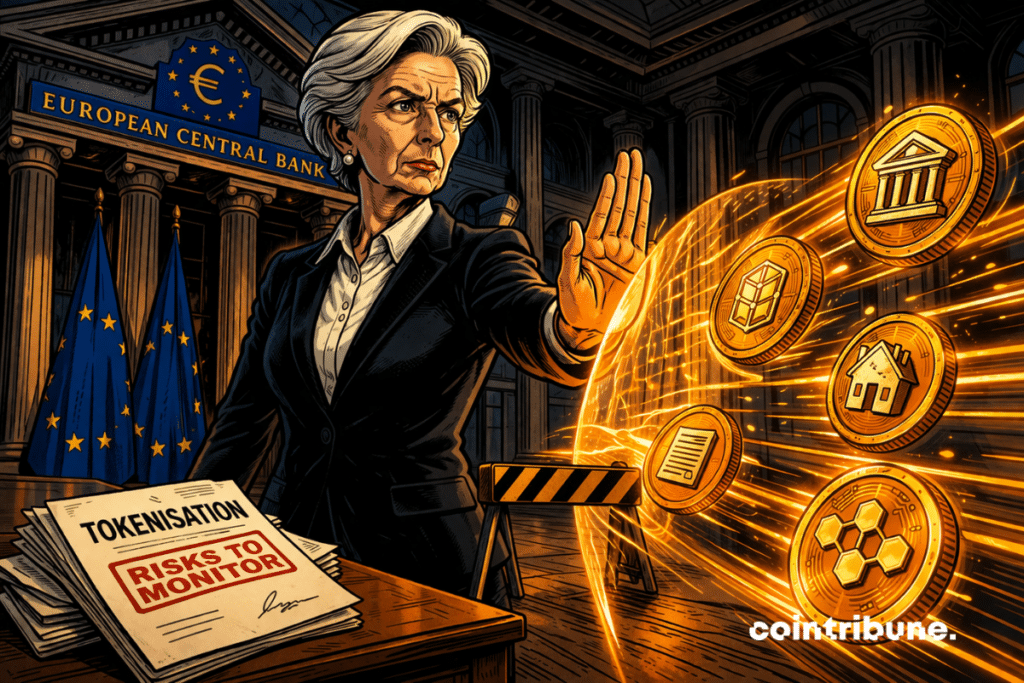
- The ECB sees tokenization as an efficiency tool, not a crypto Trojan horse.
- It requires central currency, interoperable infrastructures and a robust framework to avoid fragmentation, contagion, and disorder.
- It requires central currency, interoperable infrastructures and a robust framework to avoid fragmentation, contagion, and disorder.
- Tokenized money market funds grow fast but also bring liquidity and run risks.
Tokenization Appeals to the ECB, Away from Crypto Turmoil
First, the ECB does not close the door; it even widely opens the window of tokenization. Unlike the often unstable crypto market, tokenization appears as a structuring tool. It would simplify financial exchanges and ease capital flow.
Indeed, the ECB believes DLT can shorten the chain between issuance and settlement. Tokenized assets could thus reduce friction, automate processes, and improve overall system transparency. Some test markets already show borrowing cost drops and tighter spreads.
Tokenization and Distributed Ledger Technology (DLT) are moving from concept to small-scale deployment in European and global financial markets. Tokenized financial instruments still represent only a fraction of traditional financial markets, and uncertainties remain about their ability to scale and provide expected benefits.
Source: ECB
Meanwhile, the market remains nascent but grows quickly, reaching about 45 billion dollars by early 2026. A drop in the bucket compared to traditional markets, but a growing drop.
A Strained Crypto Finance: The ECB Rejects Fragmentation
Next, the tone changes. The ECB does not want an uncontrolled technological patchwork. The crypto market already showed dangers of fragmented systems; tokenization must not replicate this.

Indeed, the institution insists on a central point: interoperability. Without coordination, tokenized platforms risk silo operation, creating harmful fragmentation. The promise of efficiency could then turn into technical chaos.
The ECB also warns against a common illusion: technology alone cannot create a robust market. Rules must follow or even precede. Without a solid framework, today’s gains could disappear as tokenization expands.
These include the pace and modalities of adoption, the resilience of underlying infrastructures, and the ability of regulators and supervisors to effectively contain new risks while fostering efficiency gains.
Source: ECB
Thus, the battle is not only on blockchain but on the overall architecture of the European financial system.
The Real Bottleneck: Central Currency and Stability Above All
Finally, the core message appears clearly, almost brutally. The ECB does not negotiate on the settlement currency. In a tokenized world, it wants to keep control of the foundation.
It now insists on the use of central bank money, the digital euro, as the reference. Stablecoins or private solutions are not enough to guarantee system stability. The risk of contagion or imbalance remains too high.
Tokenized money market funds illustrate this dilemma. They promise speed and accessibility but also introduce liquidity and investor run risks. The speed offered by blockchain could amplify crises rather than contain them.
Furthermore, these structures remain partially off-chain, dependent on intermediaries. This hybrid mix complicates risk management and weakens the whole.
Signals to Watch Closely
- 45 billion dollars for global tokenized assets in 2026;
- 7 billion euros for tokenized money market funds;
- Growth doubled in one year for these hybrid financial products;
- 24/7 trading possible but often limited by off-chain processes;
- Strong dependence on traditional infrastructures and players.
The ECB does not hide its mistrust of the crypto universe, which it deems unstable and difficult to control. It advances differently, strengthening the centralization of digital asset supervision. Behind tokenization, it builds above all a system where innovation remains supervised, monitored, and especially driven from the very heart of institutions.
Maximize your Cointribune experience with our "Read to Earn" program! For every article you read, earn points and access exclusive rewards. Sign up now and start earning benefits.

La révolution blockchain et crypto est en marche ! Et le jour où les impacts se feront ressentir sur l’économie la plus vulnérable de ce Monde, contre toute espérance, je dirai que j’y étais pour quelque chose
The views, thoughts, and opinions expressed in this article belong solely to the author, and should not be taken as investment advice. Do your own research before taking any investment decisions.