Tom Lee sees an Ethereum recovery once the Middle East conflict ends
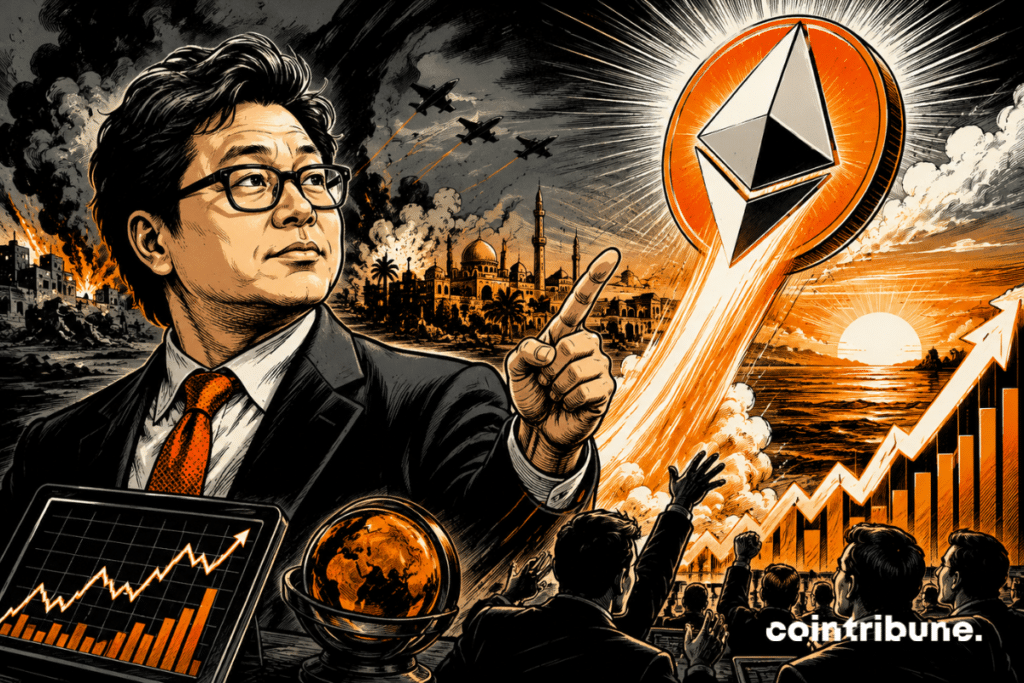
Ethereum could regain momentum if the Middle East conflict calms down. This is the idea defended by Tom Lee, who sees in the current pressure a market noise more than a real trend change.
In brief
- Tom Lee sees Ethereum rebound when the Middle East conflict loses intensity.
- The rise in oil remains today a major brake for ETH.
- Tokenization and AI keep Ethereum in a long-term bullish scenario.
Ethereum remains stuck in the oil-war shock
Ethereum is mainly undergoing macroeconomic pressure, according to Tom Lee. The issue therefore goes beyond the simple technical weakness of the price. In this context, Ethereum also needs a return of risk and a clearer framework, because the market no longer values just technology. It values visibility.
Lee’s reasoning is straightforward. When oil rises, investors reduce their exposure to risky assets. Ethereum then enters the turbulence zone. It is not sold only for its flaws. It is sold because the overall mood becomes more defensive.
Since January, ETH has fallen more sharply than Bitcoin. This underperformance fuels the idea of an excess of pessimism. For Lee, the current pressure resembles market noise more than a lasting rejection of Ethereum’s role. The Middle East conflict does not only affect crypto markets. It passes through energy, gas prices, and household morale. Oil acts as a nervous thermometer. The higher it rises, the more the market avoids long bets.
This climate also weighs on U.S. politics. A majority of Americans want a rapid exit from the conflict with Iran, but few believe in immediate peace. This contradiction establishes lasting tension: voters want the war to end but doubt a solid agreement.
For Ethereum, this uncertainty is heavy. The market hates fuzzy zones. It can accept a bad figure. It digests less easily an open war, unstable oil, and a cautious central bank. ETH thus finds itself caught in a mechanics beyond its control.
Tom Lee looks beyond the tactical noise
Tom Lee insists on the temporary nature of this pressure. He does not describe Ethereum as a broken asset. He rather describes an asset limited by an unfavorable environment. The nuance matters. His optimism relies on two main drivers. The first is the tokenization of real assets. The second is the increasing use of agentic artificial intelligence. In both cases, Ethereum can serve as a layer for settlement, execution, and programmable trust.
This is not a new idea for Lee. He has already defended Ethereum’s central role in tokenized finance, notably when tokenization was presented as a major lever for ETH. His scenario therefore relies on a long-term view. The price suffers today, but the infrastructure remains strategic.
The bullish thesis remains credible, but it does not erase the risks. Ethereum still has to convince on its fees, its fragmentation between layer 2s, and its ability to capture a lasting share of tokenized finance. The market will not pay only for a promise.
The real shift could come from a retreat in oil. If geopolitical tensions decrease, investors could return to risky assets. Ethereum would then be well positioned to benefit from a catch-up. Especially after a phase of decline more marked than Bitcoin’s.
But the signal will have to be visible. A simple diplomatic speech will not be enough. There will need to be a relaxation in energy, an appetite for risk, and more favorable flows towards ETH. At that moment, Tom Lee’s reading will take on another dimension. Ethereum would no longer be just an asset under pressure. It would become again a natural candidate for a rebound, driven by tokenization, AI, and institutional accumulation, as also shown by Bitmine’s aggressive strategy on Ethereum’s supply.
Maximize your Cointribune experience with our "Read to Earn" program! For every article you read, earn points and access exclusive rewards. Sign up now and start earning benefits.

Enseignante et ingénieure IT, Lydie découvre le Bitcoin en 2022 et plonge dans l’univers des cryptomonnaies. Elle vulgarise des sujets complexes, décrypte les enjeux du Web3 et défend une vision d’un futur numérique ouvert, inclusif et décentralisé.
The views, thoughts, and opinions expressed in this article belong solely to the author, and should not be taken as investment advice. Do your own research before taking any investment decisions.