United States : Trump defends federal jurisdiction over prediction markets
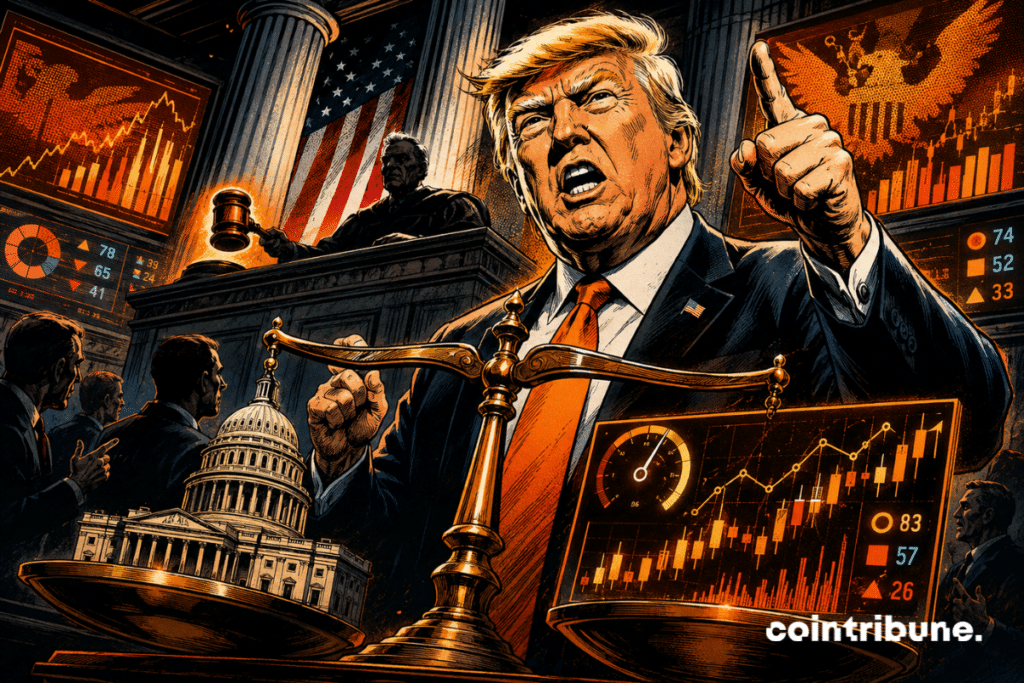
The White House opens a new regulatory phase around prediction markets. Donald Trump clearly supports the CFTC, while several American states want to keep their control power over these sensitive contracts.
In brief
- Trump supports the CFTC on prediction markets.
- States challenge this exclusive federal jurisdiction.
- Courts should decide the core of the conflict.
Trump pushes the CFTC to center stage
Donald Trump defends the federal jurisdiction over prediction markets and supports the CFTC in its desire to impose a unique national framework. The topic is gaining importance as Polymarket and Kalshi are already facing regulatory restrictions in Europe, proof that these platforms are no longer treated as mere financial curiosities.
This support is not neutral. It turns a technical debate into a political showdown. On one side, Washington wants to avoid a patchwork of local rules. On the other, several states believe these markets directly impact their gambling laws and consumer protection.
The CFTC therefore seeks to set a clear line. Contracts linked to real-world events would be regulated by the federal derivatives regulator. This approach would give more coherence to the market, but it would greatly reduce the maneuvering room of local authorities.
A battle between finance, politics, and local law
Prediction markets are no longer a niche subject. They now intersect finance, politics, sports, and major public events. It is precisely this mix that worries regulators. The bigger the sector grows, the blurrier the line becomes between forecasting tool, financial product, and activity assimilated to gambling.
The CFTC has already toughened its stance. It has challenged restrictions imposed by some states, notably in cases aimed at preventing the enforcement of local laws against these contracts. This offensive illustrates a simple but explosive question: who decides?
If the answer goes to the CFTC, states lose part of their power. If states win, the sector will have to deal with different rules depending on jurisdictions. For the stakeholders involved, it would be a permanent legal headache.
The risk of a too political market
Trump’s support adds a layer of tension. The president presents federal jurisdiction as a way to establish solid rules. But his opponents also see it as a way to limit the action of states opposed to these markets. The debate then leaves the regulatory field to enter that of partisan confrontation.
However, the problem goes beyond Trump. Prediction markets pose a real trust issue. When contracts concern elections, public decisions, or international crises, the risk of manipulation becomes more visible. The CFTC itself emphasizes the need to avoid contracts that are easily manipulable or exposed to abusive practices.
This is where the case becomes delicate. A market can aggregate useful expectations. But it can also create bad incentives. The more sensitive the event, the more precise the regulation must be. Otherwise, the displayed price risks being seen as a reliable compass, while it remains the result of sometimes highly concentrated financial interests.
A decision that will mostly go to the courts
Despite Trump’s position, the outcome will not depend solely on the White House. Federal courts will have a central role. The president’s political intervention may influence public debate, but it does not alone settle the legal arguments around event contracts.
So it is a jurisdiction battle before being a market battle. The CFTC wants to assert its exclusive authority. States want to defend their local laws. Between the two, the sector awaits a clear signal to know under which regime it will have to operate.
In essence, the United States is testing here its ability to regulate a new event finance. It is not just a question of platforms. It is a question of regulatory sovereignty. And as often with emerging markets, the rule comes after the use, especially when Kalshi and Polymarket are already expanding their playground towards crypto products.
Maximize your Cointribune experience with our "Read to Earn" program! For every article you read, earn points and access exclusive rewards. Sign up now and start earning benefits.

Fascinated by Bitcoin since 2017, Evariste has continuously researched the subject. While his initial interest was in trading, he now actively seeks to understand all advances centered on cryptocurrencies. As an editor, he strives to consistently deliver high-quality work that reflects the state of the sector as a whole.
The views, thoughts, and opinions expressed in this article belong solely to the author, and should not be taken as investment advice. Do your own research before taking any investment decisions.