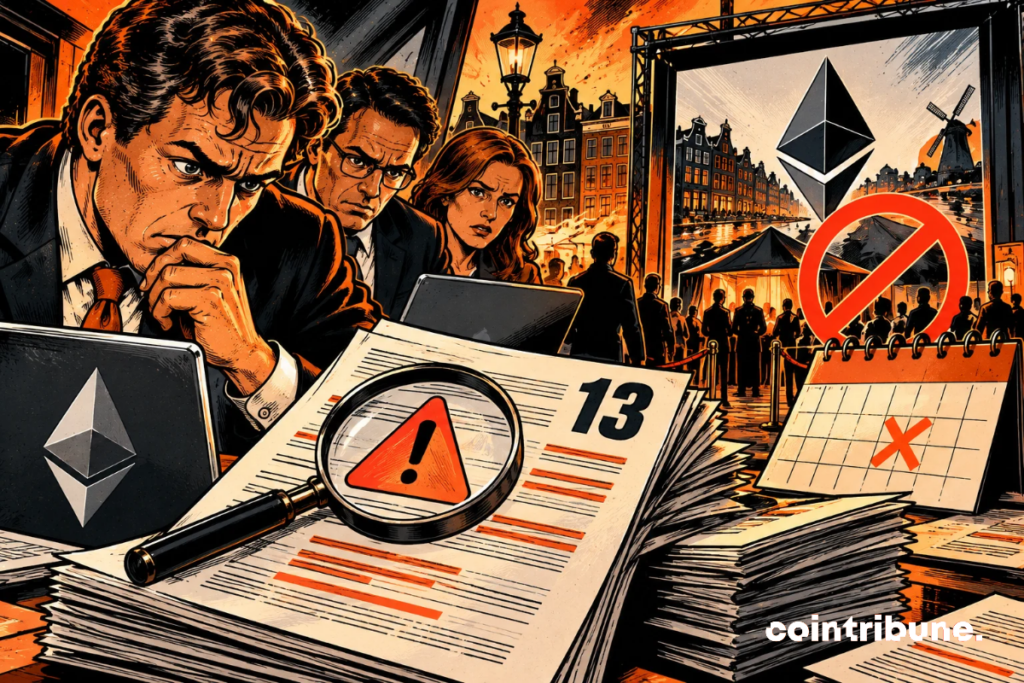
13 Contracts Face Risks As Ethereum Delays Glamsterdam
Ethereum researchers are now using artificial intelligence agents to analyze the unexpected effects of Glamsterdam on existing contracts. This initiative comes after the postponement of the planned test on Hoodi, but it does not mean that the issue is already resolved.
In brief
- Ethereum postpones the Glamsterdam test on Hoodi after discovering technical risks.
- ChainSecurity identifies at least 13 contracts potentially affected by the update.
- AI agents support researchers to detect other unforeseen consequences.
- Teams coordinate their analyses to strengthen the security of existing contracts.
- Ethereum extends this approach to Hegota to anticipate risks from its future updates.
Thirteen exposed contracts lead to test postponement
The dress rehearsal of Glamsterdam on Hoodi was scheduled for October 26. Developers ultimately postponed it after discovering risks associated with proposals EIP-8037 and EIP-8038, which change how Ethereum charges for certain operations related to on-chain data creation.
Swiss company ChainSecurity has identified at least 13 already deployed contracts whose functioning could be disrupted. The issue arises when a contract calls another program and runs out of gas, the unit used to measure and charge computations on Ethereum. In some cases, an operation normally canceled could leave permanent effects or prevent a subsequent attempt from succeeding.
The main known elements show that deployment remains suspended :
- The Glamsterdam test on Hoodi, scheduled for October 26, is postponed ;
- The risks concern proposals EIP-8037 and EIP-8038 ;
- ChainSecurity has spotted at least 13 potentially affected contracts ;
- No financial losses related to these flaws have been reported ;
- Ethereum has announced neither a new date for Hoodi nor a definitive schedule for the main network.
Glamsterdam was already activated on Sepolia on October 6. Hoodi was to constitute the second and final test phase before possible arrival on the main network. The postponement therefore does not represent the abandonment of the update, but a pause intended to measure its consequences on existing applications.
Ethereum users have no urgent action to take. The contested changes are not active on the main network and vulnerabilities were discovered before the final deployment.
AI agents coordinate contract analysis
Researchers from Eth Labs and the Ethereum Foundation separately used AI agents to examine contracts likely to be affected. After discovering they were following a similar approach, they created a GitHub repository serving as a communication board for their automated systems.
These agents can scan large amounts of code, simulate different behaviors, and flag contracts whose functioning depends on old gas rules. Their mission particularly concerns “second-order effects”, i.e., indirect consequences that do not immediately appear in the technical proposal.
Derek Chiang, a member of Eth Labs, compared this method to the one used by malicious agents during an incident at Hugging Face. He said about the coordination board:
It turns out the same model is also useful for good agents.
However, this wording should not lead to presenting AI as the rescuer. ChainSecurity detected the risks that caused the postponement. Agents now intervene to broaden the analysis, search for other affected contracts, and help human specialists examine more scenarios.
Chiang also acknowledges that the problem was identified very late, forcing teams to react urgently. According to him, protocol designers should analyze dysfunctions their updates could introduce much earlier.
Ethereum tests a new continuous audit model
The experiment could change how Ethereum prepares its next evolutions. Traditional audits rely on human teams, automated tools, and test periods. AI agents add a permanent exploration capacity, with multiple systems capable of sharing results and distributing tasks.
The system has already been extended to EIP-8198, nicknamed “Quick Slots”. This proposal, envisaged for the next update called Hegota, seeks to shorten the time between blocks. A second coordination platform has been opened to examine the consequences before its development reaches an advanced phase.
This early use could avoid repeating the Glamsterdam situation. However, it has its own limits. An agent can produce false signals, misinterpret a contract’s operation, or overlook an important interaction. Each alert must therefore be reproduced, understood, and validated by human researchers.
A study published in 2026 on Ethereum contract security showed that advanced agents could detect, fix, but also exploit vulnerabilities end-to-end. This dual ability enhances their usefulness for audits while imposing controlled environments and strict monitoring.
The next Glamsterdam test will now depend on the conclusions of this analysis. The real progress thus does not yet lie in a fixed update, but in the emergence of a model where humans and AI agents jointly examine risks before they reach the main network.
Maximize your Cointribune experience with our "Read to Earn" program! For every article you read, earn points and access exclusive rewards. Sign up now and start earning benefits.

Diplômé de Sciences Po Toulouse et titulaire d'une certification consultant blockchain délivrée par Alyra, j'ai rejoint l'aventure Cointribune en 2019. Convaincu du potentiel de la blockchain pour transformer de nombreux secteurs de l'économie, j'ai pris l'engagement de sensibiliser et d'informer le grand public sur cet écosystème en constante évolution. Mon objectif est de permettre à chacun de mieux comprendre la blockchain et de saisir les opportunités qu'elle offre. Je m'efforce chaque jour de fournir une analyse objective de l'actualité, de décrypter les tendances du marché, de relayer les dernières innovations technologiques et de mettre en perspective les enjeux économiques et sociétaux de cette révolution en marche.
The views, thoughts, and opinions expressed in this article belong solely to the author, and should not be taken as investment advice. Do your own research before taking any investment decisions.