$46B Flows Into ETF, But Bitcoin Struggles
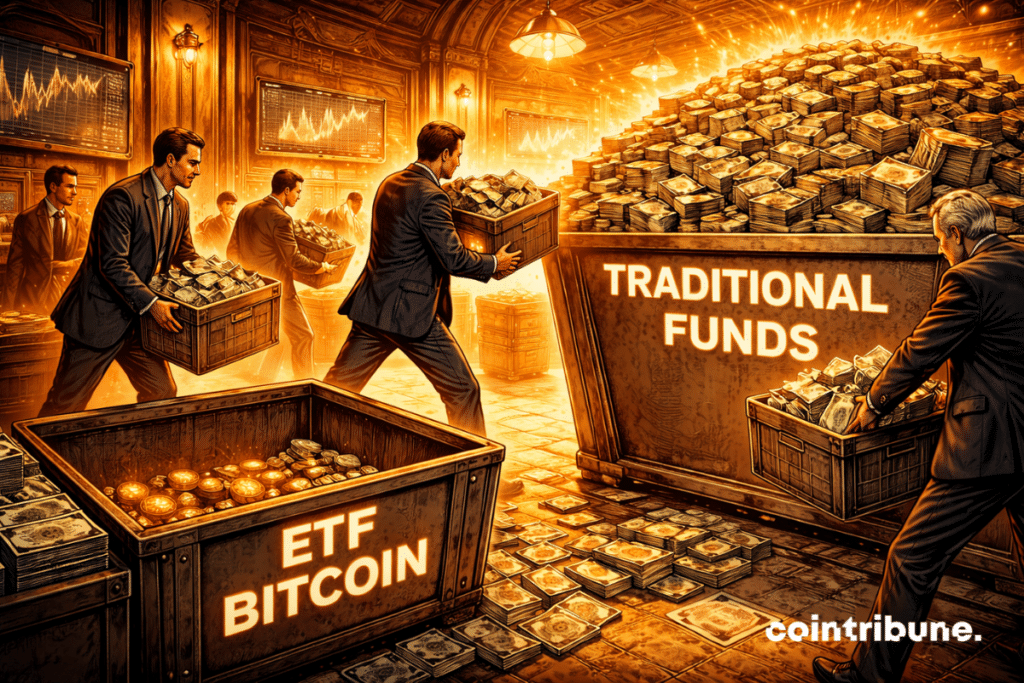
At the start of 2026, markets show a striking contrast: traditional funds attract record inflows, while Bitcoin ETFs lose momentum. This divergence, far from anecdotal, could signify a strategic shift among institutional investors, between seeking stability and persistent distrust of cryptos. In an uncertain economic context, arbitrages harden, redefining allocation priorities. Bitcoin, long touted as an alternative safe-haven asset, now seems relegated to the background by portfolio managers.
In brief
- Bitcoin ETFs start 2026 in an uncertain climate, with only $660M in net inflows since the beginning of the year.
- After four days of losses, a technical rebound of $753M was recorded on January 13, without reversing the underlying trend.
- Monthly flows to Bitcoin ETFs have sharply declined since July 2025, falling from +$6B to -$1.09B in December.
- Meanwhile, traditional ETFs recorded a record inflow of $46B in just six days.
A volatile start to the year for Bitcoin ETFs
This start of the year illustrates the persistent volatility of Bitcoin ETFs. According to data from Farside Investors, these listed products saw an inflow of $753 million this Tuesday, January 13, marking their second consecutive day of recovery after four negative sessions.
This rebound comes amid uncertainty, where investors struggle to regain the momentum observed during the first half of 2025. Despite this temporary boost, cumulative flows for the year remain modest, with $660 million in net inflows since January 1st. This figure, well below prior peaks, reflects a gradual disengagement by institutional investors.
The underlying trend has sharply reversed over the past six months, as shown by the evolution of monthly flows :
- July 2025 : nearly $6 billion in net inflows into Bitcoin ETFs ;
- December 2025 : $1.09 billion in net outflows, marking the low point of the second half of the year ;
- January 2026 : $660 million in net inflows, despite two positive technical days.
This gradual decline in momentum can be explained by several factors: increased crypto market volatility at year-end, the absence of clear macroeconomic catalysts, as well as ongoing regulatory uncertainties.
Added to this is heightened investor caution, which seems to slow down positions taken on bitcoin-related products, despite the temporary return of flows observed over the past 48 hours.
Between strategic accumulation and signals of caution
While Bitcoin ETFs struggle to regain traction, traditional investment products record an extraordinary start to the year.
According to Eric Balchunas, ETF analyst at Bloomberg, traditional ETFs attracted $46 billion in inflows in just six days, a pace four times higher than the historical average. “ETFs recorded $46 billion in inflows over the first six days of the year, an abnormally high level for a start to the year. If they maintain this pace, they would reach $158 billion for the month, about four times the usual average,” he specified in a post on X.
This rush to traditional products reflects a massive repositioning of investors towards vehicles perceived as more stable or predictable, in marked contrast to the structural volatility of cryptos.
In this environment, some crypto products still try to stand out. Ether ETFs recorded $130 million in net inflows on Tuesday, bringing their total to $240 million since the start of the year.
Meanwhile, Solana ETFs show steady growth, with $67 million in cumulative net inflows in 2026. However, leading savvy investors follow a different path. According to Nansen, these investors hold more short positions on bitcoin, with $122 million in short positions. Bullish bets focus only on a few specific assets like Ether, XRP, Zcash, or the memecoin PUMP, reflecting extreme selectivity in an uncertain market context.
While bitcoin jumps beyond $95,000, the question of its place in institutional portfolios remains open. Between ETF disengagement and strategic accumulation behind the scenes, market signals depict a quiet reconfiguration, where caution no longer necessarily means withdrawal, but repositioning.
Maximize your Cointribune experience with our "Read to Earn" program! For every article you read, earn points and access exclusive rewards. Sign up now and start earning benefits.

Diplômé de Sciences Po Toulouse et titulaire d'une certification consultant blockchain délivrée par Alyra, j'ai rejoint l'aventure Cointribune en 2019. Convaincu du potentiel de la blockchain pour transformer de nombreux secteurs de l'économie, j'ai pris l'engagement de sensibiliser et d'informer le grand public sur cet écosystème en constante évolution. Mon objectif est de permettre à chacun de mieux comprendre la blockchain et de saisir les opportunités qu'elle offre. Je m'efforce chaque jour de fournir une analyse objective de l'actualité, de décrypter les tendances du marché, de relayer les dernières innovations technologiques et de mettre en perspective les enjeux économiques et sociétaux de cette révolution en marche.
The views, thoughts, and opinions expressed in this article belong solely to the author, and should not be taken as investment advice. Do your own research before taking any investment decisions.