70% Of Binance Withdrawals Move Into Self-Custody Wallets
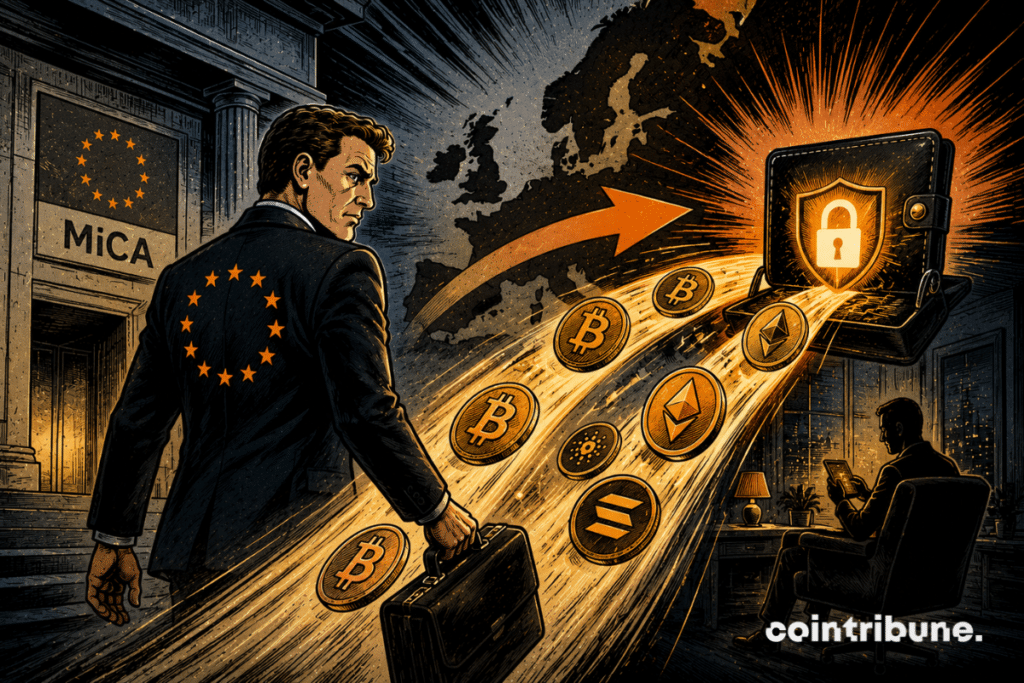
MiCA was supposed to secure European crypto. It may instead accelerate a new movement, that of capital towards decentralized finance. While regulators seek to frame exchanges through authorized actors, some users now favor solutions offering greater autonomy. The first strategic choices of major platforms reveal a growing tension between regulatory oversight and financial freedom. This confrontation could permanently reshape the balances of the global crypto market.
In brief
- Following Binance restrictions in Europe, 70 % of withdrawn funds migrated to private wallets (self-custody), compared to only 30% to MiCA-regulated platforms.
- Co-CEO Richard Teng highlights that this flight to self-hosted wallets escapes KYC/AML controls, paradoxically amplifying the risk for users.
- Binance withdrew its license application in Greece due to administrative delays and political pressure, choosing to protect its clients from a chaotic transition.
- Anchored by its global regulatory status in Abu Dhabi, the exchange accelerates deployment in Asia-Pacific and now claims 323 million global users.
The exodus of European capital to private custody after the MiCA deadline
Speaking at the Reuters NEXT Asia summit in Singapore, Binance co-CEO Richard Teng revealed a clear distribution of assets after the regulatory deadline:
- 70 % of European user funds withdrawn from the platform following this suspension directly migrated to self-custody wallets ;
- Only 30 % of outgoing flows were transferred to competing platforms duly regulated and authorized by MiCA.
This massive flight to non-custodial wallets places assets beyond the reach of surveillance, Know Your Customer (KYC) checks, and anti-money laundering (AML) measures that apply to centralized exchanges. Faced with this observation, Richard Teng publicly questioned the relevance of the new European Union rules. He stated : “does the MiCA regime really fulfill its objective of minimizing risks for users? Because once funds migrate to a self-custody wallet, the risk is actually amplified”.
This situation stems directly from Binance’s decision to suspend its services after withdrawing its MiCA license application in Greece just before the July 1 transitional deadline. The executive specified that the exchange chose to withdraw its file due to administrative approval delays, despite submitting a file deemed fully compliant by the company, to avoid imposing too short and chaotic a transition period on its clients.
These explanations echo revelations made last month by Binance founder Changpeng Zhao, who indicated that the application was about to be approved before “political forces” intervened, prompting the firm to abandon this process to target authorization in another European Union member state.
Binance’s geopolitical pivot and the offensive in Asian markets
Despite this regulatory setback in the Old Continent, Binance refuses to capitulate in Europe and simultaneously redirects its ambitions toward more receptive jurisdictions. Richard Teng indicated that several European Union countries have already invited the exchange to apply for local licenses, though he declined to name these states, reiterating the platform’s willingness to collaborate closely with the region’s regulators. To establish its institutional credibility, the co-CEO moreover emphasized Binance’s unique regulatory status, describing it as the only global crypto platform with a national regulator overseeing its end-to-end operations, specifically the Financial Services Regulatory Authority (FSRA) of Abu Dhabi.
This authority supervises governance, listing policies, transaction monitoring, and the management of the company’s wallets following an extensive review process lasting eighteen months.
Leveraging this regulatory foundation in the Middle East, the exchange platform is now deploying an expansion strategy described as aggressive across Asia, a region where it already holds licenses in Japan, South Korea, Thailand, Indonesia, Australia, India, and Pakistan.
This offensive materialized with the launch of operations in the Philippines through a strategic partnership with Blockshow, and the company anticipates obtaining additional permits in the region throughout this year. Such growth dynamics allow Binance to today claim a user base of 323 million worldwide, out of an estimated global population of about 740 million people exposed to cryptos.
The future implications of a fragmented market and a shift in sovereignty
This massive shift of liquidity to self-custody highlights a deep disconnect between Western legislators’ desire for regulation and investors’ quest for freedom. By trying to impose an overly rigid mold through MiCA, Europe could inadvertently favor the rise of geographical zones with regulation but more agility and adaptability.
If leading players are slowed by administrative delays or political interventions, capital flows will naturally continue to head toward financial hubs in the Middle East and Asia. This migration goes beyond a mere commercial issue for exchange platforms, as it raises the fundamental question of Europe’s financial sovereignty over its own crypto market.
Ultimately, the fragmentation of regulatory frameworks will force the entire sector to reconsider the relevance of excessive centralization in the face of users who now favor the principle of “not your keys, not your crypto”. Analyzing these capital movements reveals the paradox inherent in overly strict regulatory policies. By seeking to standardize to the extreme a sector born of decentralization, legislators risk producing the opposite effect of what was intended.
The prospects will depend on the European Union’s ability to adjust MiCA’s flexibility so as not to isolate itself from industrial giants, while Binance’s shift of its center of gravity to Asia and the Middle East demonstrates that the market knows how to adapt to geopolitical constraints to continue its global growth.
Maximize your Cointribune experience with our "Read to Earn" program! For every article you read, earn points and access exclusive rewards. Sign up now and start earning benefits.

Diplômé de Sciences Po Toulouse et titulaire d'une certification consultant blockchain délivrée par Alyra, j'ai rejoint l'aventure Cointribune en 2019. Convaincu du potentiel de la blockchain pour transformer de nombreux secteurs de l'économie, j'ai pris l'engagement de sensibiliser et d'informer le grand public sur cet écosystème en constante évolution. Mon objectif est de permettre à chacun de mieux comprendre la blockchain et de saisir les opportunités qu'elle offre. Je m'efforce chaque jour de fournir une analyse objective de l'actualité, de décrypter les tendances du marché, de relayer les dernières innovations technologiques et de mettre en perspective les enjeux économiques et sociétaux de cette révolution en marche.
The views, thoughts, and opinions expressed in this article belong solely to the author, and should not be taken as investment advice. Do your own research before taking any investment decisions.