Binance Says European Regulators Still Want The Exchange
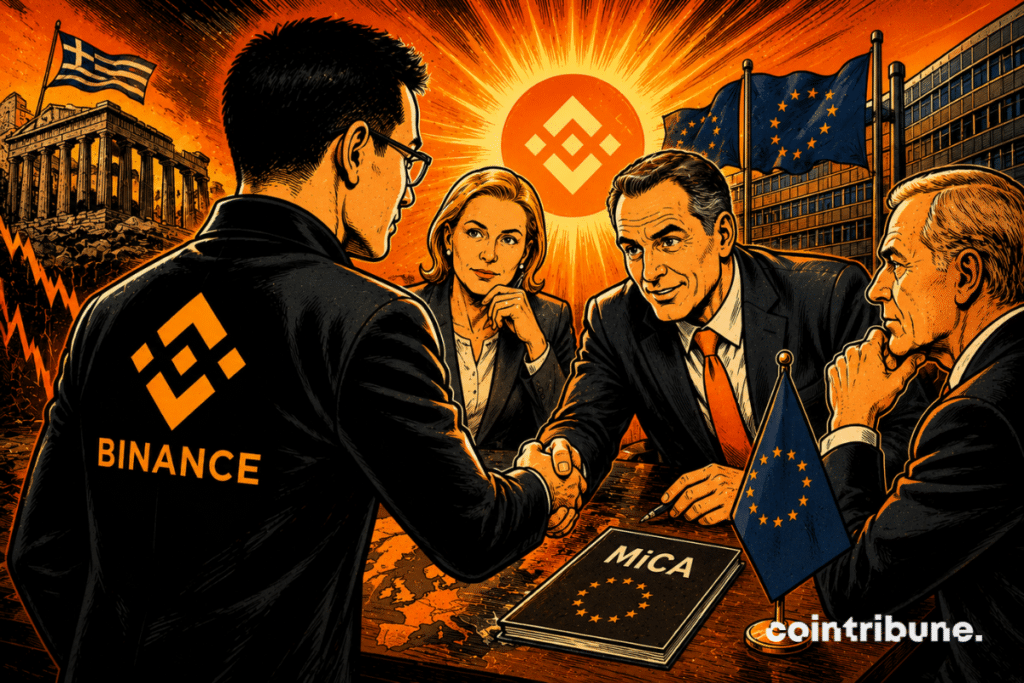
The entry into force of MiCA was supposed to normalize the European crypto market, but recent revelations from Binance prove otherwise. By unveiling the behind-the-scenes of a fragmented reality, the industry giant exposes a paradox. While the European Union shows unprecedented severity, several regulators are quietly courting the exchange behind the scenes. This issue raises questions about the effectiveness of continental legal barriers against mobile capital. Such a tug-of-war marks a major geopolitical turning point.
In brief
- Binance reveals that several European regulators have quietly invited it to apply for new licenses, despite the difficulties faced with MiCA.
- The withdrawal of its license application in Greece reveals the divergences between European ambitions and national realities.
- The new MiCA rules have pushed a majority of outgoing capital towards non-custodial wallets rather than regulated platforms.
- Faced with uncertainties in Europe, Binance is accelerating its expansion in Asia by multiplying partnerships and strategic establishments.
The regulatory behind-the-scenes of a European paradox
Richard Teng, co-CEO of Binance, formally revealed that several regulatory authorities had actively invited the platform to seek new licenses on European soil. This outstretched hand occurs, however, in a paradoxical context, marked by the voluntary withdrawal, on June 24th, of the MiCA license application that the company had filed with the Greek regulator. Several key elements shed light on this strategic reversal :
- A regulatory surprise in face of a file deemed compliant : the withdrawal occurred after reports indicated that Greek authorities planned to reject the application. Richard Teng expressed strong misunderstanding : “this took us completely by surprise, as we had submitted a fully compliant file. Moreover, the regulators themselves had confirmed it to us” ;
- The desire to protect the user experience : facing administrative delays and to avoid a sudden blocking of services, the management preferred to cut short. The executive clarified: “we don’t know exactly why the approval continued to be delayed. We preferred to withdraw our application, otherwise our users would have faced a transition period that was far too short” ;
- Confidential invitations in Europe : despite this setback, other European jurisdictions are trying to attract the exchange, although Richard Teng calls these discussions “premature” and refuses to name the countries involved.
For industry professionals, these confidential negotiations demonstrate the duality of state positions towards the world leader of exchange platforms. On the one hand, the harmonization desired by the European Securities and Markets Authority (ESMA) imposes strict discipline since the end of the transition period on July 1st, prohibiting serving European clients without a MiCA licensed entity. On the other hand, economic attractiveness pushes some Union countries to discreetly invite the platform to maintain activity on their territory. This regulatory chess game illustrates the complexity of practically applying a single legislative text on a continent where national economic interests sometimes remain divergent.
Capital flight towards DeFi
Data from this regulatory transition emphasize an unexpected phenomenon that directly contradicts the consumer protection ambitions promoted by the European Union. According to Richard Teng’s statements, the restrictions imposed by the new legal framework did not benefit already registered local platforms but rather pushed investors towards flight and total lack of control.
The co-CEO of Binance thus revealed a major statistic: “Among European Union users who subsequently withdrew their funds from our platform, 70% of these funds were transferred to non-custodial wallets. Only 30% were directed to MiCA-regulated entities”. This massive withdrawal movement directly questions the effectiveness of centralized regulatory policies in front of an audience that prioritizes asset sovereignty over institutional compliance.
Such portfolio restructuring has concretely shown up in the industry’s accounting registers. Binance recorded $1.23 billion in net outflows during the week of June 29th, marking a spectacular increase of 207% compared to the $400 million the previous week. At the same time, this transition intensified competition among platforms already holding the precious European license. For example, the exchange OKX saw its app downloads jump by 158% between June 24th and July 5th, directly benefiting from the forced reorganization of the European Union market.
The geopolitical shift and Binance’s aggressive expansion in Asia
Faced with persistent frictions on the Old Continent, Binance is accelerating its regulatory rollout in the Asia-Pacific region, capitalizing on new markets to maintain its global growth. Richard Teng recalled the vigor of this geographic expansion by stating: “we are now deployed in many regions in Asia, from Japan to Korea, through Thailand, Indonesia and Australia. We have just announced our arrival in the Philippines, and other countries will follow very soon”. This strategy demonstrates a clear willingness to diversify legal risks by firmly anchoring in jurisdictions with very promising economic dynamics, thus compensating for the legislative tightening observed at the European level.
In the Philippines, this return was orchestrated through a structural alliance with BlockShoals Technologies, following access restrictions imposed by local authorities in 2024. The legal articulation there is particularly subtle, as the agreement allows Binance to offer crypto trading under the supervision of the country’s Securities and Exchange Commission (SEC). However, neither entity holds the central bank license to handle peso transfers or regulated virtual asset services by the latter. This hybrid implantation model reveals the technical agility of the platform to reintegrate key markets despite initially hostile contexts.
In the long term, this situation outlines polarized outlooks for the global crypto industry. On one hand, the fact that 70% of fleeing capital chose self-custody proves that regulatory severity can paradoxically push users outside state supervision scope, creating a major challenge for ESMA. On the other hand, Binance’s ability to instantly bounce back in Asia while being courted in Europe shows that liquidity remains porous to borders. The future will tell if the European Union’s strict model will standardize the global ecosystem or end up isolating it to the benefit of more agile and pragmatic Asian jurisdictions.
Maximize your Cointribune experience with our "Read to Earn" program! For every article you read, earn points and access exclusive rewards. Sign up now and start earning benefits.

Diplômé de Sciences Po Toulouse et titulaire d'une certification consultant blockchain délivrée par Alyra, j'ai rejoint l'aventure Cointribune en 2019. Convaincu du potentiel de la blockchain pour transformer de nombreux secteurs de l'économie, j'ai pris l'engagement de sensibiliser et d'informer le grand public sur cet écosystème en constante évolution. Mon objectif est de permettre à chacun de mieux comprendre la blockchain et de saisir les opportunités qu'elle offre. Je m'efforce chaque jour de fournir une analyse objective de l'actualité, de décrypter les tendances du marché, de relayer les dernières innovations technologiques et de mettre en perspective les enjeux économiques et sociétaux de cette révolution en marche.
The views, thoughts, and opinions expressed in this article belong solely to the author, and should not be taken as investment advice. Do your own research before taking any investment decisions.