Bitcoin : Is The 21 Million Cap Really Untouchable?
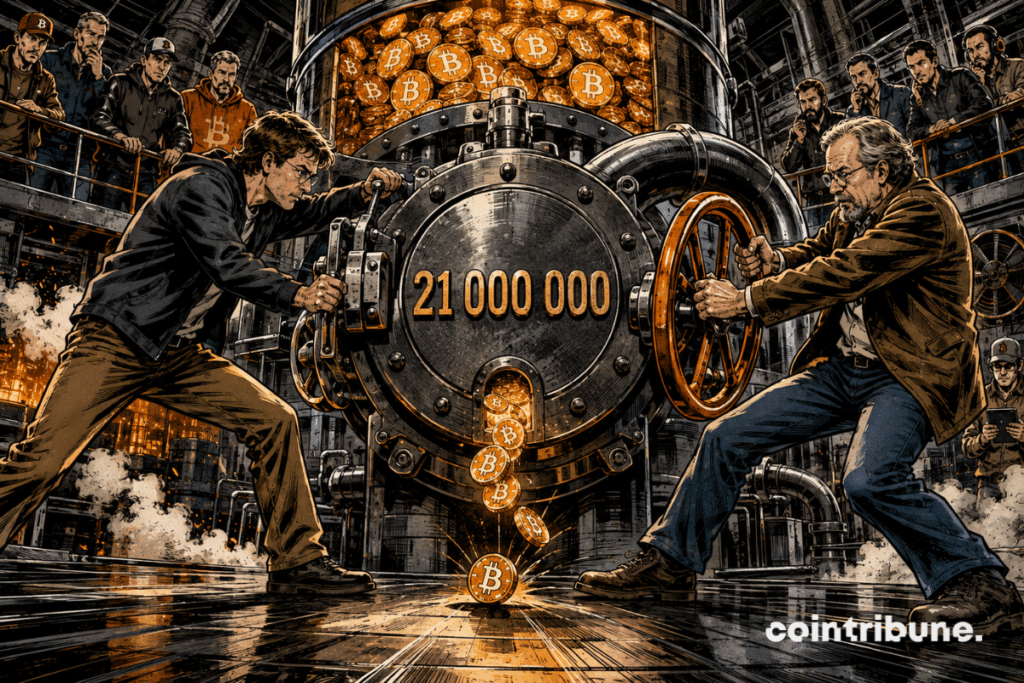
The 21 million bitcoin cap is back in the debate. Developer Peter Todd advocates for a permanent issuance to continue remunerating miners after 2140. Adam Back does not want it. The Blockstream boss sees in this argument a way to rally users to a dangerous modification of Bitcoin rules. No change is currently being prepared.
In brief
- Peter Todd defends a small permanent issuance of bitcoins after block rewards disappear.
- Adam Back rejects the idea and warns against the arguments used to promote it.
- Changing the 21 million cap would require a hard fork accepted by the market.
Bitcoin: Peter Todd wants to extend issuance
Bitcoin has just crossed the milestone of 20 million BTC mined. About one million coins remain to be produced before reaching the protocol’s set limit. This last million will take time.
Miners currently receive 3.125 BTC per block. This reward halves approximately every four years. About thirty halvings remain, and the last satoshis are expected to be produced around 2140. After that, no more new bitcoins.
Peter Todd has long wondered what will happen to miners when this reward disappears. They will then have to live solely on fees paid by users to record their transactions in blocks.
Todd considers these revenues too irregular. Some blocks yield high fees, others significantly less. According to him, this situation could encourage miners to reorganize the blockchain to recover particularly profitable blocks.
His solution is to maintain a small permanent reward. Bitcoin would then gradually exceed 21 million units.
Adam Back does not want to touch the 21 million
The idea does not please Adam Back at all. The Blockstream boss accuses supporters of this type of change of crafting simple narratives to lure uninformed users towards modifications he considers dangerous.
Back compares the approach to the recent debate around BIP-110. This controversial proposal wanted to filter certain non-payment data in Bitcoin blocks. It gathered only about 2.53% miner support while the targeted threshold was 55%.
Peter Todd nevertheless puts forward another argument.
Bitcoins continuously disappear when their owners permanently lose their private keys. A small permanent creation could therefore compensate for these losses. In his model, the available supply would eventually stabilize since coins would be lost at the same rate as new ones appear.
Monero already uses a similar mechanism with its “tail emission.”
The miner remuneration issue does not come out of nowhere. Cointribune already looked at the future profitability of mining when block rewards disappear. In the long run, fees will have to play a much larger role. The answer is not really urgent. 2140 still leaves a few years to discuss.
Exceeding 21 million would require another Bitcoin
Peter Todd can propose a new monetary policy. But the network must be convinced. Changing the 21 million limit does not look like a simple software update. It would require a hard fork. Users, developers, companies, platforms, and miners would then choose between the new rules and the old Bitcoin version.
Nothing guarantees that the inflationary chain would keep the name Bitcoin or its value. That is the whole difficulty. The 21 million is not just a number in the code. This limit has been part of Bitcoin’s economic narrative since its beginnings. Investors buy it precisely because no one can normally decide to produce more.
The community has already experienced much less sensitive technical splits. A direct change to the money supply would affect the original contract.
Adam Back therefore does not say that Bitcoin will exceed 21 million. He warns against the arguments that might one day be used to defend this idea. And the debate is just beginning. The more the block reward decreases, the more the question of securing funding will arise. Fees might suffice. Maybe not. For now, Bitcoin’s digital scarcity still rests on its 21 million cap. No one has changed it yet.
Maximize your Cointribune experience with our "Read to Earn" program! For every article you read, earn points and access exclusive rewards. Sign up now and start earning benefits.

Fascinated by Bitcoin since 2017, Evariste has continuously researched the subject. While his initial interest was in trading, he now actively seeks to understand all advances centered on cryptocurrencies. As an editor, he strives to consistently deliver high-quality work that reflects the state of the sector as a whole.
The views, thoughts, and opinions expressed in this article belong solely to the author, and should not be taken as investment advice. Do your own research before taking any investment decisions.