After China, India takes measures against Bitchat messaging
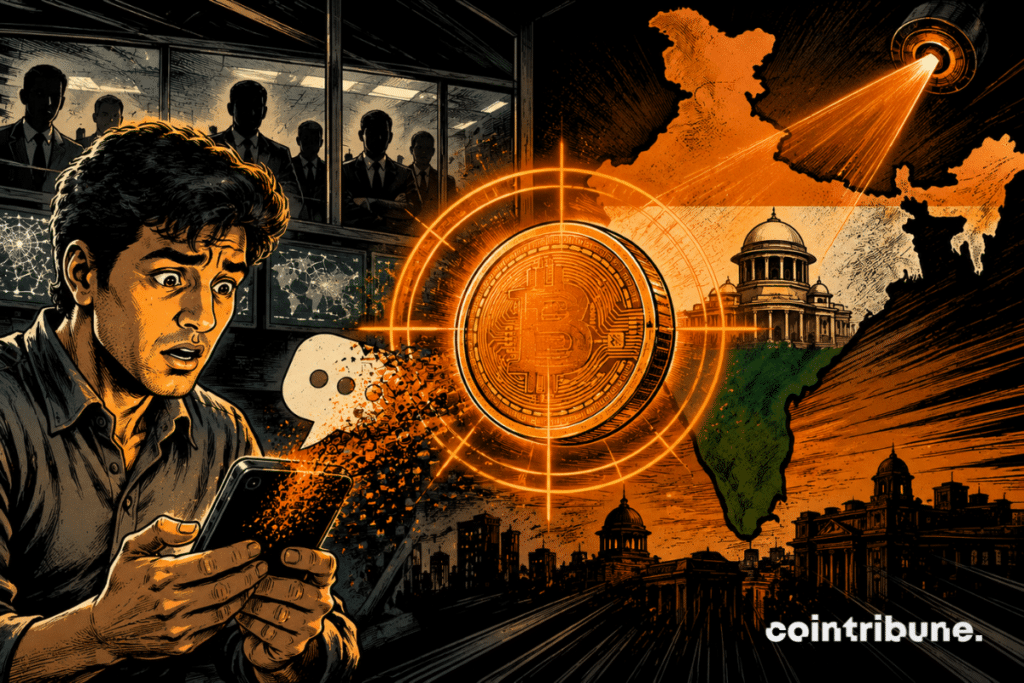
India has ordered GitHub to remove several repositories related to Bitchat, the decentralized messaging created by Jack Dorsey. Authorities blame the application for complicating user identification and surveillance. This decision places Bitcoin and censorship-resistant technologies at the center of a new conflict between public safety and digital freedom.
In brief
- India requests the removal of three GitHub repositories related to Bitchat.
- The messaging can work offline and relay Bitcoin transactions.
- Its decentralized architecture complicates surveillance and legal interceptions.
An application linked to Bitcoin is in India’s sights
Bitchat is a peer-to-peer messaging capable of working without Internet, phone number, or central server. Jack Dorsey introduced it in 2025 as a secure and decentralized messaging, suited for network outages and crisis areas. The Indian Cyber Crime Coordination Centre, attached to the Indian Ministry of Home Affairs, requested GitHub to disable three repositories associated with the project. The notification is based on section 79(3)(b) of the Indian Information Technology Act.
Authorities believe that the lack of registration, centralized logging, and classic identifiers complicates legal interceptions. Bitchat thus becomes difficult to monitor with the tools used for ordinary platforms. Bitchat is not a Bitcoin application in the strict sense. Its main function remains the exchange of encrypted messages between nearby phones. This remains possible thanks to low-energy Bluetooth and a relay system between devices.
Its link to Bitcoin comes from an additional feature. The application can carry an offline signed BTC transaction, then relay it from phone to phone. As soon as a device regains connection, the transaction can be broadcast to the Bitcoin network.
This mechanism follows one of the principles defended by Jack Dorsey: allowing users to communicate and transfer value without fully depending on a central infrastructure. Even if Bitchat does not directly rely on the Bitcoin blockchain for its messages, its architecture shares the same pursuit of autonomy.
Protests accelerate the adoption of Bitchat
The Indian decision comes in the context of student protests in New Delhi. Internet shutdowns were reportedly imposed around some gatherings, pushing participants towards offline-capable tools. Bitchat and other Bluetooth messengers allow phones to create a small local network. Each device can pass a message to the next. This gradually expands the communication zone without going through a mobile operator.
This scenario recalls the adoption of Bitchat by protesters in Nepal and Indonesia. The more authorities cut traditional channels, the more users seek decentralized solutions. The order sent to GitHub does not guarantee the software’s disappearance. The code is open source and can be copied on other platforms. At the time of the announcement, the application was also still downloadable on major mobile stores.
The case goes beyond Bitchat. It raises a simple question: can a state truly block a decentralized tool when its code can be freely duplicated and shared? Removal from GitHub can reduce the project’s visibility and slow its development. It does not destroy copies already downloaded, nor versions hosted elsewhere. This technical limitation often turns a ban into a perpetual race between authorities and developers.
For governments, these applications create a real problem. They can protect citizens during an outage or crisis, but also complicate investigations against illegal activities. The challenge is to regulate abuse without imposing general surveillance. Jack Dorsey has been building a strategy focused on Bitcoin, decentralized payments, and censorship-resistant tools for several years. His company Block itself holds BTC and is preparing payment services linked to bitcoin, as shown by its development around Block and Bitcoin.
Maximize your Cointribune experience with our "Read to Earn" program! For every article you read, earn points and access exclusive rewards. Sign up now and start earning benefits.

Enseignante et ingénieure IT, Lydie découvre le Bitcoin en 2022 et plonge dans l’univers des cryptomonnaies. Elle vulgarise des sujets complexes, décrypte les enjeux du Web3 et défend une vision d’un futur numérique ouvert, inclusif et décentralisé.
The views, thoughts, and opinions expressed in this article belong solely to the author, and should not be taken as investment advice. Do your own research before taking any investment decisions.