Americans Distrust Crypto and AI Despite Millions Spent in Politics
Crypto has already taken the lead, like a program launched early on an overheating server. No one can really deny its footprint across finance, campaigns, wallets, and even legislation today. AI, too, has embedded itself into human life with algorithms, promises, and a fair share of bugs. Yet behind these two roaring engines, public trust remains stuck on a cold “blue screen,” hesitant, wary, almost resistant, like a console refusing to reboot.

In brief
- Forty-five percent of Americans consider crypto investments too risky despite potential high returns.
- Forty-four percent believe artificial intelligence is developing too quickly for safe societal integration.
- Fairshake has already spent 28 million dollars across several competitive political primaries.
- Leading the Future raised more than 75 million dollars supporting pro-AI political candidates.
Crypto: the old bug in American trust
Americans reportedly lost $11 billion to crypto scams last year. It makes sense that this Politico poll feels like a raw, unfiltered scan. According to Public First, 45% of Americans believe crypto investing is not worth the risk, even with high returns. Nearly half trust traditional banks more than crypto platforms, while only 17% feel the opposite.
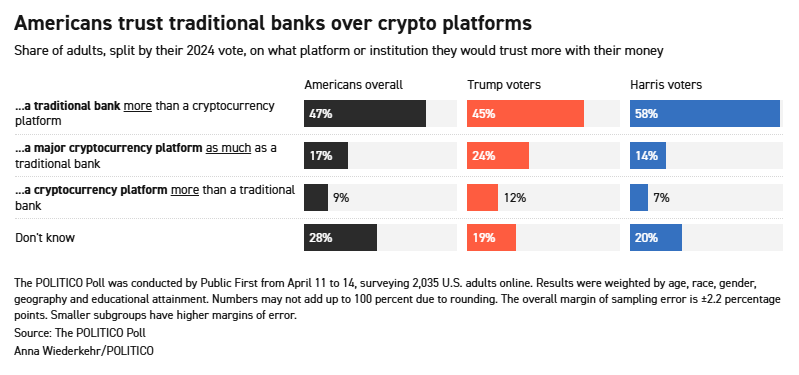
For a crypto industry preaching freedom, decentralization, and a better future, the verdict stings sharply. More than half of respondents say they have never bought or traded crypto and do not intend to.
The issue goes beyond volatility or past scandals. It is a thick, sticky, almost chemical cultural barrier. The crypto market pushes forward through lobbying, funding, and regulated products, yet the average user still stands outside the lab, coat zipped, eyebrow raised.
The technology is powerful, but public adoption lags behind. Without trust, even the most elegant protocol looks like a suspicious black box, polished outside, opaque inside, impossible to politically debug, and quickly very costly.
AI alarms voters like a prototype without a kill switch
Artificial intelligence does not inspire more confidence. The same poll shows that 44% of Americans believe AI is developing too quickly, like a model released without safeguards into a room full of cables. Two-thirds want Congress to impose strict rules or broad oversight principles.
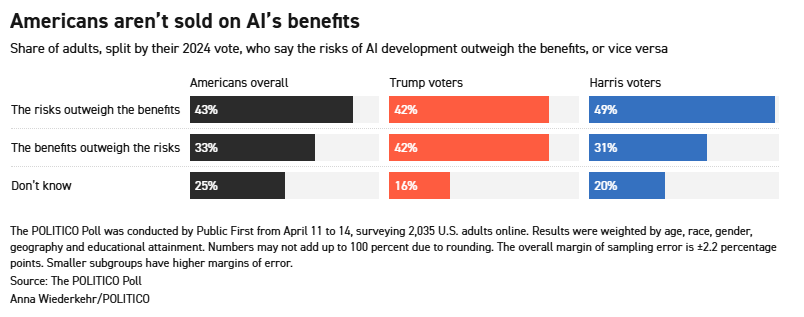
The fear is not just technical. It touches jobs, culture, economic power, and that uneasy feeling of being swallowed by a machine learning faster than its creators. Chris Murphy captures this fracture line bluntly:
Democrats’ best approach is to make their spending an issue. People do not want AI companies to run them over culturally and economically. They don’t trust crypto.
Chris Murphy, source: Politico
In this setting, AI fascinates like a particle accelerator but worries like an unsecured prototype. Voters want progress, yes, but with a fire extinguisher, a manual, and a big red button. Promises alone no longer win ballots.
Washington becomes a circuit wired by super PACs
Meanwhile, political money flows like liquid cooling inside a high-end gaming rig. Leading the Future, a pro-AI super PAC, has raised over $75 million since its launch. Fairshake, a pro-crypto group backed by Coinbase, Andreessen Horowitz, and Ripple Labs, has already spent $28 million in competitive primaries. In 2024, a Fairshake-affiliated PAC poured more than $40 million into defeating Sherrod Brown.
Yet these machines remain nearly invisible: only 9% recognize Leading the Future, and just 3% know Fairshake. Jim Renacci warns of a backlash:
Until people realize where the money’s coming in from, a lot of people don’t judge it. But I do think if they see somebody is backed by crypto, that’s always going to be a problem.
Jim Renacci, source: Politico
The numbers lighting up the dashboard
- 45% consider crypto too risky for investment ;
- 44% say artificial intelligence is developing too fast ;
- $75 million raised by Leading the Future ;
- $28 million already spent by Fairshake ;
- 41% say interest groups have too much influence.
At higher levels, though, fear changes shape. AI and bitcoin are no longer just public risks but strategic tools. Major tech players already work on classified Pentagon operations, showing how fast the deep state moves. The public hesitates, decision-makers plug in the cables, and the paradox glows almost fluorescent in the political dark.
Maximize your Cointribune experience with our "Read to Earn" program! For every article you read, earn points and access exclusive rewards. Sign up now and start earning benefits.

La révolution blockchain et crypto est en marche ! Et le jour où les impacts se feront ressentir sur l’économie la plus vulnérable de ce Monde, contre toute espérance, je dirai que j’y étais pour quelque chose
The views, thoughts, and opinions expressed in this article belong solely to the author, and should not be taken as investment advice. Do your own research before taking any investment decisions.