An explosive week was not enough to bend Bitcoin
The crypto market has just gone through a busy week, between American inflation, the Fed’s decision, and the vote on CLARITY. Bitcoin has nevertheless returned to levels it hadn’t reached for two weeks. After several sharp movements, buyers gradually took control again. The Senate’s rejection of the bill and the rate hikes by the Fed and then the BOJ did not prevent the market from restarting. The journey remains marked by high volatility and several rapid reversals.
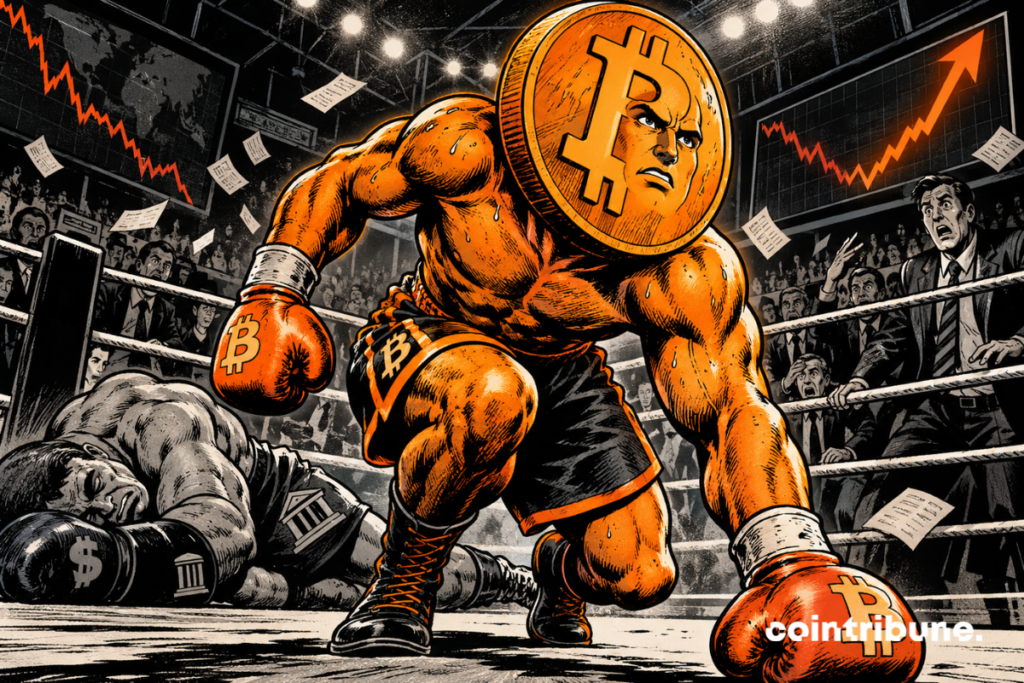
In brief
- Bitcoin went through a week marked by American inflation and several sharp movements.
- The Senate’s rejection of the CLARITY bill caused a new market setback.
- The Fed’s 25 basis point hike did not prevent the price from quickly recovering.
- Bitcoin finally returned to its levels from two weeks ago despite the BOJ rate hike.
A week opened under high tension
Seven days earlier, the American CPI figures confirmed the persistence of inflation. The Federal Reserve then had the necessary elements to prepare its monetary decision of September 16. Expectations thus focused on a rate hike, while Bitcoin reacted strongly to the new economic data.
After the CPI publication, its price fell from $77,000 to $76,000. It then jumped sharply to $79,800 before suffering a marked rejection. One hour was enough to concentrate these opposing movements before calm returned over the weekend.
The market then traded around $77,000. However, this calm did not last long. On Monday, the price fell to $76,400, then buyers took control again, allowing Bitcoin to rise back to $79,600 before the vote on CLARITY.
The rejection of CLARITY causes a new setback
The day before the vote, the market was closely following the evolution of the bill. The price had already left its highs when the Senate officially rejected the motion intended to advance the text. This announcement intensified the selling pressure.
Bitcoin then fell to $75,000, its lowest level in three weeks. Despite this new drop, buyers managed to defend this zone. The market maintained a base before the conclusion of the FOMC meeting.
The next day, the Fed raised its rates by 25 basis points. This decision came after more than three years without a hike, but Bitcoin did not experience a lasting negative reaction. Its price first slid to $75,000, then rose above $76,000 within minutes.
The BOJ rate hike does not prevent Bitcoin’s rebound
Thursday, then especially Friday, the Bitcoin price continued its rise. The Bank of Japan nevertheless raised its rates by 25 basis points, bringing its level to a 31-year high. Despite this new monetary pressure, Bitcoin surpassed $78,000 during the session.
The movement accelerated with the opening of the American markets. The price reached $81,000, its highest level in two weeks. After this rise, the market stabilized Bitcoin around this peak.
Thus, BTC ends in the green after a succession of unfavorable events. This development occurs while altcoins are also experiencing strong fluctuations. ZEC continues its rise, while NEAR gains 35%. UNI advances more than 30%, notably followed by HYPE and BCH, while RAIN falls 22%.
In the short term, BTC thus approaches the next market phase after having resisted several major announcements. Its evolution will now depend on how operators digest these events and on the price’s ability to maintain the recently regained levels.
Maximize your Cointribune experience with our "Read to Earn" program! For every article you read, earn points and access exclusive rewards. Sign up now and start earning benefits.

Journaliste et rédacteur web passionné par l’univers des cryptomonnaies et des technologies Web3. J’y traite les dernières tendances et actualités afin de proposer un contenu de haute qualité à un large public du secteur.
The views, thoughts, and opinions expressed in this article belong solely to the author, and should not be taken as investment advice. Do your own research before taking any investment decisions.