Andre Cronje Says DeFi Has Taken on a New Form
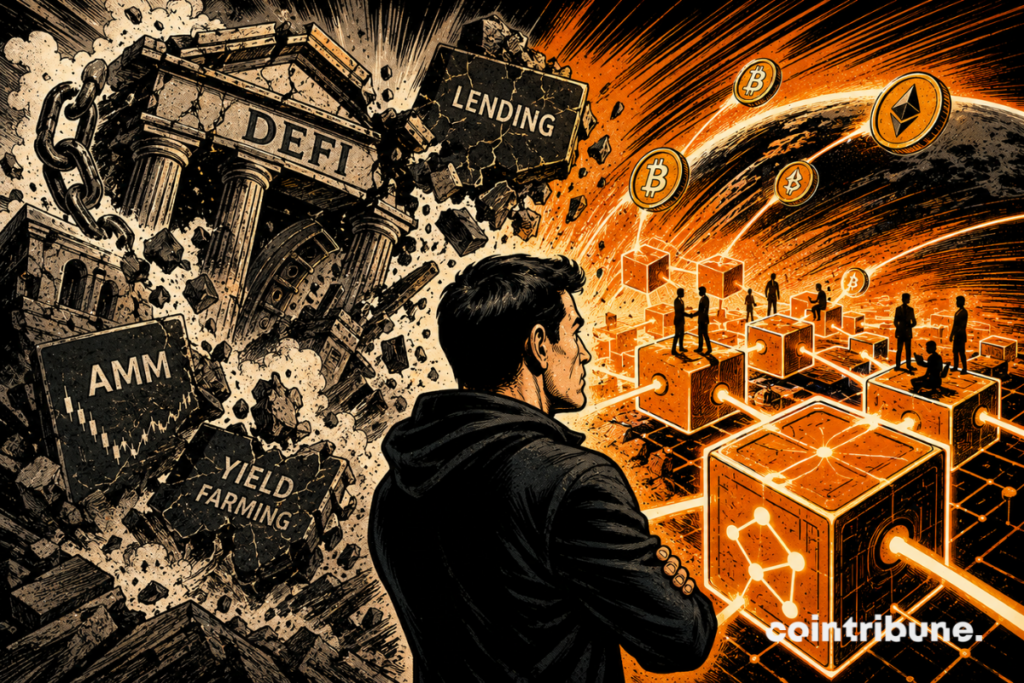
For Andre Cronje, a large part of what the industry continues to call “DeFi” is no longer really so. The founder of Flying Tulip prefers to speak of “on-chain finance” when companies, teams or committees retain intervention power over protocols. What really remains of the promise of decentralization?
In brief
- Andre Cronje reserves the term DeFi for decentralized, immutable protocols without intermediaries.
- The total value locked in DeFi dropped by 54.8% between October 5, 2025 and August 13, 2026, according to DefiLlama data.
- Security measures protect users, but reintroduce actors capable of modifying or stopping a protocol.
For Andre Cronje, DeFi has lost its original meaning
DeFi has not disappeared from discussions. Andre Cronje nonetheless estimates that it has significantly shrunk. This critique aligns with the observation of a highly concentrated DeFi governance already documented by Cointribune. Andre Cronje goes further: according to him, very few protocols still meet the strict definition of decentralized finance.
During a discussion broadcast today on X, he set three criteria: a protocol must be decentralized, immutable, and without intermediary. Immutability here means that its rules cannot be unilaterally changed after launch. However, his intervention emphasizes the role taken by companies, risk teams, and people selecting assets.
I do not think DeFi still exists outside of a few very small niches.
Cronje therefore proposes another name: on-chain finance, or open finance. Operations remain recorded on a blockchain and can be publicly viewed, without the entire organization necessarily being decentralized. A protocol can thus execute on-chain transactions while depending on a human group for its essential parameters.
Security reintroduces intermediaries into the loop
The problem is that this partial centralization does not necessarily stem from a desire to retake power from users.
It also responds to a very concrete reality: protocols sometimes manage billions of dollars and can face a flaw, price manipulation, or unexpected market behavior. At those times, waiting for a long governance process can be costly.
Teams have thus added safeguards. Emergency pause, deposit cap, limitation on certain assets, modification of risk parameters: these tools can prevent an incident from escalating. When a flaw threatens to drain a protocol in minutes, reacting quickly is no trivial matter.
But this safety net raises another question: who holds the controls? If a handful of people can suspend withdrawals, change a parameter, or decide which assets are accepted, the absence of an intermediary becomes harder to defend.
The contested vote at Aave has already shown that the boundary between community, founders, and operational teams remains hard to draw.
The working paper published by the ECB in March provides a measurable element. On Aave, MakerDAO, Ampleforth, and Uniswap, the top 100 addresses held more than 80% of the observed governance tokens. However, this study is based on records from November 2022 and May 2023. It mainly measures governance concentration, not alone the current technical decentralization of each protocol.
A market crisis that makes the debate more concrete
The discussion also takes place in a context much less favorable to DeFi. According to DefiLlama’s history, the total value locked in protocols dropped from 165.71 billion dollars on October 5, 2025 to 74.96 billion on August 13, 2026.
In a little over ten months, nearly 90.75 billion dollars left the sector, a decrease of about 54.8%.
This drop cannot obviously be attributed to protocol centralization. However, a period of strong financial pressure makes the dilemma raised by Cronje much more visible.
When markets turn or a protocol is threatened, teams often favor speed. A committee able to modify a parameter in minutes then becomes more efficient than a decentralized vote which can take days.
Cronje’s statement remains a demanding definition, not proof that all innovation has disappeared. He himself acknowledges the existence of small pockets of “real DeFi.” For the user, the right reflex now is to look beyond the label: who can modify the code, suspend withdrawals, or change parameters? Projects claiming to operate without intermediaries will have to show that this promise also holds up during crises.
Maximize your Cointribune experience with our "Read to Earn" program! For every article you read, earn points and access exclusive rewards. Sign up now and start earning benefits.

Passionné par le Bitcoin, j'aime explorer les méandres de la blockchain et des cryptos et je partage mes découvertes avec la communauté. Mon rêve est de vivre dans un monde où la vie privée et la liberté financière sont garanties pour tous, et je crois fermement que Bitcoin est l'outil qui peut rendre cela possible.
The views, thoughts, and opinions expressed in this article belong solely to the author, and should not be taken as investment advice. Do your own research before taking any investment decisions.