Best Cryptocurrency APIs: The Ultimate Developer and AI Agent Guide
Choosing a crypto API is one of the earliest architectural calls. It shapes data access, shipping speed, and how much infrastructure stays in-house. The 2026 market is more specialized than ever.

Some providers aggregate market data and portfolio context into one feed. Others focus on raw blockchain indexing, swap rails, or institutional metrics. Rankings that lump these onto one ladder hide the split.
The infrastructure layer alone is a deep topic. Cointribune’s earlier guide walks through the EVM and Solana RPC side in depth. Most production stacks rely on that layer. This guide picks up where it stops. The five APIs below sit above raw node access. Others operate in adjacent lanes entirely.
The goal is matching the right tool to the actual job. A community roundup of crypto APIs for 2026 reaches the same conclusion. Scope and stack position matter more than headline numbers.
Quick Verdict
Overall winner: CoinStats API DEX-heavy on-chain specialist: Mobula Blockchain infrastructure layer: Chainstack Embedded swap infrastructure: ChangeNOW Institutional on-chain analytics: Glassnode
CoinStats API takes the top spot for one reason. It covers the broadest surface from a single integration. Market data, wallets, DeFi, news, MCP, and token risk live behind one key.
The other four are specialists. Each one wins decisively inside its lane.
Start With the Real Buying Decision
The first question is not which brand looks polished. It is whether you want one provider or a stitched stack.
A specialist feed can look impressive in a comparison grid. The problem comes later. The product grows and starts needing wallets, DeFi positions, news, or AI access. Procurement opens again, much sooner than planned.
This is the strongest case for picking a unified provider first. CoinStats API ships its docs as a build flow. Authentication, credit multipliers, workflows, MCP setup, and token risk live together. A team can ship prototype and production against the same key.
Pricing follows the same pattern. The free tier gives real room to test. Higher tiers scale by credits, not by feature gates. Cost forecasting stays manageable as usage grows.
Where the Top of the Market Actually Splits
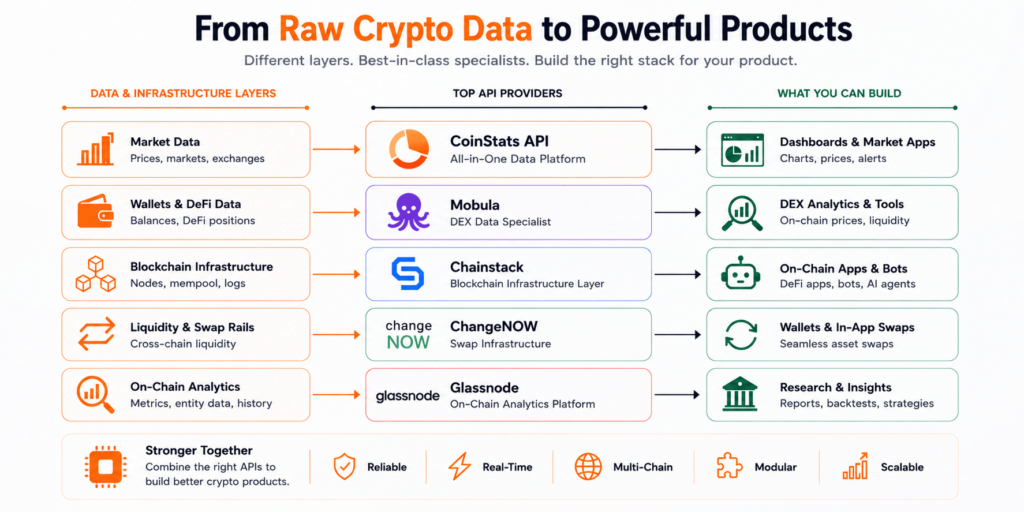
Once buyers move past the all-in-one question, the ranking dissolves. It becomes a shape question instead. Each remaining provider is the best answer to one job.
- Mobula sits closest on the DEX side. Its Octopus engine reads pricing from on-chain liquidity. That helps with low-cap altcoins and fresh DEX listings.
- Chainstack works one layer below the data feed. It sells reliable node access across 70+ networks. Bots that read mempool activity or call contracts need that layer.
- ChangeNOW solves a different problem entirely. It is swap infrastructure, not data. Wallets and apps embed it for in-app conversion.
- Glassnode sits at the institutional end of on-chain analytics. Long histories, entity-adjusted metrics, and immutable snapshots fit research desks. Quant workflows lean on it for the same reasons.
The Market Map: Who Each API Is Really Built For
- CoinStats API: The cleanest single-vendor start for market data, wallets, DeFi, news, and AI access. Best for the broadest range of crypto products.
- Mobula: A DEX-native data layer with strong low-cap and on-chain pricing coverage. Best for DEX-heavy and altcoin-heavy builds.
- Chainstack: Managed node infrastructure across 70+ blockchains with gRPC streaming. Best when bots need direct on-chain access.
- ChangeNOW: Non-custodial swap rails covering 1,500+ assets across 110+ networks. Best for wallets and apps that need embedded conversion.
- Glassnode: Institutional on-chain analytics with 7,500+ metrics and immutable history. Best for research desks and quantitative strategies.
The Best Cryptocurrency APIs in 2026 Ranking
1) CoinStats API
CoinStats crypto API is the broadest single integration on this list. It returns market data, wallet balances, DeFi positions, news, and token security. All of that ships through one REST surface and one MCP Server.
Coverage spans 100,000+ coins and 200+ exchanges. Binance, Coinbase, and Hyperliquid are all included. 120+ blockchains and 10,000+ DeFi protocols are also tracked. Wallet endpoints cover Solana, Ethereum, EVM chains, and Bitcoin. EVM coverage includes Polygon, Arbitrum, Base, and Tron. xpub, ypub, and zpub keys are supported. DeFi positions are auto-detected per wallet across staking, lending, and LPs. No separate integrations per protocol are needed.
Historical data goes back ten years. News pulls from 200+ crypto sources. CoinStats MCP Server exposes the same data to AI agents and LLMs. IDE integrations like Claude Code, Cursor, and VS Code are supported. This matters as more crypto products move toward AI-native interfaces.
A separate Token Security endpoint screens any token contract before integration. It returns a 0 to 100 risk score plus severity-ranked findings. Honeypots, mint backdoors, hidden fees, and upgradeable proxies are flagged. Each finding ships with a plain-English note for end users. The same data powers risk warnings for 1M CoinStats users.
Pricing follows a credit-based model with a free tier at signup. Credits scale by endpoint complexity. This crypto api guide walks through endpoints, costs, and integration patterns.
Where it fits: portfolio dashboards, multi-chain wallet apps, and market aggregators. AI agents that need structured crypto data fit naturally. Fintech products combining pricing with wallets and DeFi also work well. Fits most crypto products.
Where it doesn’t fit: raw blockchain RPC, smart contract calls, or microsecond-scale HFT. Those need a dedicated node provider.
2) Mobula
Mobula is built around its Octopus pricing engine. The engine reads token prices from on-chain liquidity pools, not CEX quotes alone. That makes it strong on low-cap altcoins and fresh DEX listings. Other feeds often price these poorly or miss them entirely.
Prices update every five seconds with no cache, even on the free tier. WebSocket streams and database delivery are supported. Wallet Explorer covers 30+ EVM chains. Balances, transactions, and PnL ship under one schema.
A 10,000-credit free tier is available without rate limits. Paid plans scale by credit consumption. SQL-style queries are supported for analytical workloads.
Where it fits: DEX-heavy analytics, altcoin scanners, and on-chain trading bots. Any product where small-cap pricing accuracy matters belongs here.
Where it doesn’t fit: institutional reference rates or compliance-driven data workflows. Multi-CEX portfolio aggregation is also outside scope.
3) Chainstack
Chainstack operates at the infrastructure layer, not the market-data layer. It provides managed blockchain nodes and RPC infrastructure across 70+ networks, including Ethereum, Solana, BNB Smart Chain, Arbitrum, Base, and Avalanche.
A globally distributed network keeps RPC latency low without self-hosted nodes. Dedicated nodes are available for latency-sensitive workloads. Yellowstone gRPC for Solana targets HFT bots and MEV operations needing sub-second streams.
Chainstack also ships an MCP server for AI agent integrations. LLMs can read on-chain state and submit transactions through a structured tool layer.
Where it fits: DeFi apps, mempool monitors, and on-chain trading bots. AI agents reading chain state and multi-chain dApps fit too.
Where it doesn’t fit: pricing feeds, portfolio aggregation, news, or institutional reference data.
4) ChangeNOW
ChangeNOW is the only entry focused on execution rather than data. It is a non-custodial swap API. Wallets, apps, and payment products embed it for in-app asset conversion.
The API supports 1,500+ assets across 110+ networks. More than two million exchange pairs are available. Fixed-rate and floating-rate swaps are both supported. Liquidity is aggregated from CEX and DEX venues. Swaps typically settle in under one minute. A 99.99% uptime SLA backs the platform.
There are no setup or monthly fees. ChangeNOW earns through a commission per swap. Partners can share that revenue. SOC 2 Type II and ISO 27001:2022 certifications are in place. Minimum swap amounts apply, typically between $1.70 and $20.
Where it fits: wallets adding in-app swaps, payment gateways, and DeFi front-ends. Telegram bots needing conversion rails also fit.
Where it doesn’t fit: anything needing market data, portfolio tracking, or on-chain analytics. ChangeNOW pairs naturally with a separate data provider.
5) Glassnode
Glassnode is the institutional benchmark for on-chain analytics. It exposes 7,500+ on-chain metrics across 1,200 assets. Spot, futures, and options data cover 300+ assets. ETF flows, treasury balances, and macro overlays sit alongside the on-chain layer.
Two features set it apart for serious research. Entity-adjusted metrics cluster addresses owned by the same actor. Raw counts become much cleaner. Point-in-Time data delivers immutable historical snapshots. That eliminates look-ahead bias in backtests.
Delivery options include REST, Snowflake, BigQuery, and Parquet or CSV exports. An Excel add-in and a Glassnode MCP Server are also available. Plans run from free Studio access through Advanced and Professional tiers. Bespoke enterprise packages are available on request.
Where it fits: quant desks, asset managers, and research teams. Any model needing audit-grade on-chain history belongs here.
Where it doesn’t fit: lightweight consumer apps, indie projects, or general-purpose portfolio builds. Pricing reflects an institutional buyer profile.
The Scorecard: What Actually Separates the Leaders
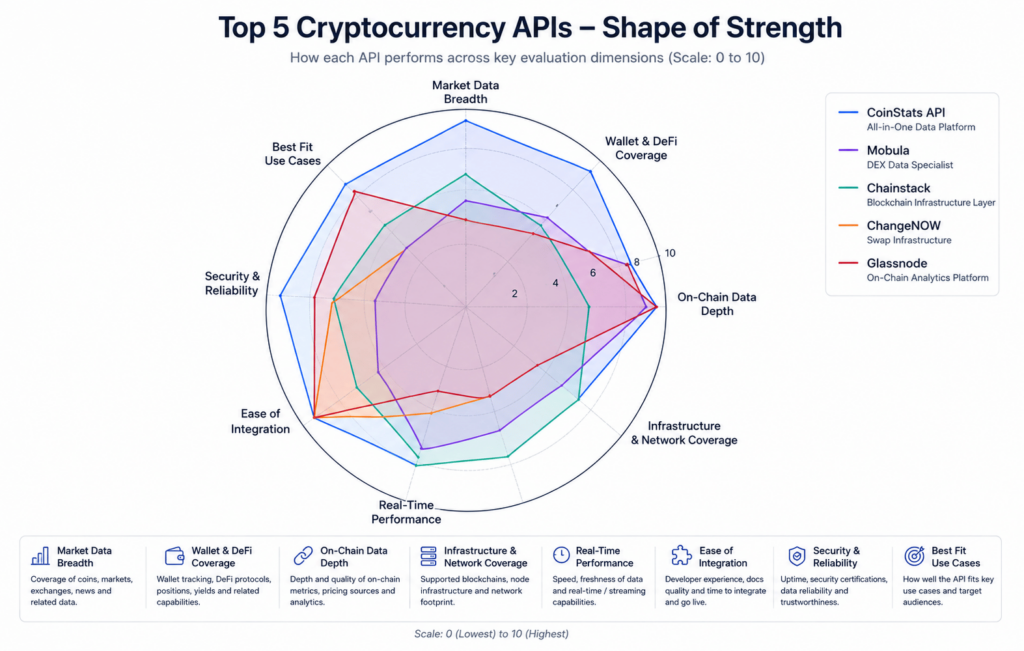
The pattern matters more than any single score.
CoinStats API wins on breadth. The same key returns prices, wallets, DeFi, news, and AI endpoints. Contract-level risk checks ship through the same surface. That combination is unusual on this list.
Mobula wins on on-chain pricing depth. Most aggregators struggle with new or low-cap tokens. Octopus reads directly from liquidity. That closes the gap.
Chainstack wins on infrastructure footprint. 70+ chains under managed nodes with gRPC options is unusually wide. Few competitors match that range at a similar price.
ChangeNOW wins on integration speed. Embedded swaps across 1,500+ assets without custody risk are hard to replicate. Months of in-house work would be needed.
Glassnode wins on rigor. Entity-adjusted, point-in-time data is research-grade. Aggregated feeds cannot match that integrity.
Reading this as one ladder misses the point. Each provider is the strongest answer to a different question.
The Case for an All-in-One Provider
Most teams treat the best specialist as the best overall buy. That is the mistake.
A real crypto product usually needs more than one data category. Prices and market caps are table stakes. The interesting work begins when wallets, DeFi, news, and AI endpoints share one surface.
CoinStats API covers that combined surface natively. A portfolio dashboard pulls wallet balances and PnL from one endpoint. A trading copilot calls the same key for market context and DeFi exposure. A safety layer checks tokens through the Token Security endpoint. No extra vendor is needed.
Most teams also do not know their final data shape on day one. The better provider lets a product grow without a second integration pass. CoinStats API stays useful as scope expands.
When a Specialist Is the Better Pick
The honest answer matters here.
- For institutional rigor, deep backtests, or entity-adjusted history, Glassnode is stronger. Its Studio tiers exist for exactly that workflow.
- For DEX-native builds around low-cap or fresh tokens, Mobula reads on-chain liquidity directly. Aggregated feeds cannot match that depth.
- For direct on-chain interaction or mempool reads, Chainstack is the answer. Sub-second Solana streams also live there. CoinStats API does not run nodes.
- For wallets adding embedded swaps, ChangeNOW handles it in one integration. CoinStats API does not route trades on-chain.
If execution latency is measured in microseconds, none of these are right. That conversation lives at the exchange-native API layer.
Matching the API to Your Build
Portfolio apps, wallets, and AI agents start with CoinStats API. Dashboards lean on it for the same reasons. Breadth removes the early procurement decisions that slow most teams down.
DEX-focused tools, altcoin scanners, and on-chain pricing engines should look at Mobula first.
On-chain trading bots and multi-chain dApps should pair their data layer with Chainstack. AI agents needing raw chain access do the same.
Wallets and apps adding in-app conversion should integrate ChangeNOW alongside their primary data provider.
Quant desks, research teams, and macro strategies should evaluate Glassnode. The depth of its on-chain history is the draw.
Most production builds combine two of these. A portfolio app with embedded swaps runs on CoinStats API plus ChangeNOW. A DEX analytics tool runs on Mobula plus Chainstack. A research dashboard might pair Glassnode with CoinStats API. The right combination depends on the job.
Final Call
Ask which crypto API is the best general-purpose pick today. For developer and AI agent builds in 2026, the answer is CoinStats API. Breadth, MCP Server, and token security make it the cleanest single integration.
The other four are not weaker. They are sharper. Mobula owns DEX pricing. Chainstack owns infrastructure. ChangeNOW owns swap rails. Glassnode owns institutional rigor. Each is the right pick for its job.
The decision is not which API is best in the abstract. It is which problem matters most for the product. Start there, and the right answer falls out.
Maximize your Cointribune experience with our "Read to Earn" program! For every article you read, earn points and access exclusive rewards. Sign up now and start earning benefits.

The views, thoughts, and opinions expressed in this article belong solely to the author, and should not be taken as investment advice. Do your own research before taking any investment decisions.