Bitcoin And Ethereum Sit At The Core Of Kiyosaki’s Crisis Thesis
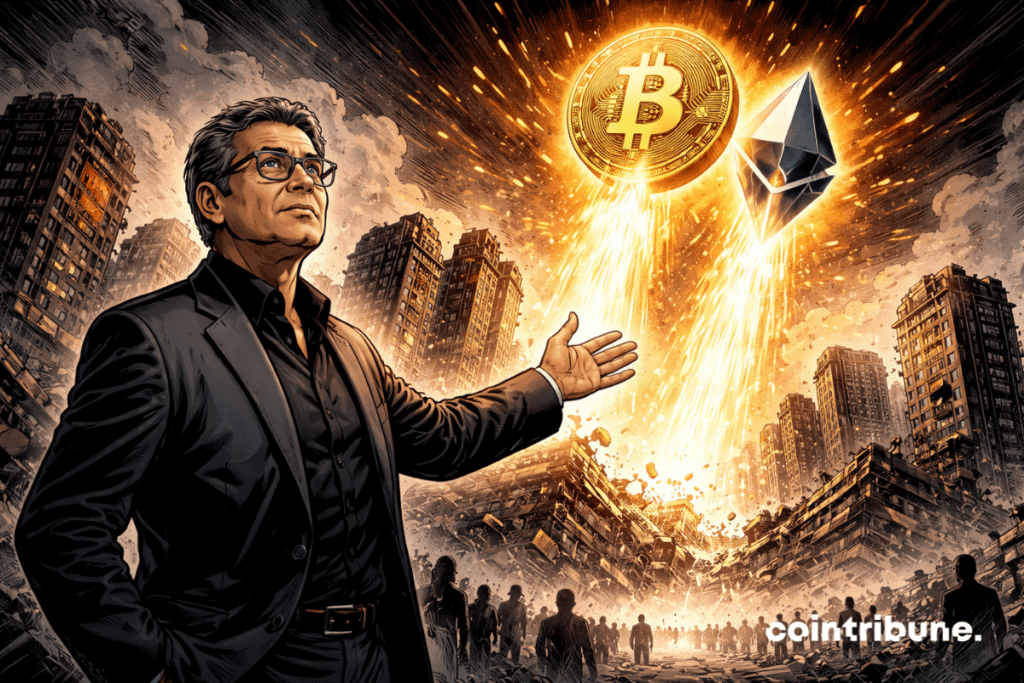
Robert Kiyosaki revives the scenario of a major crash with a prediction that is already shaking the crypto market. The author of “Rich Dad, Poor Dad” sees bitcoin reaching $750,000 and Ethereum $95,000 one year after a global financial crisis. Beyond the announcement effect, his statement raises a decisive question: what would alternative assets be worth if distrust towards the financial system suddenly worsened?
In brief
- Robert Kiyosaki revives the scenario of a global financial crisis and associates this hypothesis with a strong revaluation of several alternative assets.
- The author of Rich Dad, Poor Dad predicts bitcoin at $750,000 and ethereum at $95,000, with a horizon set one year after the crash.
- His reading is not limited to cryptos, as he also anticipates a surge in gold and silver in the same context of rupture.
- His reasoning is based on the same market logic: in case of a systemic shock, part of the capital could divert from traditional finance towards assets considered more resilient.
Robert Kiyosaki sets extreme targets for bitcoin and Ethereum
In a particularly explicit statement, Robert Kiyosaki, despite his double game, sketches the future of assets in case of a global financial shock. The author of “Rich Dad, Poor Dad” does not just anticipate a rise in the crypto market: he integrates this perspective into a real rupture scenario.
His message is based on a simple idea: a global crash could mark the starting point of a strong revaluation of certain assets.
The figures advanced by Robert Kiyosaki give his statement a particular resonance. In his publication, he predicts bitcoin at $750,000 per unit one year after the crash, before adding that Ethereum could reach $95,000 in the same timeframe.
The decisive point lies in this time precision : Robert Kiyosaki does not target an immediate goal, but a level likely to be reached one year after the crash.
- Robert Kiyosaki projects bitcoin at $750,000 ;
- He also forecasts Ethereum at $95,000 ;
- Both levels are linked to a global Financial Crash scenario ;
- The timeline is an integral part of his thesis: one year after the crash.
A similar crisis reading for gold, silver and cryptos
The other part of this statement goes beyond the crypto market alone. Robert Kiyosaki also anticipates a surge in gold and silver after the burst of a “huge asset bubble”.
On X, he sees gold climbing to $35,000 an ounce and silver to $200 an ounce one year after the burst. This symmetry is not trivial: in his reasoning, bitcoin, Ethereum, gold and silver belong to the same set of assets likely to benefit from a systemic crisis.
His statement then goes beyond a simple projection on bitcoin and Ethereum. By asking his audience: “in your opinion, at what levels will the prices evolve one year after the next global financial crisis?”, Robert Kiyosaki shifts the debate towards the hypothesis of a new global shock. In this logic, the revaluation of cryptos would not result from a sector-specific catalyst, but from a broader capital reallocation movement after a major crash.
At this stage, more than his price targets, it is the scenario he outlines that draws attention. Robert Kiyosaki announces a possible takeoff of bitcoin, but the extent of this trajectory would depend primarily on a global financial shock and a lasting shift in investor confidence.
Maximize your Cointribune experience with our "Read to Earn" program! For every article you read, earn points and access exclusive rewards. Sign up now and start earning benefits.
Diplômé de Sciences Po Toulouse et titulaire d'une certification consultant blockchain délivrée par Alyra, j'ai rejoint l'aventure Cointribune en 2019. Convaincu du potentiel de la blockchain pour transformer de nombreux secteurs de l'économie, j'ai pris l'engagement de sensibiliser et d'informer le grand public sur cet écosystème en constante évolution. Mon objectif est de permettre à chacun de mieux comprendre la blockchain et de saisir les opportunités qu'elle offre. Je m'efforce chaque jour de fournir une analyse objective de l'actualité, de décrypter les tendances du marché, de relayer les dernières innovations technologiques et de mettre en perspective les enjeux économiques et sociétaux de cette révolution en marche.
The views, thoughts, and opinions expressed in this article belong solely to the author, and should not be taken as investment advice. Do your own research before taking any investment decisions.