Bitcoin : Bitmain in the crosshairs of Washington for potential security threat
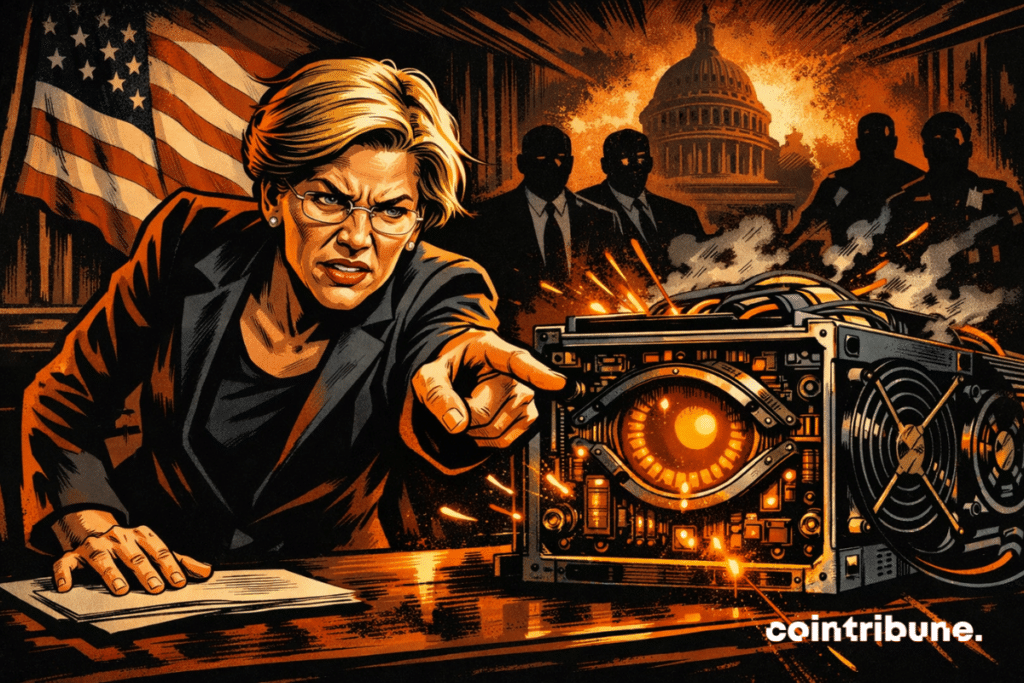
Elizabeth Warren puts Bitmain back under pressure in Washington. This time, the issue is neither the price of Bitcoin nor speculation. It concerns a much more sensitive point: American national security and the place of a Chinese manufacturer at the heart of the global mining infrastructure.
In brief
- Elizabeth Warren places Bitmain at the center of a sensitive file in the United States.
- Bitcoin hardware becomes a national security issue.
- The links between Bitmain and American Bitcoin make the case even more political.
Warren brings Bitcoin hardware into the political arena
Elizabeth Warren now targets Bitmain head-on. In a letter addressed to Commerce Secretary Howard Lutnick, the senator requests documents, internal exchanges and details on how the administration handles risks related to the Chinese manufacturer. The signal is clear: the case is no longer just technical, it becomes political.
This offensive is based on a federal investigation already revealed in November 2025. According to Bloomberg, the operation, called “Operation Red Sunset,” sought to determine whether certain Bitmain ASIC machines could be remotely exploited for espionage or disruption of the American power grid. The exact status of this investigation remains unclear, which further fuels suspicion.
The most important thing here is elsewhere. When a senior senator demands accountability regarding the hardware that powers part of the global Bitcoin, it means that the industry is no longer seen as a simple technological market. It enters the classic logic of industrial rivalry between Washington and Beijing.
Bitmain is not a secondary company in the Bitcoin ecosystem
Bitmain is not a peripheral player. The group occupies a central position in the market for ASIC machines, those specialized devices that secure the Bitcoin network through mining. According to the Cambridge Digital Mining Industry Report, the sector leader alone captures about 82% of the market, while the three main manufacturers together exceed 99%.
It is this weight that makes the case explosive. When such a dominant supplier is targeted by security suspicions, the issue goes far beyond Bitmain itself. It touches the hardware dependency of part of the global mining, including in the United States, on a very concentrated supply chain. Bitcoin is decentralized at the protocol level, but its physical industry remains much more concentrated.
Bitmain understands this well. The company announced in 2025 its plan for the first American factory, with initial production expected in early 2026 and a ramp-up later in the year. On paper, this choice might have seemed purely industrial. In reality, it also looked like an attempt to anchor locally in an already tense geopolitical climate.
The case becomes even more sensitive with the Trump network
The most delicate point of this case remains the link between Bitmain and American Bitcoin, the mining company supported by Eric Trump and Donald Trump Jr. Reuters reported in 2025 the launch of this structure with Hut 8. Bloomberg later indicated that American Bitcoin had signed a contract to purchase 16,000 Bitmain machines for 314 million dollars.
Warren’s letter therefore does not stop at the technological risk. She also requests details on possible communications between Bitmain, the Trump family, and Commerce Department officials. In other words, she poses a second, even more political question: can a sensitive foreign company benefit from special treatment because of its connections to the presidential entourage?
This mix of Bitcoin, national security, China, and closeness to the Trump family gives the case a much broader scope than a simple regulatory dispute. Even without public prosecution at this stage, the message sent to the market is clear: in the United States, owning or selling mining machines is no longer just a matter of energy performance or profitability. It is now also a matter of sovereignty.
What this case really says about industrial Bitcoin
The Bitmain episode reveals a contradiction that often returns in the Bitcoin industry. The network was designed to reduce political dependencies. Yet, its real infrastructure still depends on manufacturers, ports, chips, customs, and state arbitrations. Protocol neutrality does not remove the vulnerability of the industrial chain.
This is probably what makes the case more important than it seems. Warren is not attacking Bitcoin as such. She shines a light on the fact that behind the narrative of an open network remain concentration points capable of becoming national security issues. This is a distinction that many industry players prefer to avoid.
For the market, the next steps will matter. If Washington toughens its stance on Bitmain, the whole US mining sector might have to rethink its suppliers, its costs, and its expansion strategy. And if nothing happens quickly, the mere suspicion will nonetheless continue to weigh. In industrial politics, doubt alone is sometimes enough to change the game.
Maximize your Cointribune experience with our "Read to Earn" program! For every article you read, earn points and access exclusive rewards. Sign up now and start earning benefits.

Fascinated by Bitcoin since 2017, Evariste has continuously researched the subject. While his initial interest was in trading, he now actively seeks to understand all advances centered on cryptocurrencies. As an editor, he strives to consistently deliver high-quality work that reflects the state of the sector as a whole.
The views, thoughts, and opinions expressed in this article belong solely to the author, and should not be taken as investment advice. Do your own research before taking any investment decisions.