Bitcoin Falls As Asia and Wall Street Turn Red
Bitcoin briefly fell below $63,000, driven by a sharp correction in global technology stocks. The rout of chipmakers in Asia, doubts about AI financing, and the threat of a US rate hike triggered a widespread risk-reduction movement.
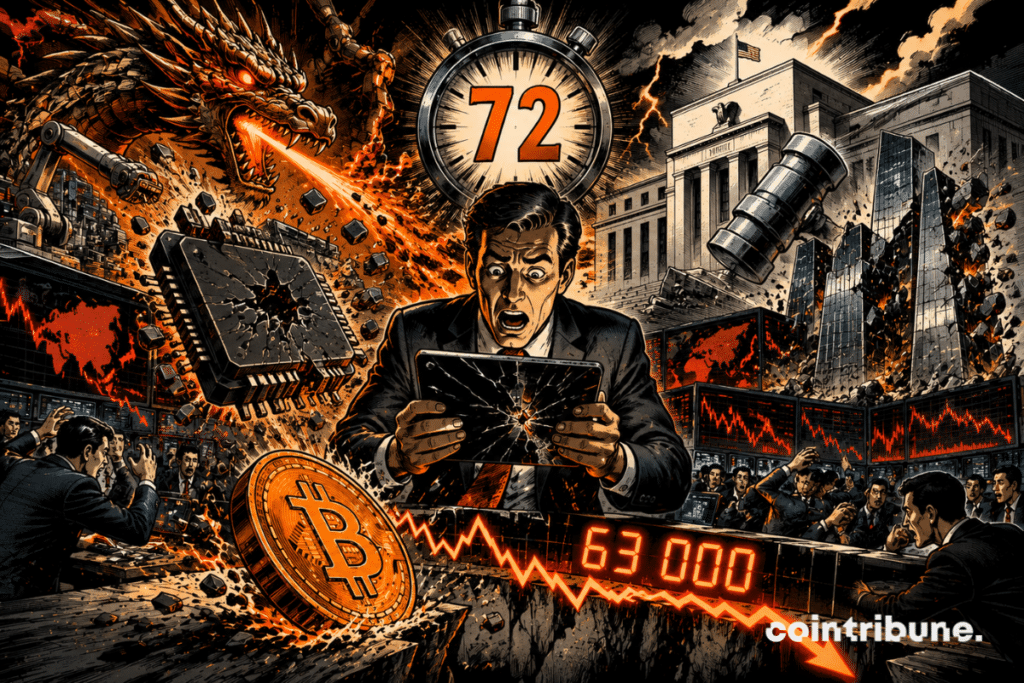
In brief
- Bitcoin briefly fell below $63,000 along with tech markets.
- China and concerns about AI financing triggered the correction.
- The Fed decision could amplify or calm the movement.
Bitcoin driven by the fall of technology stocks
Bitcoin approached its lowest level in ten days as investors simultaneously sold cryptos and AI-related stocks. This movement recalls the recent tech stock crash, which had already brought BTC around the same threshold. The shock began on Wall Street. Nvidia lost about 5%, while SanDisk dropped over 10%. The pressure then spread to Asia, where markets are heavily exposed to semiconductors.
South Korea’s KOSPI plunged over 10%, triggering a circuit breaker. Samsung Electronics and SK Hynix suffered double-digit losses. In Japan, the Nikkei fell more than 4%, with sharp declines in memory and equipment manufacturers.
The first shock comes from China. A Beijing-backed company reportedly began producing locally developed immersive DUV lithography machines. This technology has long been dominated by the Dutch group ASML. The announcement does not mean China has already caught up with ASML. Its machines remain less efficient and large-scale production still needs to prove itself. Still, the strategic signal is powerful.
Investors understand that China’s dependence on Western equipment may decline faster than expected. This threatens ASML’s future margins and alters the outlook for American, Japanese, and South Korean manufacturers. The current correction therefore reflects less an immediate break in the global supply chain than a sharp revaluation. The market had factored in lasting Western dominance. It now discovers that this assumption is less certain.
AI financing worries Wall Street
The second source of tension concerns Nvidia. The group is reportedly discussing a financial guarantee of around $250 billion for a massive data center intended for OpenAI. It could also participate in financing the chips used by that same project.
This setup is worrying because it looks like circular financing. Nvidia would help its clients finance infrastructure that would then buy its own processors. The system can accelerate sales but also makes demand more dependent on credit.
Investors therefore wonder if AI growth is solely based on real needs or if some part is maintained by the suppliers themselves. This question is enough to weaken an already highly valued sector.
Bitcoin directly suffers from this mistrust. When a risk-reduction move begins, the most volatile positions are often sold first. Liquidations then amplify the decline, as seen during the recent bullish position purge.
The Fed can extend or ease the correction
The Federal Reserve meeting adds a third source of uncertainty. The FOMC meets July 28 and 29. Markets now estimate about a 35% chance of a 25 basis-point rate hike. This probability was considerably lower a week ago. A surprise hike would strengthen the dollar and make yield-bearing investments more attractive. Bitcoin, which pays no yield, could then face renewed pressure.
Maintaining rates would not guarantee a rebound either. Kevin Warsh might accompany his decision with a firm speech and prepare the market for a September hike. In that case, relief would remain limited. Results from Microsoft, Meta, Apple, and Amazon will also be decisive. They will need to show that the hundreds of billions invested in AI generate sufficient revenue. Disappointment would fuel the semiconductor correction and weigh further on cryptos.
The $63,000 threshold thus becomes a first test, but the zone around $61,000 seems more decisive. Bitcoin must absorb the tech shock without triggering a new wave of leveraged selling. Upcoming sessions will depend less on blockchain than on the Fed, tech results, and confidence in AI financing. The market confirms once again that stocks and cryptos often fall together when liquidity becomes the priority.
Maximize your Cointribune experience with our "Read to Earn" program! For every article you read, earn points and access exclusive rewards. Sign up now and start earning benefits.

Enseignante et ingénieure IT, Lydie découvre le Bitcoin en 2022 et plonge dans l’univers des cryptomonnaies. Elle vulgarise des sujets complexes, décrypte les enjeux du Web3 et défend une vision d’un futur numérique ouvert, inclusif et décentralisé.
The views, thoughts, and opinions expressed in this article belong solely to the author, and should not be taken as investment advice. Do your own research before taking any investment decisions.