Bitcoin takes off, oil falls after the opening of Hormuz
An Iranian announcement was enough to move two markets at once. On one side, oil fell sharply. On the other, bitcoin gained altitude, passing above 76,000 dollars with an intraday peak around 78,000 dollars on Friday.
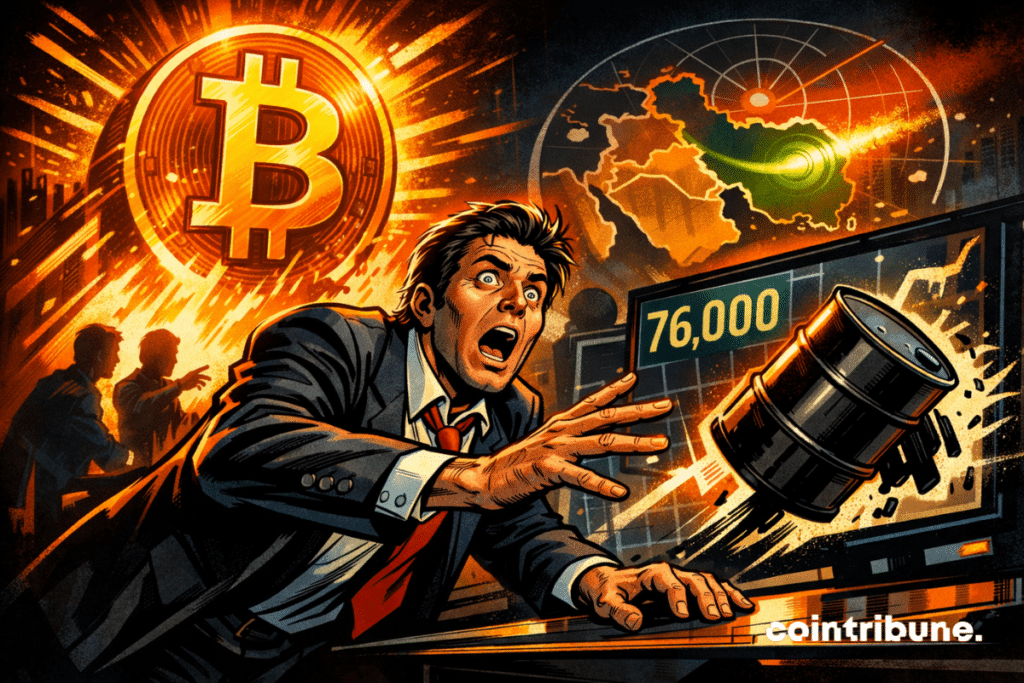
In brief
- Bitcoin climbs with the return of risk appetite.
- Oil falls after the announced reopening of Hormuz.
- The easing remains fragile as long as no final agreement is signed.
Hormuz has reopened, and the risk premium has declined
Iran indicated that the Strait of Hormuz remains open to commercial traffic during the ongoing truce. This passage concentrates a decisive share of global energy trade. As soon as this choke point seems less threatening, the fear premium embedded in the barrel deflates.
That is exactly what the markets did on Friday. Brent dropped about 10% to 11% after this announcement, while major stock indices rose again. Some observers, carried away by the prevailing optimism, even mention a bitcoin reaching one million dollars in the coming years.
This day’s movement is not anecdotal. It shows that operators immediately reassessed a de-escalation scenario, even partially. Bitcoin benefited from this shift. It did not spike because the world became safer overnight. It rose because, for a few hours, the market accepted paying more for risky assets and less for energy hedging. This is an important nuance. It says a lot about the current moment.
Bitcoin regains its role as an offensive asset
The signal is almost counter-intuitive for those who still see bitcoin only as a safe haven. On Friday, it mostly reacted as an offensive asset. When geopolitical risk eases, flows return to the most volatile segments of the market. Bitcoin is part of this category.
The movement was visible in prices. According to market data, bitcoin surpassed 76,000 dollars, briefly touched 77,037 dollars, and was still trading around 77,883 dollars at the time of consultation. This is not a vertical explosion. It is rather a clear return of risk appetite after several sessions dominated by caution.
This momentum also comes in a broader context. Global stocks rose after the Hormuz announcement, while the oil price drop also eased some of the feared inflationary pressure. In short, the market suddenly saw less energy shock, thus a little more breathing room for growth assets. Bitcoin seized this window.
The easing exists, but remains conditional
It would however be excessive to see this as a durable return to calm. Donald Trump confirmed that the US naval blockade targeting Iran remains in place until the conclusion of a comprehensive agreement. In other words, the strait is reopened to commerce, but the strategic pressure has not disappeared.
Meanwhile, discussions are progressing without being finalized. Axios revealed that an agreement framework was being studied, notably including the possibility of unfreezing up to 20 billion dollars of Iranian funds in exchange for concessions on the stockpile of enriched uranium. It is serious, but not signed. And as long as it is not signed, the market remains exposed to a sudden return of tension.
This is why the bitcoin rise must be read with cool-headedness. This rebound chiefly reflects tactical relief. It does not prove that Middle Eastern risk is behind us. It only shows that, as things stand, traders pay less for the catastrophe scenario than they did just a few days ago. For bitcoin, this is already enough to significantly change the market climate. At the same time, BlackRock has resumed its purchases, reinforcing this renewed confidence.
Maximize your Cointribune experience with our "Read to Earn" program! For every article you read, earn points and access exclusive rewards. Sign up now and start earning benefits.

Fascinated by Bitcoin since 2017, Evariste has continuously researched the subject. While his initial interest was in trading, he now actively seeks to understand all advances centered on cryptocurrencies. As an editor, he strives to consistently deliver high-quality work that reflects the state of the sector as a whole.
The views, thoughts, and opinions expressed in this article belong solely to the author, and should not be taken as investment advice. Do your own research before taking any investment decisions.