Brazil: The Central Bank under pressure after its statements on stablecoins and money laundering
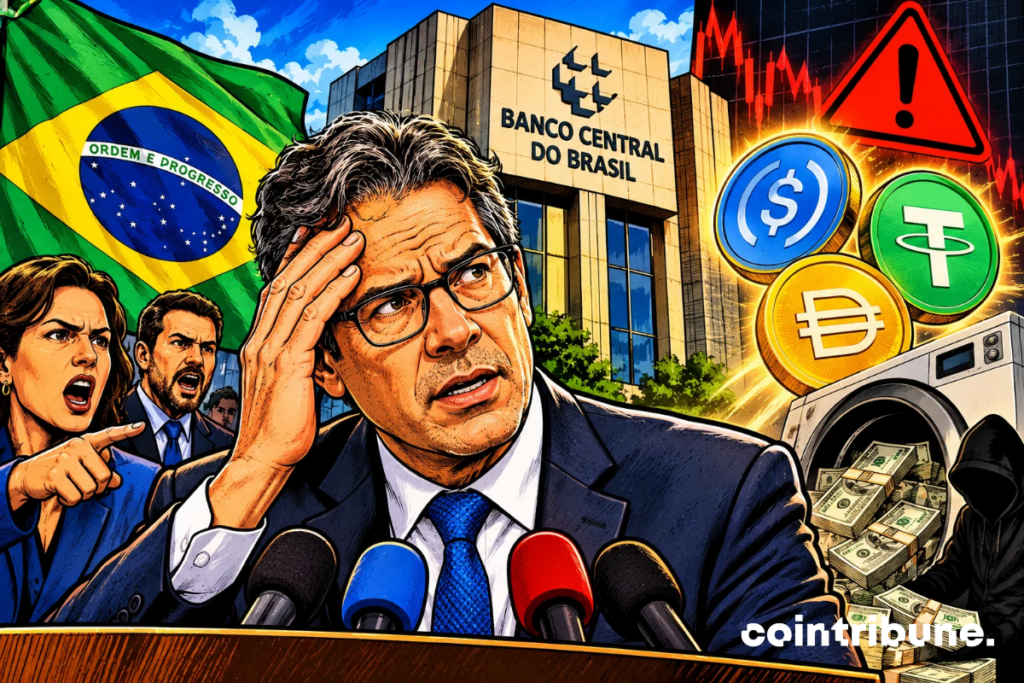
The Central Bank of Brazil faces demands for explanation after remarks attributed to an official on stablecoins. He supposedly linked their usage to money laundering and an informal system. These statements provoke reactions in Congress and in the digital assets sector. The stakeholders involved demand clarifications on the rules of international payments in a context of strong local adoption.
In Brief
- An official from the Brazilian Central Bank supposedly associated the conversion of funds into stablecoins with money laundering risks.
- The ILM and several parliamentarians demand official explanations on these controversial statements.
- ABToken contests any conflation between stablecoins and laundering, advocating an analysis based on the origin of the funds.
- Resolution 561 already regulates certain cross-border crypto payments, while a bill awaits examination in Congress.
Remarks attributed to an official provoking reactions
During a crypto event, Gerson Romantini supposedly made these statements. He reportedly considered that legitimate funds lost their lawful character when converted into stablecoins, according to the local media Livecoins. He also suggested that certain operations could constitute money laundering. Finally, he compared this market to the “dólar-cabo,” an informal circuit allowing fund transfers beyond borders.
These statements triggered reactions among elected officials and crypto businesses. The Instituto Livre Mercado (ILM) wants to obtain the minutes of the concerned meeting. The group also requests the supporting technical and legal documents according to local media BitNotícias. It mainly seeks to know if the Central Bank plans limits on fintechs using stablecoins in Brazil.
The Bancada do Livre Mercado is preparing an information request to submit to Congress, according to BitNotícias. The Brazilian Association of Tokenization and Digital Assets (ABToken) also demands a public clarification. It fears that overly broad restrictions could disrupt legal payments and investments that are dedicated to compliance. For these organizations, authorities must distinguish illicit uses from regular financial operations.
In Brazil, crypto actors contest the conflation with laundering
The ILM contests the idea that using a stablecoin alone suffices to characterize laundering. According to the group, the offense depends first on the criminal origin of the funds. It also assumes that an operation seeks to hide or disguise this origin. Thus, the chosen technology to transfer money cannot, by itself, establish the existence of a crime.
ABToken asserts that the use of stablecoins does not, by itself, constitute laundering. The association asks regulators to examine each operation according to several precise criteria. They notably must study the source and destination of the funds, as well as the identity of concerned persons. Transaction traceability and compliance controls must also be part of this analysis.
This request fits within the framework of Brazil’s money laundering law. The text defines the offense as the concealment or disguise of assets directly or indirectly derived from criminal activity. For sector actors, this definition requires an evaluation based on the facts of each transaction. ABToken warns that a general approach could create legal uncertainty, weaken legitimate operations, and reduce investments in security and compliance.
Cross-border payments remain governed by specific rules
Organizations also request clarifications on the “stablecoin sandwich.” A provider first receives the client’s local currency, then converts it into stablecoin. It then transfers the token on a blockchain before exchanging it for fiat currency in another country. A recent document from the International Monetary Fund presents this mechanism as a potentially less costly solution for cross-border payments.
However, exchange and conversion fees may reduce expected savings in Brazil. The country already limits this model under its electronic foreign exchange system called eFX. This system regulates certain payment and international transfer services. Resolution 561, effective October 1st, specifies the authorized settlement methods for these operations.
In Brazil, payment between an eFX provider and its foreign partner must go through a foreign exchange operation. It may also use a Brazilian real account opened in Brazil in the name of a non-resident. Settlement of these payments via cryptocurrencies is explicitly prohibited. This rule targets a specific category of services and does not constitute a general ban on buying or holding stablecoins in Brazil.
According to Livecoins, Romantini reportedly indicated that institutions can use cryptocurrencies as infrastructure for foreign exchange operations. However, they could not sell tokens to their clients for them to convert and pay abroad. Meanwhile, lawmakers are reviewing bill 4308/2024, which provides a framework for stablecoins. The text still awaits a report from the lower house’s economic development committee.
The next steps depend on the Central Bank’s responses to requests for clarification and parliamentary work on the bill. A detailed stance could clarify the boundary between authorized uses and suspicious operations. eFX rules will continue, within their scope, to regulate certain international settlements. In Brazil, the debate now focuses on how to control risks without automatically equating stablecoins with declared money laundering.
Maximize your Cointribune experience with our "Read to Earn" program! For every article you read, earn points and access exclusive rewards. Sign up now and start earning benefits.

Journaliste et rédacteur web passionné par l’univers des cryptomonnaies et des technologies Web3. J’y traite les dernières tendances et actualités afin de proposer un contenu de haute qualité à un large public du secteur.
The views, thoughts, and opinions expressed in this article belong solely to the author, and should not be taken as investment advice. Do your own research before taking any investment decisions.