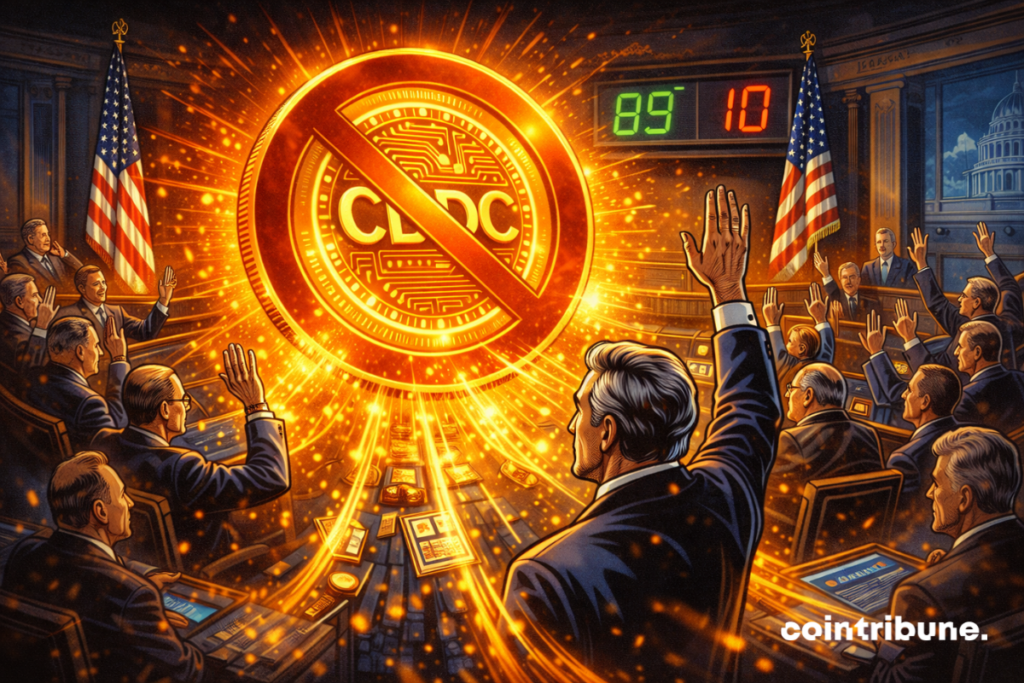
By 89 votes to 10, the Senate blocks the Fed's digital dollar until 2030
In the United States, the idea of a currency fully controlled by the state triggers visceral reactions. Many citizens reject this surveillance tool disguised as a simple electronic wallet. Politicians have just decisively settled this debate. By an unambiguous vote, the Senate said no to the Fed’s digital dollar. A brilliant victory now looms for privacy advocates. A resounding slap for central bank technocrats.
In brief
- The US Senate voted 89 to 10 to ban the CBDC until December 2030.
- The anti-CBDC amendment is hidden in a 302-page housing bill.
- Ralph Norman denounces a technology that would give unprecedented power to unelected bureaucrats.
- Private stablecoins like USDC are explicitly excluded from this government ban.
89 votes to 10: the Senate buries the CBDC until 2030
The score reaches a magnitude beyond all political observers’ forecasts. By 89 votes to 10, the US Senate formally prohibited the Federal Reserve from issuing a central bank digital currency. This prohibition extends until December 31, 2030, meaning five full years without a state digital dollar in the territory.
The majority is overwhelming, almost insulting to proponents of programmable money. But the most surprising aspect lies beyond just those numbers. This ban does not travel alone through the halls of the US Congress. It is attached like a carriage to the “21st Century ROAD to Housing Act”, a massive bill on affordable housing.
A 302-page legislative package where the future of money hides in the last lines of the text. Senators voted for houses accessible to hardworking middle classes. They also, perhaps unknowingly, rang the death knell for the digital dollar for the whole decade.
The maneuver is clever both tactically and politically. It now forces the House of Representatives to clearly position itself on this thorny topic.
The crypto revolt against CBDC: “a control mechanism” according to Ralph Norman
Ralph Norman never minces words when it comes to defending fundamental individual freedoms. The representative, one of thirty signatories of a letter to the Senate, sums up the fear driving opponents:
A CBDC would give unelected bureaucrats unprecedented power over Americans’ finances and threaten fundamental economic freedom.
Ray Dalio, the famous hedge fund manager, adds with the same force about the core problem. “There will be no privacy, and it’s a very effective government control mechanism“, he said in an interview with Tucker Carlson. Programmable money would allow taxing, freezing, or monitoring accounts in real time without any oversight.
The “authoritarian surveillance technology” becomes the bogeyman uniting politicians otherwise at odds. Warren Davidson himself, critical of both sides, warns that overly regulated stablecoins could become disguised CBDCs. Fear of state control now transcends traditional partisan divides.
The strategic exemption: stablecoins as the new American weapon
The text passed by the Senate contains a subtlety that changes the entire global geopolitical game. The ban does not concern “open, permissionless, and private” digital currencies, according to the exact terms of the amendment. Stablecoins pegged to the dollar are officially invited to the upcoming major monetary party.
Scott Bessent, the Treasury Secretary, and Donald Trump see much farther than the simple domestic market. For them, these private tokens represent a means to extend the dollar’s hegemony against the Chinese digital yuan. A formidable geopolitical weapon, disguised as a harmless and attractive financial innovation.
The administration thus buries state money but encourages private monetary competition. A Hayekian vision put at the service of American public power. Yet uncertainty remains on procedural and legislative grounds. Trump threatens not to sign any law without voter identification text. The House can torpedo the entire device if it wishes.
The digital dollar is dead for five years, but nothing says this strange legislative marriage will survive the next weeks of intense negotiations.
The historic vote in key figures
- 89 senators voted for banning the CBDC, against only 10 staunch opponents;
- December 31, 2030 is the deadline until which the Fed cannot issue digital currency;
- The housing bill carrying the crucial amendment comprises 302 pages;
- 30 representatives signed the letter calling for a permanent digital dollar ban;
- 0 digital dollar will see the light of day before the end of the current American decade.
Americans do not reject all digital currencies. They have just authorized Elon Musk’s X Money on their territory. A famous economist states this project could outperform Bitcoin on a crucial point. The difference is simple: they accept private innovation. They only reject state control disguised as technical progress.
Maximize your Cointribune experience with our "Read to Earn" program! For every article you read, earn points and access exclusive rewards. Sign up now and start earning benefits.

La révolution blockchain et crypto est en marche ! Et le jour où les impacts se feront ressentir sur l’économie la plus vulnérable de ce Monde, contre toute espérance, je dirai que j’y étais pour quelque chose
The views, thoughts, and opinions expressed in this article belong solely to the author, and should not be taken as investment advice. Do your own research before taking any investment decisions.