Can Naoris Protocol Save Bitcoin from Quantum Risk?
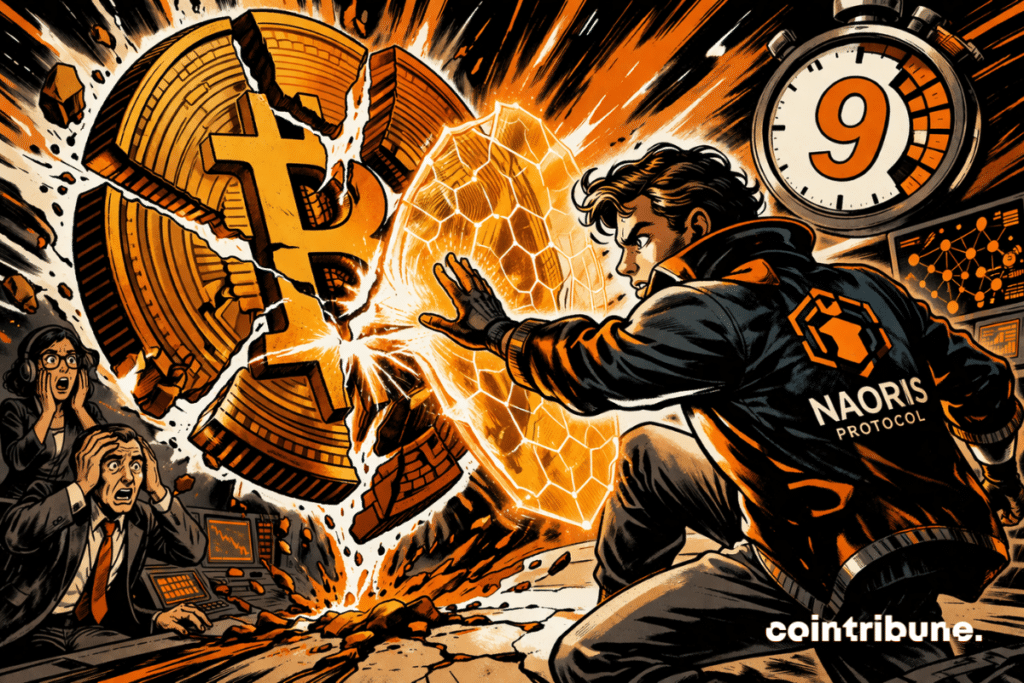
Bitcoin faces a new quantum alert. Google Research now estimates that a future cryptographically relevant quantum computer could break ECDLP-256, the base of elliptical cryptography used in the ecosystem, with fewer than 500,000 physical qubits and in just a few minutes. The figure of “9 minutes” summarizes this acceleration, but Google’s official formula remains more cautious: “a few minutes.”
In brief
- Google sharply narrows the quantum risk horizon for Bitcoin.
- Naoris Protocol offers a credible but still incomplete path for Bitcoin.
- The real urgency is now preparation, not denial.
The real alarm signal for Bitcoin
The important point is not that Bitcoin would be broken tomorrow morning. The real shock is that the security window appears less wide than previously thought. Google explains that its new estimates greatly reduce the resources needed to attack this cryptography, with about a twentyfold reduction in the number of physical qubits previously considered.
This changes the tone of the debate. For a long time, the quantum risk was categorized as a “distant problem.” Now, it enters the category of “a problem to prepare for seriously.” Google even talks about a transition to post-quantum cryptography and recalls its own migration timeline for 2029.
We must also avoid misunderstanding. Google does not say that all Bitcoin is already vulnerable in the same way. The group mainly recommends limiting exposure or reuse of vulnerable wallet addresses, which clearly shows that the danger also depends on how keys are used on the chain.
Naoris Protocol provides a lead
In this context, Naoris Protocol tries to position itself as a post-quantum oriented security layer. The project presents itself as a “quantum-forward” infrastructure capable of securing blockchain transactions today while serving as a bridge to broader post-quantum standards.
On paper, the argument is attractive. Naoris documentation states that its Post-Quantum Signed Transactions system can incorporate quantum-resistant cryptography, notably with Dilithium-5, via a Layer 2-type overlay without a hard fork. This is precisely the kind of promise that appeals to a nervous market facing quantum risk.
But we must keep a cool head. Naoris mainly talks about rapid compatibility for EVM chains. For Bitcoin, its own documentation only indicates that a kit dedicated to Bitcoin Script is on the roadmap. In other words, Naoris cannot yet be seriously presented as the ready-to-use solution that “saves Bitcoin” today.
What Bitcoin really needs to do now
The credible answer will not come from a single marketing protocol, no matter how ambitious. It will require a heavier combination: progressive migration to post-quantum schemes, adaptation of wallets, discipline on exposed addresses, and probably technical and political debates much less glamorous than commercial promises. Google also emphasizes that solutions already exist, but they will take time to deploy.
This is where Naoris can still have a use. Not as a red button that makes Bitcoin invincible, but as an integration lab, an experimentation layer, and a demonstrator of what a more modular post-quantum blockchain security could become.
Its interest is real if we look at it as a technical building block, not as a universal remedy. The real conclusion is therefore quite clear. Yes, the quantum alert around Bitcoin becomes more serious. Yes, Naoris Protocol can be part of tomorrow’s toolbox.
Maximize your Cointribune experience with our "Read to Earn" program! For every article you read, earn points and access exclusive rewards. Sign up now and start earning benefits.

Fascinated by Bitcoin since 2017, Evariste has continuously researched the subject. While his initial interest was in trading, he now actively seeks to understand all advances centered on cryptocurrencies. As an editor, he strives to consistently deliver high-quality work that reflects the state of the sector as a whole.
The views, thoughts, and opinions expressed in this article belong solely to the author, and should not be taken as investment advice. Do your own research before taking any investment decisions.