Canada Among The Hardest Hit By Coldcard Exploit
Hardware wallets are among the safest solutions for storing bitcoins offline. However, this certainty has just been shaken. A critical flaw discovered in the Coldcard ecosystem allowed the theft of 116 million dollars, revealing a software vulnerability that went unnoticed for five years. The case questions the reliability of self-custody tools, as digital sovereignty emerges as a pillar of the Bitcoin ecosystem. The losses, mostly concentrated in Canada, further emphasize the scale of this incident.
In brief
- The hacking of Coldcard wallets siphons funds from more than 1,200 users worldwide.
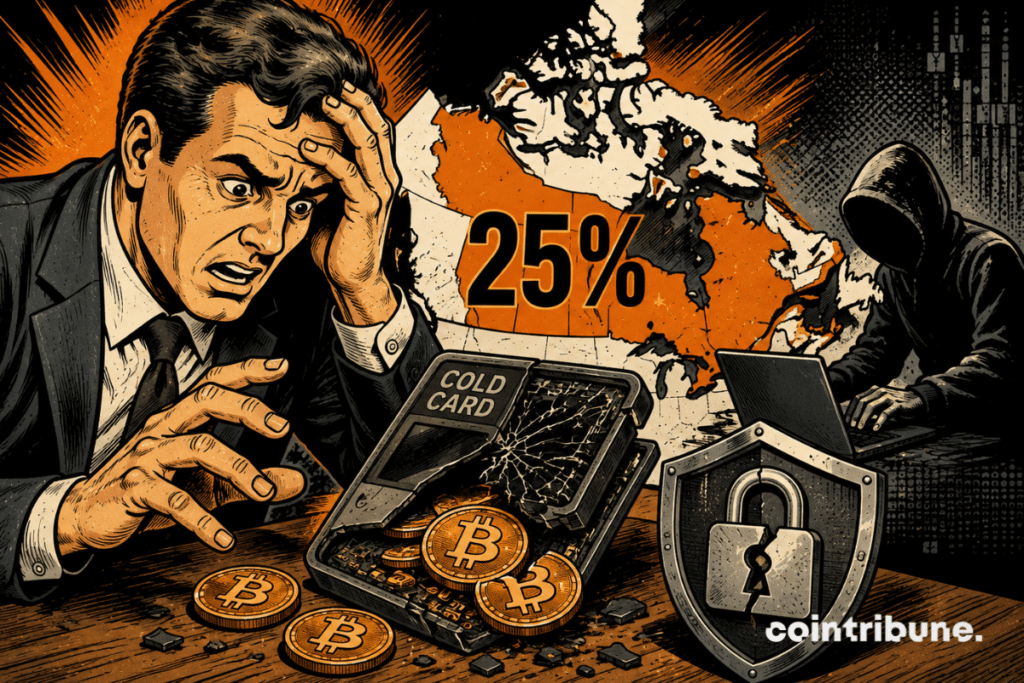
- Canadian investors account for 25% of total losses, followed by Australia, the United States, and Thailand.
- A configuration error in the firmware weakened the random generation of private keys for five years.
- The ecosystem questions classic self-custody in favor of multi-signature and multi-party computation.
Coldcard: Canada on the front line of the $116 million hack
Analytical data reveals a particularly disproportionate geographical distribution of damages caused in the Coldcard case, which are established according to the following map :
- Canada (25%) : Canadian bitcoin holders constitute the primary demographic affected by this attack, absorbing a quarter of the total attributable losses. This heavy regional concentration is largely explained by the territorial anchoring of Coldcard’s parent company, Coinkite, whose headquarters are located in Toronto, historically fostering strong local adoption by early investors ;
- Australia (15% to 20%) : according to visual analysis provided by the specialized company Chainalysis, this country ranks second among the nations most severely impacted by this asset siphoning ;
- The United States and Thailand (10% to 15%) : these two countries follow immediately in the ranking of recorded damages, with losses for each territory estimated within this range ;
- Global overall impact : while the attack primarily struck English-speaking jurisdictions and pioneers in bitcoin adoption, significant damages are also observed in Western Europe, Latin America, as well as in major crypto hubs on the African continent such as Nigeria and South Africa.
In total, the consolidated amount of assets stolen during this incident, particularly bitcoin, now reaches 116 million dollars. The financial community watches this unprecedented scale hack with concern, which raises questions about the vulnerability of physical wallets supposed to be isolated from any external network. The speed with which funds were siphoned across multiple continents illustrates the methodical precision of the hackers and the systemic fragility of users relying on a single equipment model.
A software flaw hidden for five years
The origin of this situation dates back to a specific firmware modification made several years before the hack occurred. In a detailed analysis of the incident, Galaxy Research identified a firmware update from March 2021, specifically the integration of a new random number generator, as the single point of failure that enabled the attack. “It was miswired and reverted by default to a weaker generator. Thus, it failed silently, without warning. No one knew that their private keys were generated with low entropy,” explained Galaxy Research. Explaining how standard controls missed this configuration error for over five years, Natalie Newson, Senior Blockchain Investigator at CertiK, indicated that the root cause stems from the MICROPY_HW_ENABLE_RNG setting being set to zero. “For a static guard checking #ifndef, a macro defined as 0 remains defined,” she added.
This invisible vulnerability caused a critical weakening of entropy. Due to this automatic fallback to a pseudo-random software entropy system, the mathematical complexity of the generated private keys was considerably reduced without the user being informed. The hacker was thus able to algorithmically reconstruct the vulnerable keys and orchestrate a highly efficient automated sweep. The fact that a low-level security component remained faulty in the source code during this period reveals the limits of classic static analysis in hardware quality control processes.
Towards the end of single signature?
To address this vulnerability and manage the operational risk related to deploying emergency patches amid automated theft waves, strict protocols now apply to both manufacturers and users. Natalie Newson emphasizes that hardware architecture must evolve: “the strongest control measure is to eliminate the fallback mechanism in production and have a single approved RNG provider,” specifying that the entire key generation process must strictly fit within a validation limit compliant with the NIST FIPS 140-3 standard.
Furthermore, she highlights that during incident response, “the priority must be to immediately communicate the extent of the vulnerability, identify affected users, and provide clear mitigation guidelines while rigorously validating any fix before release.” For non-technical users holding a compromised seed phrase and fearing to brick their device during an urgent firmware update, the expert recommends first acquiring a new trusted hardware wallet, generating an offline seed phrase there, validating the setup with a low-value test transaction, then transferring all funds to this new secured wallet before attempting any firmware update on the original device.
Addressing this breach of trust, Nanak Nihal Khalsa, co-founder at Human.tech, notes that “the formula, not your keys, not your coins, misses an important fact: you are always outsourcing trust, even with self-custody. This provides further proof that self-custody does not change this fact.” On her side, Natalie Newson recalls the intrinsic limits of single-signature architectures: “Single-signature self-custody offers no margin for error. Users relying on a single device place trust in the physical hardware, the firmware, and all its dependencies as well as quality assurance controls.”
Faced with this observation, the sector is converging towards systematic adoption of multi-vendor multi-signature structures or threshold signatures (MPC). She concludes by stating that this approach must become the standard: “yes, it should be the baseline norm. The goal is to move from trusting a single device to guaranteeing that no compromised component or actor can move the funds alone. In practice, signing keys or threshold shares must cover independent organizational and technological failure domains, so no vendor can reconstruct the key or authorize a transaction alone.”
This situation marks a decisive turning point in the perception of crypto security. It demonstrates that simply offline storage of a hardware wallet no longer guarantees absolute protection if the software trust chain is compromised from the start. Going forward, the industry will need to abandon the zero-risk illusion linked to a single device in favor of distributed architectures. The transition to multi-signature multi-manufacturer and multi-party computation technologies is now no longer an advanced option but the only viable standard to ensure the sustainability of capital self-custody.
Maximize your Cointribune experience with our "Read to Earn" program! For every article you read, earn points and access exclusive rewards. Sign up now and start earning benefits.

Diplômé de Sciences Po Toulouse et titulaire d'une certification consultant blockchain délivrée par Alyra, j'ai rejoint l'aventure Cointribune en 2019. Convaincu du potentiel de la blockchain pour transformer de nombreux secteurs de l'économie, j'ai pris l'engagement de sensibiliser et d'informer le grand public sur cet écosystème en constante évolution. Mon objectif est de permettre à chacun de mieux comprendre la blockchain et de saisir les opportunités qu'elle offre. Je m'efforce chaque jour de fournir une analyse objective de l'actualité, de décrypter les tendances du marché, de relayer les dernières innovations technologiques et de mettre en perspective les enjeux économiques et sociétaux de cette révolution en marche.
The views, thoughts, and opinions expressed in this article belong solely to the author, and should not be taken as investment advice. Do your own research before taking any investment decisions.