CLARITY Act clears final hurdle: Senate vote in May
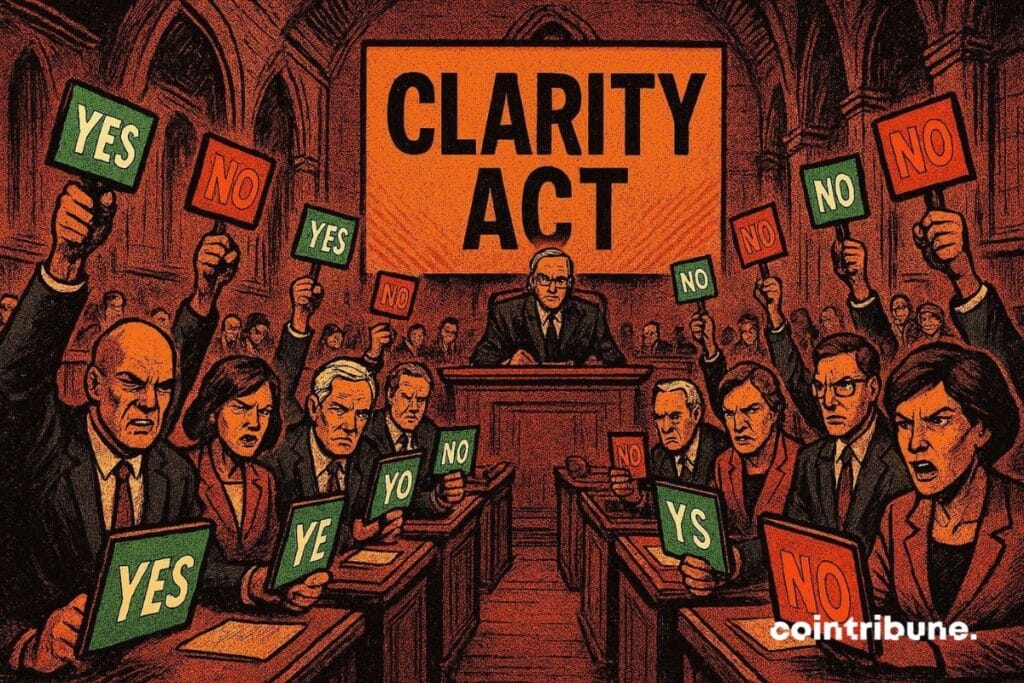
The CLARITY Act, the flagship bill for crypto regulation in the US, has just overcome its biggest hurdle. With a historic compromise on stablecoins, the Senate could vote as early as May 2026. A major breakthrough for the industry, but also for investors.
In brief
- The CLARITY Act reaches a key milestone with a compromise on stablecoin returns, allowing active use rewards.
- The Senate could vote in May 2026, finally providing a clear regulatory framework for crypto in the US.
- Swift passage could boost innovation, attract investors and stabilize the crypto market.
The CLARITY Act clears its final hurdle: the Senate
The CLARITY Act, stalled for months in the Senate, has finally found common ground on the thorny issue of stablecoin yields. Senators Thom Tillis (R-NC) and Angela Alsobrooks (D-MD) have proposed a compromise banning interest equivalent to bank deposits, while allowing reward programs linked to the active use of stablecoins.
This text, welcomed by Circle (USDC) and Coinbase, avoids unfair competition with traditional banks, while preserving innovation. To this end, the Senate Banking Committee could now organize a markup as early as mid-May, before the summer recess. If the timetable is adhered to, the bill could be passed before the November 2026 elections. Long-awaited regulatory clarity for players in the crypto sector, who are finally hoping for a stable framework in which to operate in the United States.
Crypto could take off immediately after this decision
The Senate vote in May and the passage of the CLARITY Act could trigger a wave of investment and innovation in the US crypto ecosystem. Indeed, with clear rules on stablecoins, platforms like Coinbase, Kraken or Tether will be able to launch new compliant products, attracting both institutional and retail investors. What’s more, crypto ETFs, tokenized loans and regulated DeFi solutions could explode, boosting the crypto market’s market capitalization.
In addition, foreign companies, hitherto reluctant to set up in the US due to legal uncertainty, could also accelerate their expansion. Furthermore, clear regulations could reduce market volatility, reassuring investors. Finally, with a solid legal framework, traditional banks could finally collaborate with crypto players, paving the way for hybrid products (e.g. accounts paying interest in stablecoins).
The CLARITY Act marks a turning point for crypto in the United States. If the Senate votes in May, the industry could see a historic boom. But will this framework be enough to reconcile innovation and consumer protection? The debate remains open.
Maximize your Cointribune experience with our "Read to Earn" program! For every article you read, earn points and access exclusive rewards. Sign up now and start earning benefits.

The world is evolving and adaptation is the best weapon to survive in this undulating universe. Originally a crypto community manager, I am interested in anything that is directly or indirectly related to blockchain and its derivatives. To share my experience and promote a field that I am passionate about, nothing is better than writing informative and relaxed articles.
The views, thoughts, and opinions expressed in this article belong solely to the author, and should not be taken as investment advice. Do your own research before taking any investment decisions.