Stablecoin Payments: JPMorgan Debunks the Myth of Unlimited Growth
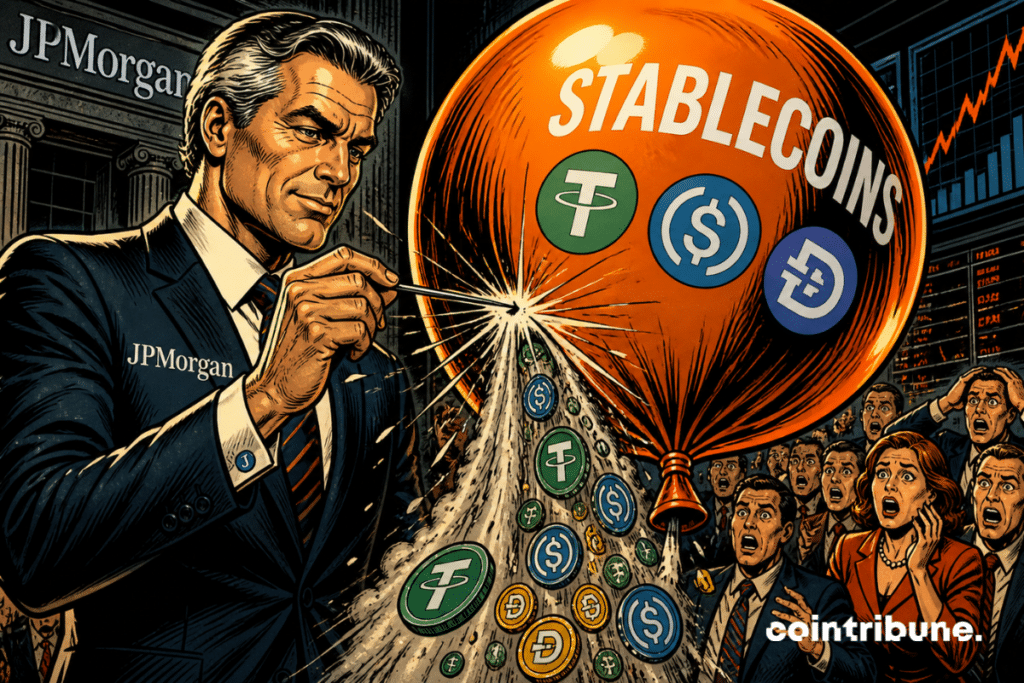
Crypto has carved out a massive role in modern finance, and stablecoins are rolling forward like armored trucks. They are everywhere—payments, transfers, exchanges, and institutional balance sheets. Yet JPMorgan has quietly dropped a stone in the pond, without raising its voice. Yes, usage is exploding, but market capitalization may not follow the same path, because digital money now moves faster than the old narratives of the global crypto market—and far more efficiently than before.
En bref
- JPMorgan estimates stablecoins process around $17.2 trillion in annualized transaction volume today globally.
- Market capitalization remains near $300 billion despite strong yearly growth across the sector.
- Higher velocity allows stablecoins to support more payments without significantly expanding total supply.
- USDT and USDC together dominate nearly 90% of the global stablecoin market today.
Stablecoins: Trillions in Motion, But No Endless Jackpot
The first trap is confusing usage with size. According to JPMorgan, annualized stablecoin transaction volumes reach around $17.2 trillion, while some estimates climb as high as $46 trillion over twelve months. Market capitalization, however, remains close to $300 billion, even after growing by roughly $100 billion in a year.
The contrast scratches at expectations. In the crypto industry, many envisioned a straight road to the trillion mark. JPMorgan instead describes a market that is more tense than massive, where the same token works harder.
Analysts even point to a colder projection: $500 to $600 billion in market cap by 2028. That is not insignificant, far from failure. But it is not the infinite jackpot promised by overly eager prophets either.
Stablecoins are growing, yes—but their true power lies in fast, deep, almost organic movement that can now be measured precisely.
Velocity Is Redefining the Real Value of Digital Money
The word that disrupts the narrative is velocity, and it is no consultant gimmick. It measures how frequently the same stablecoin circulates over a given period. The faster it moves, the less the market needs to mint massive amounts of new tokens.
JPMorgan states it clearly:
In our opinion, the more widely used stablecoin-based payment systems become, the higher their efficiency and thus their velocity. In turn, higher velocity would likely limit the expansion of the stablecoin universe going forward, even if their usage in payments rises exponentially from here.
JPMorgan, source: The Block
In the global crypto market, this marks a subtle but profound shift in thinking. Instant payments are pushing users to expect money to move as fast as information itself. Stablecoins are becoming less like idle reserves and more like blazing rails—fast, reused, almost impatient. That is why raw size remains useful, but no longer sufficient as a metric.
Crypto: A Mature, Concentrated, Less Spectacular Infrastructure
What follows looks less like a bubble and more like quiet industrialization. Regulation is moving in that direction, with the GENIUS Act and requirements for fully backed reserves in dollars or Treasuries.
USDT holds 65% to 70% of the market, while USDC captures 20% to 25%, leaving little room for outsiders. Asia still dominates global usage, showing that real-world payments are overtaking simple crypto trading.
JPMorgan Payments sums up the shift:
Consumers and businesses increasingly expect funds to move as fast as information. The sharp growth in real-time payment signals that instant settlement is moving from a ‘nice-to-have’ to a ‘must-have.’
JPMorgan Payments, source: Cryptopolitan
Key figures revealing the hidden mechanics
- Annualized volume estimated at $17.2 trillion, according to JPMorgan today.
- Total market capitalization close to $300 billion today.
- JPMorgan targets $500 to $600 billion by 2028.
- USDT and USDC control nearly 90% of the global stablecoin market.
This battle already goes far beyond the technical comfort of digital payments. Between Europe and the United States, stablecoins are becoming a battleground for sovereignty, currency control, and influence. France is pushing back with euro-denominated alternatives, proving that no one wants to let the digital dollar dictate the rules of this new programmable crypto finance alone. The tug-of-war has only just begun.
Maximize your Cointribune experience with our "Read to Earn" program! For every article you read, earn points and access exclusive rewards. Sign up now and start earning benefits.

La révolution blockchain et crypto est en marche ! Et le jour où les impacts se feront ressentir sur l’économie la plus vulnérable de ce Monde, contre toute espérance, je dirai que j’y étais pour quelque chose
The views, thoughts, and opinions expressed in this article belong solely to the author, and should not be taken as investment advice. Do your own research before taking any investment decisions.