Crypto: A federal judge clears Caitlyn Jenner in the JENNER memecoin case
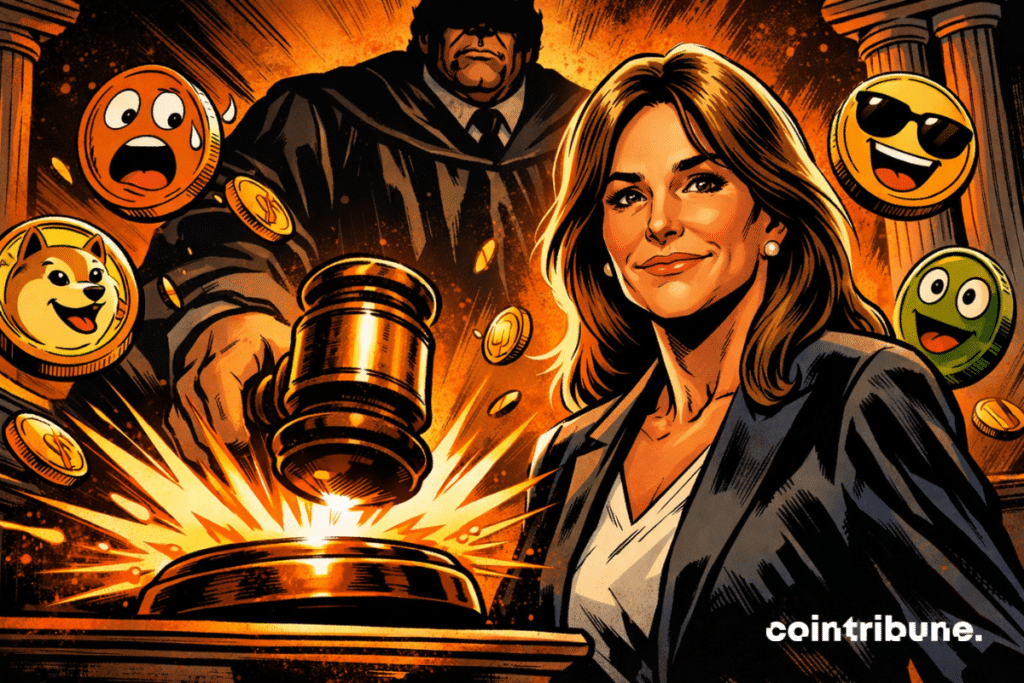
Caitlyn Jenner escapes a class action lawsuit. A California federal judge ruled that her memecoin JENNER was not a financial security, thus closing the door to any lawsuit on this basis. A decision that raises much broader questions about the legal framework for celebrity cryptos.
In brief
- A California federal judge dismissed the class action lawsuit against Caitlyn Jenner related to her JENNER memecoin.
- The judge ruled that the token did not constitute a financial security under U.S. law.
- Investors claimed to have lost thousands of dollars following the token price collapse.
A federal judge closes the door on the plaintiffs
On Thursday, April 17, 2026, in Los Angeles, Federal Judge Stanley Blumenfeld Jr. issued his order. He dismissed the amended complaint filed by a group of buyers of the JENNER token, led by British citizen Lee Greenfield, who claimed to have lost more than $40,000 in the venture.
The judge’s reasoning can be summed up in a few words: the JENNER token does not meet the criteria of an “investment contract” under the Howey test, a key reference in U.S. securities law.
To qualify an asset as a security, the law requires pooling of funds in a common enterprise accompanied by an expectation of profit. The plaintiffs provided no convincing evidence to this effect.
Blumenfeld also relies on the defendants’ own words: “the $JENNER token is a memecoin on the Ethereum blockchain intended solely for entertainment purposes.” A formulation that carried significant weight.
The decisive point is this: promotion by a celebrity, no matter how massive, does not create any legal link between investors and a common enterprise. Jenner promised to increase the token’s value through her influence and fame, not to manage a project for the direct benefit of its buyers. In the eyes of the law, this distinction is fundamental.
A crypto born in controversy, dead in indifference
The story of the JENNER token is, in many respects, a textbook case of the excesses in the memecoin market. Launched in May 2024 on the Solana blockchain via the Pump.fun platform, it quickly sparked passions, and not for the right reasons.
Caitlyn Jenner, like other celebrities of the time, claimed to have been scammed herself by Sahil Arora, presented as a collaborator on the project. An accusation that sowed doubt from the start. Jenner then decided to relaunch the token on Ethereum, a decision that caused the collapse of the original Solana token, according to investors.
Result? After peaking at nearly $7.5 million in market capitalization in June 2024, the token lost almost all of its value. Thousands of buyers were left with severe losses, leading to the filing of the first complaint in November 2024.
The plaintiffs clung to one argument: Jenner had promised that once $50 million in capitalization was reached, a 3% fee would fund token buybacks, donations to Trump’s campaign, and even the tokenization of her Olympic gold medal. The judge was not convinced. These promises, according to him, did not establish a clear link between investors’ funds and an expected financial return.
Ultimately, legally, Caitlyn Jenner gets off. But investors’ losses remain real. This case highlights a glaring regulatory gap: until legislators clearly regulate celebrity memecoins, the line between crypto entertainment and market manipulation will remain dangerously blurred.
Maximize your Cointribune experience with our "Read to Earn" program! For every article you read, earn points and access exclusive rewards. Sign up now and start earning benefits.

Passionné par le Bitcoin, j'aime explorer les méandres de la blockchain et des cryptos et je partage mes découvertes avec la communauté. Mon rêve est de vivre dans un monde où la vie privée et la liberté financière sont garanties pour tous, et je crois fermement que Bitcoin est l'outil qui peut rendre cela possible.
The views, thoughts, and opinions expressed in this article belong solely to the author, and should not be taken as investment advice. Do your own research before taking any investment decisions.