Crypto Bill Sparks Debate Between Senate Committees
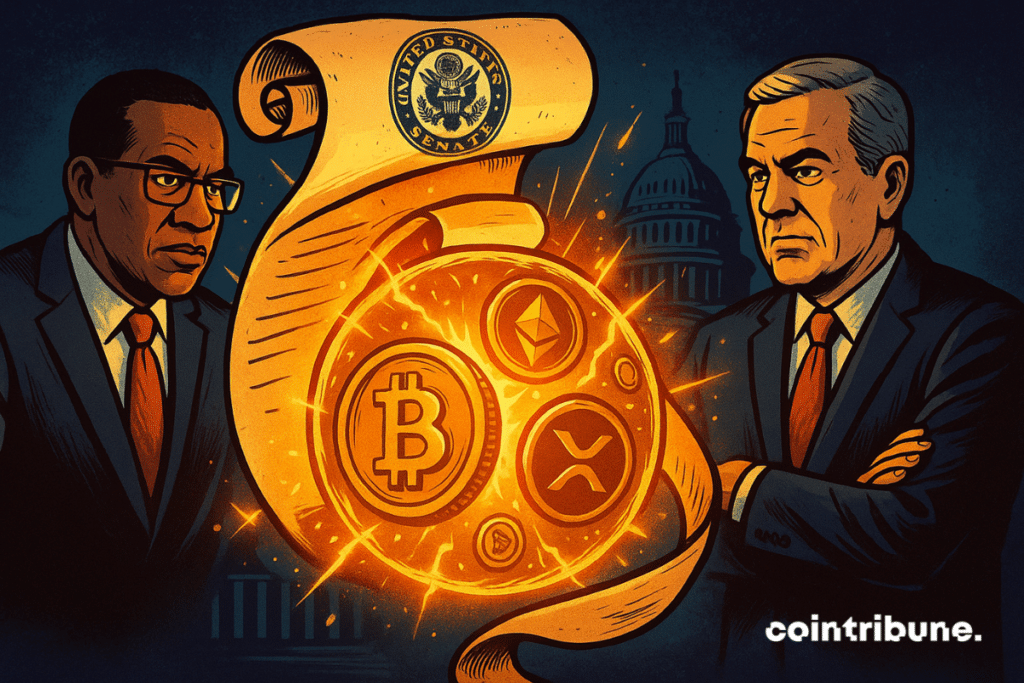
While the United States struggles to align on crypto regulation, the Senate breaks the deadlock. The Agriculture Committee has just unveiled an ambitious bill aimed at clarifying the roles of regulators, CFTC and SEC, and laying the foundations for a coherent legal framework. Led by Senators Boozman and Booker, the text also addresses key concepts such as DeFi, DAOs, and blockchain. This is a first step towards more readable regulation.
In brief
- The US Senate unveils a bill aimed at clarifying crypto market regulation.
- The text, led by Senators Boozman and Booker, assigns a central role to the CFTC to oversee the spot crypto market.
- Legal definitions are introduced for key concepts such as blockchain, DeFi, and decentralized autonomous organizations (DAO).
- Several sections of the bill are still under discussion, reflecting ongoing disagreements within Congress.
A framework for the CFTC, an attempt to bring order to regulatory chaos
The release of the preliminary bill by the Senate Agriculture Committee after many discussions with David Sacks represents a major milestone in the legal structuring of the US crypto market.
Concretely, this initiative aims to clarify the respective competencies of the CFTC and SEC, two agencies often in conflict in their interpretation of these assets. Republican Senator John Boozman states that “the CFTC is the agency responsible for overseeing the spot market of digital goods, and it is essential to establish clear rules for this emerging market while protecting consumers”.
His Democratic counterpart Cory Booker highlights that this bill “will give the CFTC new powers to regulate the crypto spot market, offer new protections to retail investors, and ensure the agency has the necessary resources to oversee this growing market”.
Here are the key elements that this bill aims to regulate :
- The “blockchain” is structurally defined to establish its legal boundaries ;
- Decentralized finance (DeFi) is mentioned as a distinct area requiring appropriate regulation ;
- Decentralized autonomous organizations (DAO) are identified as legally distinct entities ;
- The term “digital commodity” is clarified to distinguish assets overseen by the CFTC from securities under the SEC.
Several sections of the text are still bracketed, indicating unresolved disagreements and remaining negotiation margins. As it stands, this bill marks a structural turning point in the way Congress intends to address the crypto ecosystem, laying legal foundations capable of meeting the calls for regulatory clarity often expressed by industry players.
A still contested text
Despite this apparent consensus around the strengthened role of the CFTC, some provisions of the text are already subject to internal criticism. An excerpt of the proposal, still bracketed, mentions “the viewpoint of a minority,” a position supported by some Democratic senators, according to which the Agriculture Committee should not have jurisdiction over certain aspects of the bill, particularly those related to blockchain developers or blockchain service providers.
These lawmakers advocate for broader collaboration with the Senate Banking Committee, which oversees the SEC, and thus the enforcement of securities laws. This divergence reflects a power struggle between Senate committees over control of the crypto framework, at a time when regulating digital finance has become a major political issue.
This bill also resonates with other recent initiatives. The CLARITY Act, passed by the House of Representatives in July, already granted a central role to the CFTC. The version presented by the Banking Committee in July could merge with this new draft.
However, the exact terms of this merger remain unclear, and the legislative schedule uncertain. Some key elements, such as DeFi, NFTs, or stablecoins, remain undefined or absent from the text, limiting its immediate scope and potentially fueling future regulatory tensions.
While several sector players welcome this bill, like Ji Hun Kim (Crypto Council for Innovation) who sees it as a significant step toward an adapted framework for cryptos, or Mason Lynaugh (Stand With Crypto, Coinbase), for whom it is an important step toward a sensible regulatory framework, others point out the risks of inconsistencies if institutions fail to harmonize their approaches.
Ultimately, this proposal marks legislative progress, but above all the start of a complex political undertaking, where institutional balances and divergent interests will have to adjust to create a coherent regulation with the end of the shutdown, protective and sustainable for the crypto market in the United States.
Maximize your Cointribune experience with our "Read to Earn" program! For every article you read, earn points and access exclusive rewards. Sign up now and start earning benefits.

Diplômé de Sciences Po Toulouse et titulaire d'une certification consultant blockchain délivrée par Alyra, j'ai rejoint l'aventure Cointribune en 2019. Convaincu du potentiel de la blockchain pour transformer de nombreux secteurs de l'économie, j'ai pris l'engagement de sensibiliser et d'informer le grand public sur cet écosystème en constante évolution. Mon objectif est de permettre à chacun de mieux comprendre la blockchain et de saisir les opportunités qu'elle offre. Je m'efforce chaque jour de fournir une analyse objective de l'actualité, de décrypter les tendances du marché, de relayer les dernières innovations technologiques et de mettre en perspective les enjeux économiques et sociétaux de cette révolution en marche.
The views, thoughts, and opinions expressed in this article belong solely to the author, and should not be taken as investment advice. Do your own research before taking any investment decisions.