Crypto: DeFi Jumps 38% as Wall Street Starts to Take Notice
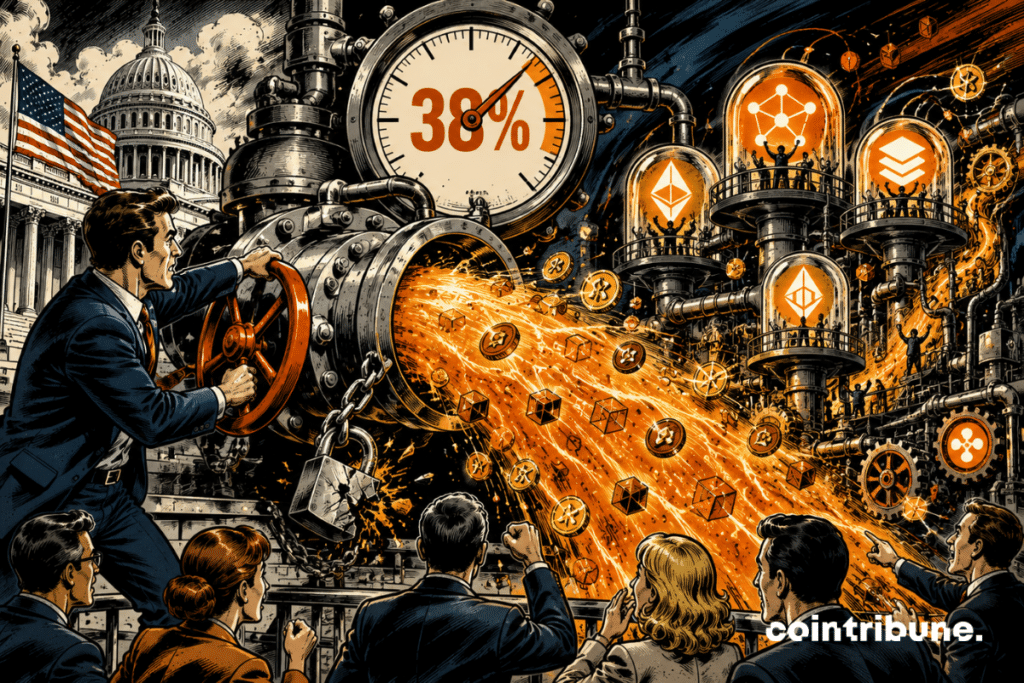
DeFi is rapidly recovering. The SoSoValue crypto index $DEFI.ssi has gained nearly 38% since August 17, rising from 0.3616 to around 0.498 after peaking at 0.511. The rebound of Bitcoin and Ethereum helped. But investors are also eyeing Washington: the new rules being considered in the United States could allow DeFi protocols to better redistribute their revenues to their tokens.
In brief
- The SoSoValue DeFi crypto index has gained about 37.7% since August 17.
- Uniswap generated 7.18 million dollars in revenue over 30 days.
- The SEC proposes a framework that could facilitate certain value redistribution mechanisms.
DeFi crypto gains nearly 38%
The movement accompanies a broader shift in tone in the United States. The SEC had already launched its Project Crypto to modernize US regulation. The market is now accelerating. The $DEFI.ssi index was at 0.3616 on August 17. It since reached 0.511 before falling back around 0.498. Total gain: about 37.7%.
Bitcoin and Ethereum also rebounded over the same period. Short position buybacks also contributed to the movement. SoSoValue points to another factor: the crypto market is beginning to reassess how DeFi protocols can use their revenues.
For years, some projects have collected millions of dollars of fees without their tokens benefiting directly.
Distributing these revenues or buying back tokens could bring these assets closer to securities in the eyes of US regulators. Teams remained cautious. Washington is starting to change the rules of the game.
The revenues of crypto protocols come back into focus
The amounts are starting to matter. Over the last 30 days, Uniswap generated about 7.18 million dollars in revenue. PancakeSwap follows with 5.16 million. Jupiter reached 4.69 million, Aave 4.12 million and Aerodrome 4.11 million.
They are no longer just governance tokens attached to crypto applications. Several protocols are now seeking to directly link their economic activity to their assets.
Hyperliquid uses part of its trading fees to buy HYPE. Uniswap ties some revenues to the burning of UNI. Jupiter dedicates 50% of protocol fees to buy back JUP. PancakeSwap also uses some of its revenues to buy back and burn CAKE.
Ethena wants to go even further. When USDe reaches the planned supply threshold, the project proposes to use 95% of net revenues paid to its foundation to buy back ENA. DeFi is also looking to reach more users. Aave is considering, for example, a crypto app combining fiat currency, self-custody, and lending. The revenues already exist. The change mostly concerns their destination.
Washington has not yet settled everything
On August 18, the SEC proposed its new “Regulation Crypto Assets” framework. The text notably provides two exemptions allowing certain crypto offerings up to 5 million dollars over four years or 75 million over twelve months, with different obligations.
It mainly adds a conditional safe harbor mechanism. When a project has completed the essential management efforts it promised, its token could, under certain conditions, no longer be associated with an investment contract.
For DeFi, this distinction matters a lot. The CLARITY Act project in the Senate also provides protections for certain non-controlling developers, validators, node operators, oracle providers, and self-custody software. It also leaves room for rewards related to staking, trading, governance, or liquidity provision.
Nothing is fully locked yet. The SEC’s proposal remains open for comments and the CLARITY Act still needs to pass the Senate. The sector had already expressed concerns about certain versions of the text. Yet the crypto market is not waiting for the process to end. +37.7% since August 17. Millions of dollars in monthly revenues. And tokens finally starting to reclaim part of the activity they represent.
Maximize your Cointribune experience with our "Read to Earn" program! For every article you read, earn points and access exclusive rewards. Sign up now and start earning benefits.

Fascinated by Bitcoin since 2017, Evariste has continuously researched the subject. While his initial interest was in trading, he now actively seeks to understand all advances centered on cryptocurrencies. As an editor, he strives to consistently deliver high-quality work that reflects the state of the sector as a whole.
The views, thoughts, and opinions expressed in this article belong solely to the author, and should not be taken as investment advice. Do your own research before taking any investment decisions.