Crypto: Ethereum, Solana Top Hacker Targets 2026
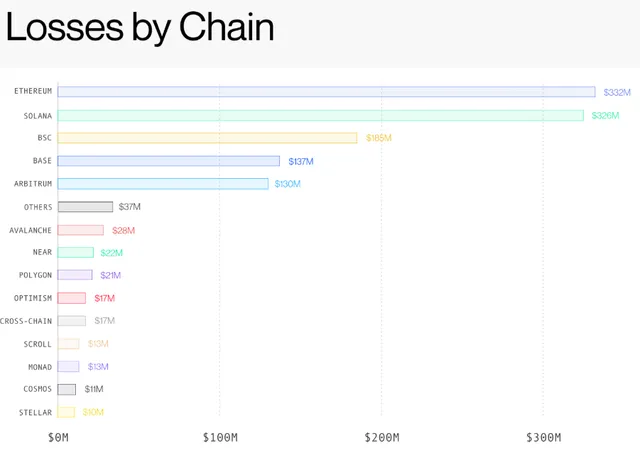
On July 28, 2026, the security platform specialized in onchain transaction analysis Blockaid publishes its security report for the first half of 2026. The facts are alarming: losses related to crypto hacks amount to 3.1 billion dollars, spread over more than 75 major attacks. The highest number of hacks ever recorded in such a short period! Ethereum accounts for more than half of the losses. Nevertheless, Solana also establishes itself among the most targeted crypto networks.

In brief
- 3.1 billion dollars were stolen during more than 75 crypto hacks in the first half of 2026.
- Ethereum accounts for 53% of the losses, ahead of Solana, the second most targeted blockchain.
- Private key thefts and phishing attacks now surpass smart contract exploits.
- Hackers increasingly target users, wallets, and crypto infrastructures.
- For the crypto industry, cybersecurity becomes a key issue for institutional adoption.
Ethereum remains the preferred target of crypto hackers
With approximately 1.63 billion dollars stolen by crypto hackers, Ethereum represents nearly 53% of hacks recorded in the first half. Blockaid’s report nonetheless highlights an important point: this observation does not necessarily mean that the architecture of this crypto blockchain is more vulnerable than that of its competitors.
Ethereum still concentrates the largest share of value locked in DeFi. It hosts thousands of decentralized applications. Most importantly, it serves as the reference infrastructure for many crypto financial protocols. This liquidity concentration naturally attracts cybercriminals, who favor targets offering the best potential returns.
This logic is comparable to that observed in the traditional financial system. The world’s largest banks regularly rank among the most attacked institutions, not because they are the least secure, but because they hold the largest assets.
Solana becomes an increasingly attractive target
The second most affected crypto blockchain, Solana totals approximately 373 million dollars in losses. This growth is largely explained by the rise of its ecosystem.
The explosion of memecoins, increased transaction volumes, and rapid DeFi development have significantly increased the crypto network’s activity. This attracts not only new users but also malicious actors seeking opportunities.
The increase in attacks on the Solana crypto network can therefore be interpreted as a maturity sign. Decryption: as an ecosystem gains economic importance, it becomes a more profitable target for hackers.
Smart contracts are no longer the main weak point
The Blockaid report provides valuable information on:
- the nature of crypto attacks;
- the evolution of the methods used.
For several years, the biggest losses mainly came from errors in smart contracts. Now, this trend is reversing. According to Blockaid, about 1.83 billion dollars were stolen after wallet compromises, private key thefts, phishing attacks, or critical infrastructure compromises.
This simply means that crypto hackers today favor strategies that are often simpler and more profitable:
- deceiving a user;
- compromising an administrator;
- gaining access to a private key
This shift is probably the main change in crypto cybersecurity since the rise of DeFi.
Cybersecurity now goes beyond the crypto blockchain
Interviewed by Cointelegraph, Blockaid CEO Ido Ben-Natan recalls that 2025 was already a heavy year with 2.58 billion dollars lost over 63 incidents. However, this sum was concentrated on a single major event in the first quarter: the hack of the crypto exchange Bybit amounting to 1.4 billion dollars. Ethereum and Arbitrum then ranked at the top of the most affected networks.
The attacks observed in 2026 show that crypto cybersecurity is now a global issue. Today’s cybercriminals seek to compromise wallets, multisig signatures, web interfaces, APIs, or even the accounts of technical teams.
This approach progressively brings crypto project security closer to that of large tech companies. Social engineering campaigns, targeted phishing, and credential compromises are growing in importance compared to purely technical exploits.
For developers as well as investors, protection no longer relies solely on the robustness of protocols. It also includes access management, infrastructure monitoring, and good operational practices.
A transformation happening at a strategic moment for the crypto industry
Figures published by Blockaid far exceed the scope of developers. With the arrival of ETFs, asset tokenization, and growing interest from banks and asset managers, trust in the crypto ecosystem now depends on its ability to protect capital.
Each major attack thus weakens this trust. More importantly, it reminds that security is one of the essential conditions for institutional adoption. Crypto platforms will need to invest more in real-time threat detection, enhanced authentication, and monitoring tools (including those based on artificial intelligence).
In any case, Blockaid’s report highlights a profound mutation: crypto attacks target code less and less and users, private keys, and infrastructures more and more. For an industry aiming to attract institutional investors, strengthening cybersecurity is no longer an option. It is an essential condition.
Maximize your Cointribune experience with our "Read to Earn" program! For every article you read, earn points and access exclusive rewards. Sign up now and start earning benefits.

My name is Ariela, and I am 31 years old. I have been working in the field of web writing for 7 years now. I only discovered trading and cryptocurrency a few years ago, but it is a universe that greatly interests me. The topics covered on the platform allow me to learn more. A singer in my spare time, I also cultivate a great passion for music and reading (and animals!)
The views, thoughts, and opinions expressed in this article belong solely to the author, and should not be taken as investment advice. Do your own research before taking any investment decisions.