Crypto: Solana's Capacity for Intricate Transactions is Tripled
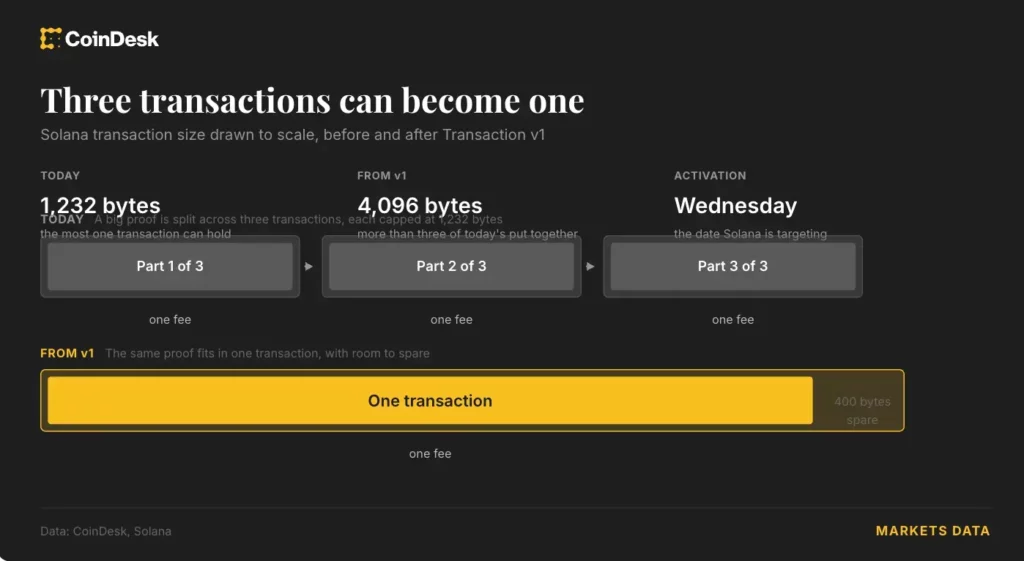
Solana strengthens its ceiling as Ethereum simplifies its entry point. Two updates published almost simultaneously, yet addressing different issues. The Solana blockchain targets Wednesday to triple the maximum transaction size, from 1,232 to 4,096 bytes, a technical evolution called Transaction v1. At the same time, a tweet confirms that Ethereum approved EIP-8141 for its upcoming major upgrade, Hegotá, planned for 2027 where crypto users will be able to pay their transaction fees directly in stablecoin. This, without holding any ETH. Two competing networks, two strategic projects, and a shifting balance of power on two distinct fronts.

In Brief
- Solana strengthens its technical ceiling to catch up with one of Ethereum’s historical strong points.
- Ethereum, on its side, prepares a radical simplification of the user experience on gas payment.
- The two networks are not catching up on the same delay: each fixes its own historical weakness, on a different timeline.
Solana Strengthens its Transaction Ceiling from 1,232 to 4,096 Bytes
The transaction ceiling change on Solana is defined by two proposals, SIMD-0296 and SIMD-0385, co-written by Jacob Creech and Andrew Fitzgerald. The new format is already running on Solana’s test and development networks, and existing formats will continue to work. Wallets and crypto applications therefore will not need to migrate to v1 unless they require this additional space.
The old limit of 1,232 bytes dated back to Solana’s original network design, where each crypto transaction had to fit in an internet data packet of about 1,280 bytes. A constraint the blockchain made largely obsolete by modifying its traffic transmission in 2022. The new limit stops at 4,096 bytes because four kilobytes correspond to the standard memory page size used by validators’ hardware. Going further would force a transaction to spread across multiple pages, increasing its processing cost.
The current challenge goes beyond a simple technical feat because Solana has always been faster and cheaper than Ethereum. But the blockchain lagged behind on one specific point which was its rigidly capped transactions, whereas Ethereum imposes no protocol size limit and allows developers to execute massive operations for higher fees. By tripling its ceiling, Solana thus closes a good part of that historical gap.
What the New Transaction Limit on Solana Unlocks
Here is what could now fit in a single transaction and with a single fee instead of several.
- Operations that had to be split into several transactions until now;
- Large crypto proofs;
- Payments requiring numerous approvals;
- Certain confidential transfers.
However, the change has a downside because all software that reads the blockchain (wallets, explorers, trading applications) must be updated to recognize the new v1 format. A non-updated service might see its requests fail against a transaction in the new format. Or worse, display a zero priority fee when a user has actually paid one, as this data is now stored elsewhere. Heavier crypto transactions also consume more network bandwidth, which could push users to offer higher priority fees during congestion.
SOL VS Ethereum: Two Delays Caught up, Two Opposite Schedules
Where Solana catches up on a raw technical handicap, Ethereum tackles a handicap of a completely different nature which is the obligation to hold ETH just to interact with its own network. An adoption barrier identified for years, but whose fix will only arrive with the Hegotá upgrade in 2027. Vitalik Buterin himself framed EIP-8141 as the culmination of ten years of work on account abstraction. A way of saying it is not a one-off fix but the continuation of a project underway since the crypto network’s inception.
The balance of power thus plays out on two different planes and not on the same tempo because Solana fixes a technical weakness immediately, which mechanically brings it closer to Ethereum in terms of complexity it can absorb. Ethereum, on its side, does not seek to compete on raw capacity. No, it aims to make its network more accessible to crypto users who never had to understand ETH, but it does so on a one-and-a-half-year horizon. Solana closes its gap and Ethereum creates a new simplicity aspect. Provided, of course, it meets its schedule.
Key Takeaways on Solana Tripling its Transaction Size
- Solana targets Wednesday to triple its transaction ceiling, from 1,232 to 4,096 bytes, via Transaction v1 (SIMD-0296 and SIMD-0385)
- Crypto wallets, explorers, and services reading Solana must update to avoid errors or incorrect fee data
- Ethereum confirmed EIP-8141 for its Hegotá upgrade (2027), allowing gas to be paid in stablecoin without holding ETH
Two networks, two projects, two schedules. Solana fixes its raw capacity starting this week, whereas Ethereum (ETH) targets accessibility, but not before 2027. On the balance of power between the two chains, tempo will make as much difference as the technical aspect itself.
Maximize your Cointribune experience with our "Read to Earn" program! For every article you read, earn points and access exclusive rewards. Sign up now and start earning benefits.

The world is evolving and adaptation is the best weapon to survive in this undulating universe. Originally a crypto community manager, I am interested in anything that is directly or indirectly related to blockchain and its derivatives. To share my experience and promote a field that I am passionate about, nothing is better than writing informative and relaxed articles.
The views, thoughts, and opinions expressed in this article belong solely to the author, and should not be taken as investment advice. Do your own research before taking any investment decisions.