Crypto : France Accuses Adoption Delay Compared to Several European Countries
Crypto has settled into the French landscape but without causing a clear shift. In 2026, the topic no longer frightens as much. It intrigues, it circulates, it joins conversations. Yet, when it comes time to buy, France is still moving forward in small steps.
In brief
- Crypto is progressing in France, but without a clear break.
- The country remains behind several European neighbors.
- The real turning point now goes through banks and stablecoins.
A crypto known by all, but still little held
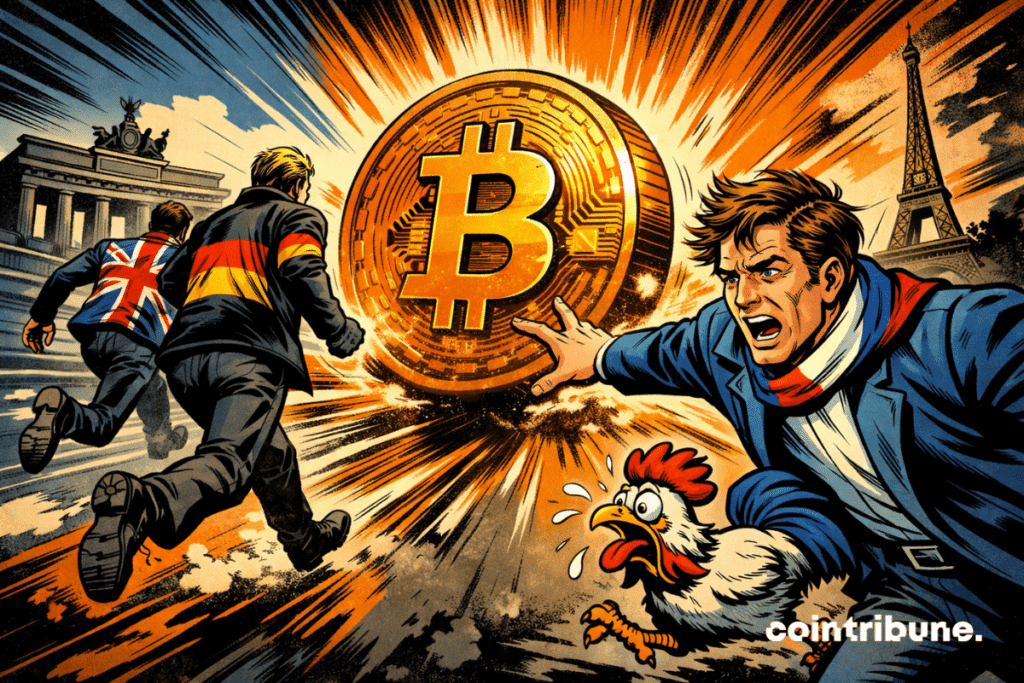
France remains behind its neighbors. This is the central point of this 2026 barometer. According to Adan, 93% of French people now know crypto-assets, but ownership stagnates around 11%. The contrast is obvious: crypto has won the battle of notoriety, not yet that of mass adoption.
This figure tells something very French. The market is no longer marginal, but it has not yet broken through the ceiling of caution. People look, understand better, sometimes consider entering. Then they stop at the edge. Crypto becomes familiar in minds, but not yet natural in wallets.
Adan speaks of a market that is gradually integrating into the classic financial landscape. It is probably the best way to sum up the sequence. Crypto no longer shocks. It no longer fascinates as before either. It enters a more adult phase, almost more ordinary. And it is precisely there that France reveals its delay.
The dropout is especially seen in the European comparison
The real signal is not read in the isolated 11% French. It appears when compared to others. Germany climbs to 17% owners and the Netherlands to 20%, according to Adan’s 2026 barometer. The detailed text on the study also adds a United Kingdom at 16%, Belgium at 15%, and Italy at 13%. In other words, France no longer closes the symbolic march. But it leads nothing either.
This gap is not anecdotal. It shows that in Europe, some markets have already passed a cultural milestone. Where France still treats crypto as a peripheral pocket, other countries integrate it faster into their savings, investment usage, and tomorrow, payment. The French delay no longer only has a regulatory dimension. It also becomes behavioral.
The paradox is that France has an old framework on the subject. The Pacte law paved the way as early as 2019, and MiCA now reinforces European readability. Yet, the field does not progress at the same pace as the regulatory arsenal. The structure exists. The popular momentum remains measured.
A supplementary asset class, not yet a driver
The 2026 barometer describes an investor more rational than ideological. Adan presents him as a savvy saver, who allocates on average 14% of his assets to crypto-assets, often in addition to traditional assets. The formula matters. It clearly says that crypto does not yet replace classic investments. It adds to them.
This changes the usual reading of the sector. It is no longer really a mass speculative rush. It looks more like a pocket of exposure, closely monitored, used with restraint. Crypto in France looks less like an absolute conviction than a prolonged test. People enter to diversify, not to overturn everything.
This more cautious tone also explains the slow pace of progress. The French market advances, but it filters. It sorts. It selects. It is not a country jumping headlong into a trend. It is a country opening the door, checking the weather, then deciding if it truly goes out. In crypto, this national habit can be seen very well.
The real turning point starts here
The most interesting change may not come from bitcoin. It comes from how crypto approaches familiar circuits. Adan highlights the growing use of known solutions, such as banks and cards, to access DeFi or to pay. La Tribune summarizes the movement more bluntly: nearly one in two French savers wants their bank to manage their cryptos.
This shift is decisive. For years, entering crypto went through platforms considered technical, sometimes opaque, often intimidating. In 2026, demand changes form. The French no longer just want assets. They seek reassuring rails. Crypto does not become more rebellious. It becomes more institutional.
Maximize your Cointribune experience with our "Read to Earn" program! For every article you read, earn points and access exclusive rewards. Sign up now and start earning benefits.

Enseignante et ingénieure IT, Lydie découvre le Bitcoin en 2022 et plonge dans l’univers des cryptomonnaies. Elle vulgarise des sujets complexes, décrypte les enjeux du Web3 et défend une vision d’un futur numérique ouvert, inclusif et décentralisé.
The views, thoughts, and opinions expressed in this article belong solely to the author, and should not be taken as investment advice. Do your own research before taking any investment decisions.