Crypto: The CLARITY Act Could Be Delayed for Several Years
While the world watches wars and bombs, the United States is tinkering with its digital economy. The Genius Act, dedicated to stablecoins, has already passed smoothly. But the CLARITY Act remains stuck in the Senate corridors. Worse, it could rot there for many years. This text, which should finally define what is a security and what is a commodity, is caught in a violent war of interests. Between traditional banks and crypto giants, no one wants to give in.
In Brief
- The CLARITY Act must pass the Senate committee before the end of April 2026 or it risks being buried.
- The main sticking point remains the banking amendment banning yield on stablecoins.
- Coinbase sees 20% of its revenue threatened by this provision defended by banks.
- Even an agreement on yield would not be enough: DeFi and SEC powers will pose problems afterward.
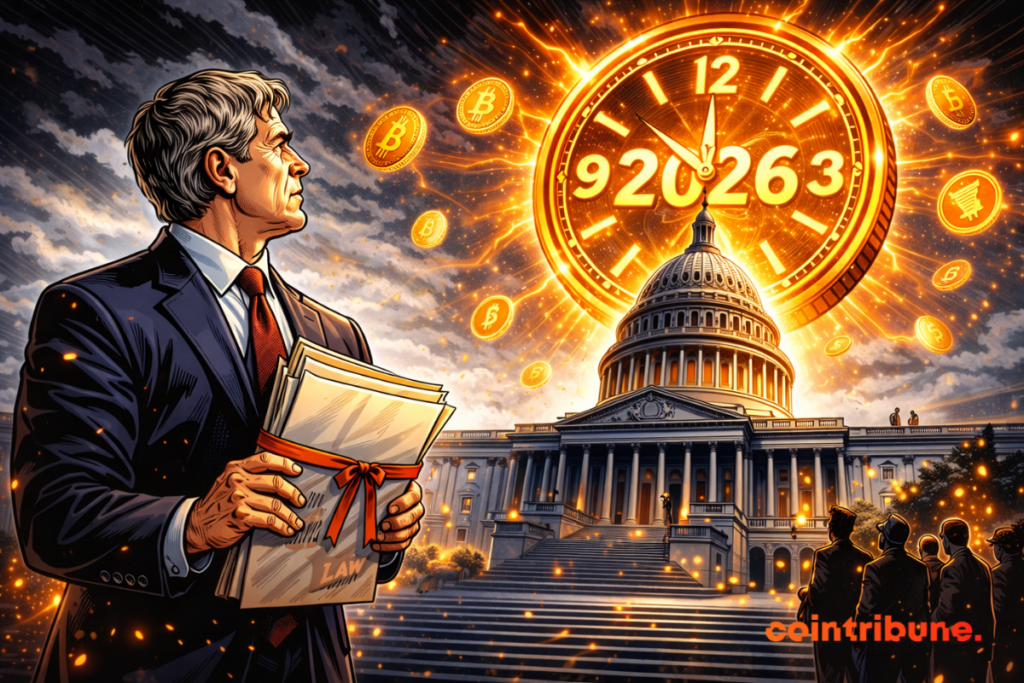
Seven Weeks to Save the CLARITY Act from a Long-Term Burial
The clock has been ticking since July 17, 2025. On that day, the CLARITY Act passed the House with 294 votes. A historic victory after years of intense lobbying. Since then, the Senate has been dragging its feet without clear explanation. Twice, it postponed the review without giving a specific date.
Today, Alex Thorn’s warning strikes like a well-sharpened guillotine:
If the CLARITY Act does not pass committee by the end of April, the chances of seeing it adopted in 2026 become extremely low. It must reach the Senate by early May. Time is running out and chances decrease every day.
Why does this deadline seem so crucial today? Because the Senate’s schedule is already completely clogged by the SAVE America Act, a priority electoral reform for the majority in power. And because behind that, the midterm elections are fast approaching.
In November, Republicans could lose a chamber of Congress. If that happens, the CLARITY Act can wait until 2027, 2029, maybe even longer. Seven weeks is all that remains to save seven years of uncertainty.
Yield War: When Banks Bury Crypto Regulation
The main obstacle has a barbaric name: stablecoin yield. Behind this word hides a fierce war of interests between two worlds that politely hate each other. Traditional banks are pushing an amendment that would prohibit crypto platforms from paying interest on stablecoins held by their clients.
Their argument seems irrefutable: an account that pays yield is functionally equivalent to a traditional savings account. Therefore, it should be subject to the same strict rules: guaranteed funds, mandatory reserves, constant supervision.
For Coinbase, these revenues represent nearly 20% of total revenue. Brian Armstrong cries legal hold-up pure and simple: a provision “designed to protect banks’ profits rather than consumers.”
President Donald Trump got involved on March 4:
The United States must finalize this market structure, ASAP.
Nothing works so far. Banks hold firm despite presidential pressure. And as long as this battle continues, the text remains stuck in the Senate limbo.
Yet, Alex Thorn already warns: even if the yield is resolved, other bombs patiently await their turn.
Clarity Act and Crypto: Behind the Yield, the Real Contentious Issues
Because the CLARITY Act is much more than a technocratic amendment on stablecoins. It is six legislative pillars that reshape the entire US regulation.
First, the classification of digital assets. Then, the division of powers between the SEC and CFTC. The legal protection of DeFi, this decentralized sector that gives regulators cold sweats. The new fundraising rules for blockchain projects. And even the outright ban of retail CBDCs, the digital currency that the Biden administration nevertheless wished for.
Each topic carries its share of tensions and impossible compromises. Alex Thorn lists the hidden dangers:
It is very possible that rewards are not the “final” obstacle, but simply the hill on which the bill is currently dying. Other obstacles will likely follow, which are being prepared behind the scenes but have not yet surfaced.
Meanwhile, Sandeep Nailwal, the head of Polygon, sums up the existential challenge: “Once institutions have this answer, they can fully commit on-chain.”
The countdown continues relentlessly.
What Blocks the CLARITY Act in Numbers
- 20% of Coinbase’s revenue comes from income related to threatened stablecoins;
- 294 votes in favor at the House in July 2025, but the Senate still has not voted;
- 7 weeks: the maximum window to save the text before the midterm elections;
- 2 Senate committees working on parallel versions, complicating any agreement;
- 72%: the chances of signing in 2026 according to prediction markets.
As for the Biden administration’s CBDC project, it is now officially buried. The US Senate has just included an outright ban on these digital currencies in a major housing reform. A shrewd way to kill the project without direct debate. Crypto breathes a little, but the CLARITY Act remains in intensive care.
Maximize your Cointribune experience with our "Read to Earn" program! For every article you read, earn points and access exclusive rewards. Sign up now and start earning benefits.

La révolution blockchain et crypto est en marche ! Et le jour où les impacts se feront ressentir sur l’économie la plus vulnérable de ce Monde, contre toute espérance, je dirai que j’y étais pour quelque chose
The views, thoughts, and opinions expressed in this article belong solely to the author, and should not be taken as investment advice. Do your own research before taking any investment decisions.