Elon Musk Predicts the End of Work and Money in 10 years
On July 23, 2026, The Economist publishes a 90-minute interview between its editor-in-chief Zanny Minton Beddoes and Elon Musk. The main topic: the future of AI. One of the first trillionaire in history’s answers made headlines worldwide in a few hours. Asked about Tesla and SpaceX’s future sources of revenue, Musk does not respond with a turnover figure or a market strategy. He states: “I will make another prediction. Money will no longer matter in 2036.”
In brief
- Elon Musk believes AI will surpass human intelligence in about five years.
- He predicts that work will become optional during the next decade.
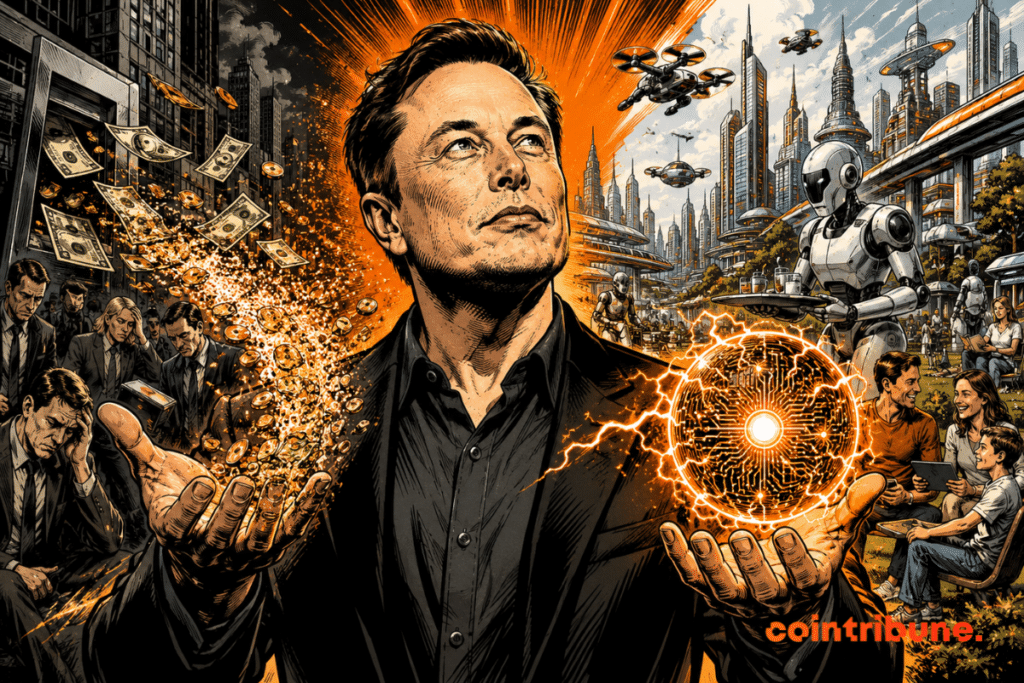
- According to him, money will also lose its importance by 2036.
- These announcements come as Tesla falls on the stock market and SpaceX declines after its historic IPO.
AI Could Make Work Optional According to Elon Musk
For Elon Musk, the next breakthrough will not only come from automation. He believes that artificial intelligence will surpass the sum of human intellectual capacities in about five years.
This development would open an economy where machines perform the majority of productive tasks. Work would then become optional rather than essential. Explanation: everyone could continue to engage in an activity out of personal interest rather than financial necessity.
The billionaire takes this reasoning even further. He considers that money will gradually lose its importance by 2036. The reason is that goods and services will become sufficiently abundant thanks to technological progress.
This projection thus rests entirely on a continuous acceleration of artificial intelligence’s performance. However, it does not provide any details on the economic functioning of such a society.
Another Key Element of Musk’s Speech: A Global Competition Around Artificial Intelligence
During the interview granted to The Economist, Elon Musk highlights the rapid progress made by China. According to him, the country is approaching the ability to produce its own advanced chips designed for AI. Enough to reduce its dependence on Western technologies.
He also praises the level reached by the Anthropic Fable model launched in June 2026. However, he believes the Chinese Kimi K3 model is also quickly closing the gap.
To limit risks, Musk proposes a novel mechanism: the main AI laboratories would share their new models with their competitors one to two weeks before their launch. Each player could thus signal potential risks to American and Chinese authorities before any public release.
These Statements Come in a Less Favorable Context for Elon Musk’s Companies
The same day as this interview, Tesla published mixed quarterly results. Its revenue reached a record $28.24 billion, a 26% increase! However, adjusted earnings per share stood at $0.33, versus $0.51 expected by analysts. The stock closed down 14.5%. This is its biggest drop in over a year.
SpaceX is also experiencing a turbulent period. Listed on the stock exchange in June 2026 during a historic operation, the company saw its valuation decline after reaching a peak of $2.6 trillion. Its thirteenth Starship test flight was also interrupted before takeoff after the failure of several Raptor engines.
During the interview, Elon Musk also admits spending too much time on politics during his stint at the head of the Department of Government Efficiency (DOGE). He says he got carried away but continues to defend several decisions made during that period.
What It Would Imply for Currency if the Scenario Were to Occur
Analysts anticipate three possible consequences if Elon Musk’s prediction were to come true:
- Lower prices on goods and services whose production can be massively automated. This includes electronics, textile industry, and certain digital services.
- Growing pressure on governments to finance massive income transfers. The fact is that salaried employment would lose its centrality as a mechanism for wealth distribution.
- A shift in scarcity towards energy since land would be available for data centers and robotic factories (and human attention).
In the same context, they raise a fundamental governance question: who decides the distribution of abundance if AI production remains concentrated among a few dominant private players?
Musk himself acknowledges this transition would be chaotic. According to him, it could even generate significant social tensions if jobs disappear faster than new roles appear to replace them.
In any case, Elon Musk’s statements extend a belief he has defended for several years: artificial intelligence will transform not only businesses but also the foundations of the global economy. Whether the 2036 deadline proves true or not, the debate it reignites goes far beyond the sole Tesla-SpaceX case. It joins questions already well known to crypto analysts, central banks, and state digital currencies.
Maximize your Cointribune experience with our "Read to Earn" program! For every article you read, earn points and access exclusive rewards. Sign up now and start earning benefits.

My name is Ariela, and I am 31 years old. I have been working in the field of web writing for 7 years now. I only discovered trading and cryptocurrency a few years ago, but it is a universe that greatly interests me. The topics covered on the platform allow me to learn more. A singer in my spare time, I also cultivate a great passion for music and reading (and animals!)
The views, thoughts, and opinions expressed in this article belong solely to the author, and should not be taken as investment advice. Do your own research before taking any investment decisions.