Ether Supply Reaches Decade Low as Staking Demand and Institutional Activity Tighten Market
Ether has entered a critical phase as exchange balances drop to their lowest level in nearly ten years. Supply continues moving into staking and long-term holding, leaving fewer tokens available for trading. Market structure is tightening as well, even as investor sentiment remains cautious. Recent network events and steady institutional demand are also adding to this overall market trend.

In brief
- Exchange balances fall to 8.7%, marking Ether’s tightest supply conditions since 2015 as staking and custody demand increase.
- Validator issues after the Fusaka upgrade stress network reliance, yet long-term ETH positioning holds firm.
- Price momentum signals show hidden buying strength, with OBV trends pointing toward possible upward movement.
- Whales accumulate during volatility as ETH stays near $3,000, keeping focus on tightening supply and rising institutional activity.
Ether Supply Shrinks Faster Than Bitcoin as Exchange Balances Drop
Centralized platforms now hold just 8.7% of circulating Ether, the lowest share since Ethereum went live in 2015. Balances stayed around that level over the weekend, according to Glassnode, suggesting a long-term decline in coins held on exchanges. With fewer tokens on hand, traders are watching for any signs of a supply squeeze.
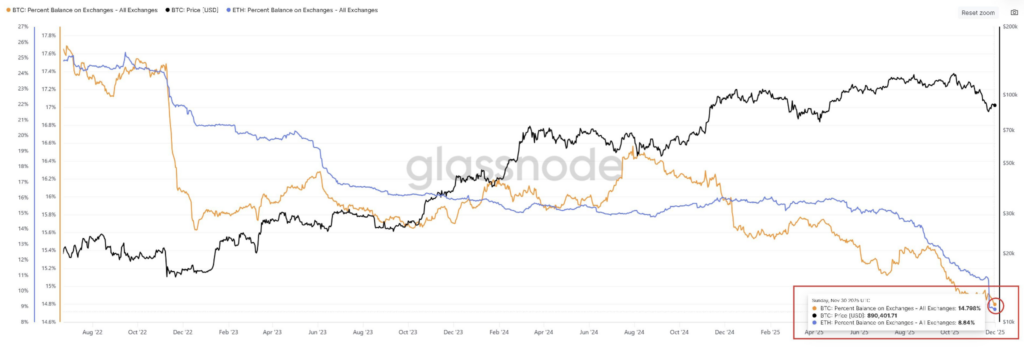
Ethereum keeps shifting into staking, restaking protocols, layer-2 networks, digital asset treasuries, and private wallets. Milk Road noted that these trends have pushed Ethereum into its tightest supply conditions to date. Bitcoin is moving at a slower pace, with about 14.7% of its supply still held on exchanges.
While supply trends lead the narrative, network stability briefly became a concern. A Prysm client bug cut validator participation by roughly 25% following the Fusaka upgrade. Ethereum nearly lost finality during the event, raising questions about dependence on a small group of consensus clients. Outflows from exchanges did not shift, suggesting long-term positions stayed intact.
Institutional Interest and On-Chain Trends Point to Building Strength
Ether outflows accelerated in early July, then fell 43% as DAT buying picked up, adding demand. Sentiment has softened, yet analysts still view supply trends as the stronger force. Milk Road said supply keeps tightening “while the market decides its next move.”
Several factors continue to influence current conditions:
- ETH is increasingly locked in staking contracts.
- Restaking participation is rising across major protocols.
- Layer-2 networks are expanding and require native ETH.
- Use of ETH as collateral in structured loops has grown.
- Long-term holders are shifting assets into private custody.
Price action signals also add another layer to the current outlook. Analyst Sykodelic pointed to an On-Balance Volume breakout last week that moved above resistance before cooling off, a pattern often linked to accumulation. Sykodelic said price action still looks constructive and could push higher before a deeper pullback.
Ether has mostly stayed above $3,000 in recent days, though resistance near $3,200 remains firm. Price trades around $3,050, with market activity still muted. Recent volatility cleared roughly $6.4 billion in leverage and added pressure. Even at that, large holders continued buying through the dip.
ETH’s strength against Bitcoin improved as the ETH/BTC pair broke above its downtrend line. With the recent upgrade and growing institutional interest, analysts see conditions forming for a potential new growth phase once sentiment lines up with tightening supply.
Maximize your Cointribune experience with our "Read to Earn" program! For every article you read, earn points and access exclusive rewards. Sign up now and start earning benefits.

James Godstime is a crypto journalist and market analyst with over three years of experience in crypto, Web3, and finance. He simplifies complex and technical ideas to engage readers. Outside of work, he enjoys football and tennis, which he follows passionately.
The views, thoughts, and opinions expressed in this article belong solely to the author, and should not be taken as investment advice. Do your own research before taking any investment decisions.