Ethereum: Why the Activity Peak Could Be Very Bad News
Ethereum seems to be speeding straight towards success. After its recent updates and the rise of its on-chain activity, the network has plenty to attract the crypto sphere. Lower fees, more transactions, and vitality worthy of its glory days. Yet, the path of progress is never without pitfalls. Behind the soaring curves and triumphant charts, a more insidious threat lurks, hidden within the very blocks of the blockchain.

In brief
- The Ethereum network exceeded 1.29 million active addresses after the Fusaka update.
- 67% of new addresses received less than one dollar in stablecoins, a sign of attacks.
- $740,000 was stolen by hackers exploiting the drop in transaction fees.
- Despite everything, Ethereum remains the market leader in RWA with over 60% share.
When Ethereum’s Success Hides an Illusion of Activity
On January 16, Ethereum made headlines amid an explosion of activity. More than 1.29 million active addresses were recorded on the main network, surpassing all Layer 2s like Arbitrum, Base, or Optimism. On X, Token Terminal celebrated: “layer 1 outperforms all major layer 2s in daily active addresses“.
A shared enthusiasm among the community:
Layer 2s are roads – Ethereum L1 is the place. When the essentials are at stake (settlement, security, finality, liquidity, trust), activity always returns to the main network. It is the gravitational well. Layer 2s extend Ethereum. Ethereum anchors the world.
The Book of Ethereum
But behind this fireworks of numbers hides another reality. According to researcher Andrey Sergeenkov, this record surge is “largely artificial“. He discovered that 67% of new addresses received less than one dollar in stablecoins in their first transaction. These are not real users but potential victims of “dust poisoning,” a sophisticated phishing technique.
Hackers send tiny amounts to wallets, creating fake histories. The distracted user, copying a familiar address, sends their funds… to the attacker. Result: over $740,000 stolen, including $509,000 from a single wallet.
Ethereum has broken records, yes — but sometimes, records ring hollow.
Fusaka, the Update That Opened Pandora’s Box
Behind this paradox lies irony: Fusaka, the update deployed in early December 2025, enabled these large-scale attacks. Its goal? To make Ethereum smoother and more accessible. Result: transaction fees were cut by six. A revolution, until it became an economic weapon for attackers.
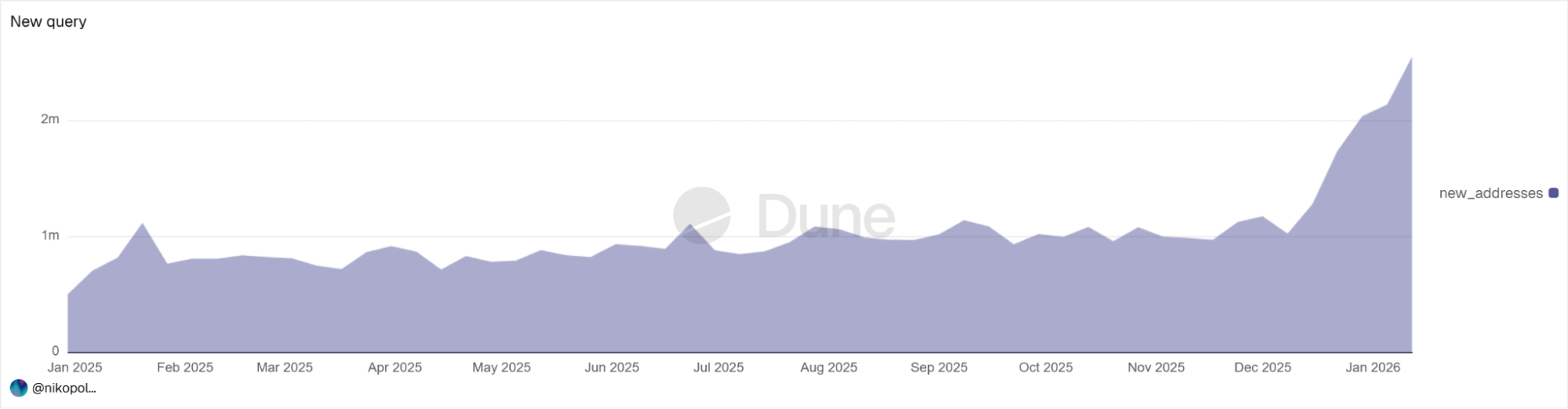
By making spam cheap, Ethereum inadvertently turned its technical success into a systemic flaw. Sergeenkov documented the mechanism: over 2.7 million new addresses in one week and 17 million weekly transactions, a 63% increase. But 80% of this activity would be generated by malicious contracts automating micro-transfers of stablecoins.
You cannot evolve an infrastructure without first addressing user security. What developers are currently doing is reckless experimentation, disguised as a revolution, where ordinary people bear all the risks.
Andrey Sergeenkov
Ethereum developers, in trying to democratize network access, inadvertently subsidized a spam economy. Fusaka enabled the rebirth of the mainnet… and its demons.
Ethereum Facing Its Paradox: Technical Power, Human Flaw
Numbers don’t tell everything. Ethereum’s activity is exploding, but trust is wavering. For crypto novices, rising activity rhymes with vitality. For researchers, it is a warning.
And yet, it’s not all bleak: despite this shockwave, Ethereum remains the dominant hub of Web3. According to ARK Invest, the blockchain controls 60 to 66% of the real-world asset tokenization market (RWA). Institutional treasuries acquired 1.2 million ETH in Q4 2025, a sign of intact confidence.
But the rift is symbolic. The fee drop accelerated adoption but also malice. The world’s most advanced blockchain faces an immutable enemy: human error.
As a researcher noted on The Defiant, developers traded caution for innovation. And that is the whole paradox of the crypto industry: wanting to build a world without intermediaries, yet each user remains the weakest link.
Key Takeaways from Ethereum’s Activity Peak
- 1.29 million active addresses recorded mid-January;
- 80% of this activity would be automated spam;
- $740,000 stolen via “dust poisoning” attacks;
- $2,958: ETH price at press time;
- Ethereum holds more than 60% of the RWA market.
Ethereum’s future is being written at a fast pace, but new dangers loom. According to Vitalik Buterin, an even more formidable threat is emerging: the quantum risk. If advances in quantum computing confirm, they might undermine the network’s cryptography before 2028. After the poison of spam, it might be time itself that will come to challenge Ethereum — the era of the quantum machine.
Maximize your Cointribune experience with our "Read to Earn" program! For every article you read, earn points and access exclusive rewards. Sign up now and start earning benefits.

La révolution blockchain et crypto est en marche ! Et le jour où les impacts se feront ressentir sur l’économie la plus vulnérable de ce Monde, contre toute espérance, je dirai que j’y étais pour quelque chose
The views, thoughts, and opinions expressed in this article belong solely to the author, and should not be taken as investment advice. Do your own research before taking any investment decisions.