Fed access debate puts stablecoins at center of payment shift
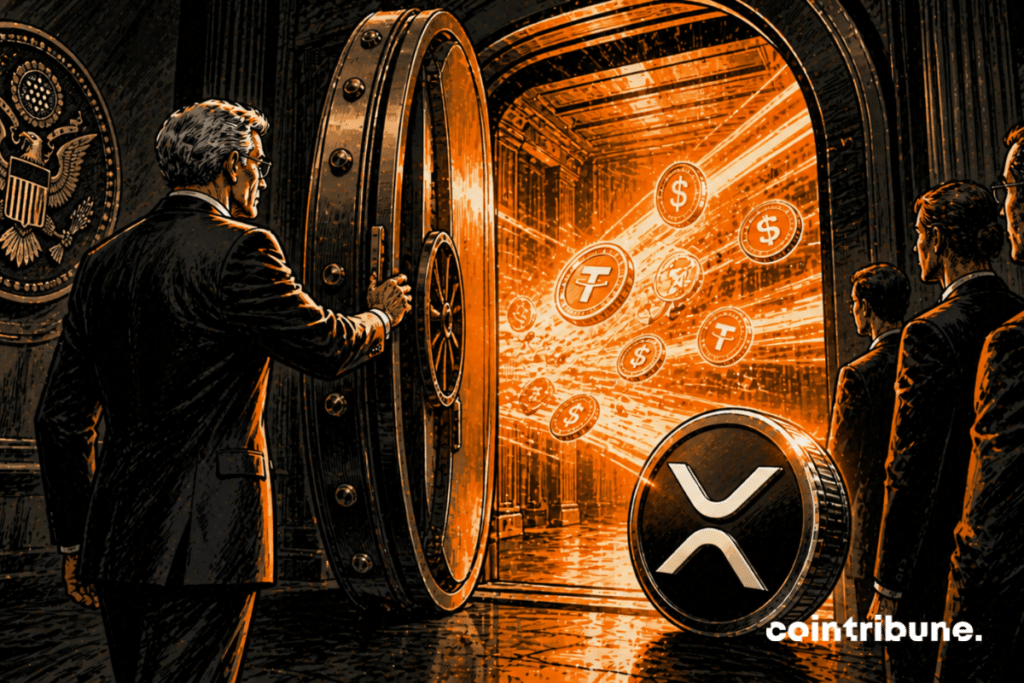
A seemingly minor technical reform could profoundly transform dollar payments. In the United States, the idea of granting certain stablecoin issuers access to the Federal Reserve is disrupting the established balance between banks and fintechs. In this context, XRP is making a comeback with an unexpected promise: becoming a key component in the circulation of monetary flows. Still hypothetical, this scenario fits into a broader restructuring of the U.S. financial infrastructure.
In brief
- A proposal in the United States aims to open access to Federal Reserve accounts to certain stablecoin issuers, challenging the exclusive role of banks in payment settlement.
- Authorities, including the Fed and the FDIC, are working on a structured regulatory framework to oversee these new players and their obligations.
- In this new model, stablecoins could access monetary infrastructure directly, reducing intermediaries and transaction frictions.
- XRP appears as a technical solution to ensure the movement of funds after settlement, complementing the existing system.
Towards direct access to the Fed for stablecoins
The debate was reignited by Asheesh Birla, CEO of Evernorth, who outlined on X a proposal to grant limited access to Federal Reserve accounts to certain stablecoin issuers.
He emphasized the importance of this tool by stating: “A master account at the Federal Reserve is the core of the payment system. It provides direct access to settling dollars at the source. Today, only banks have it. Every payment app must go through a bank to access it.”
This statement highlights a potential transformation at the very core of dollar payments.
Several regulatory elements support this dynamic:
• A Federal Reserve note dated March 30 explores the use of stablecoins to reduce frictions in cross-border payments;
• The described model relies on conversion into stablecoins, a simplified transfer, and then reconversion into local currency;
• The FDIC approved on April 7 a proposal regulating stablecoin issuers;
• This framework includes requirements on reserves, risk management, capital, and asset custody.
These developments are gradually shaping an architecture where stablecoins could gain more direct access to U.S. monetary infrastructure.
XRP considered as a means of payment circulation
In this scenario, XRP’s role is not at the settlement level, but downstream, in the movement of funds. Asheesh Birla clarifies this distinction by referring to the RLUSD stablecoin: “RLUSD is issued by Ripple’s New York-regulated trust company. This regulatory profile is close to what a restricted access to a Federal Reserve master account envisions.” He adds: “If the proposal moves forward and RLUSD qualifies, settlement will still occur through the Federal Reserve. But XRP would then become a rail for the movement of dollars within the U.S. payments infrastructure.”
This view positions XRP as a technical tool capable of streamlining financial flows once settlement has been completed via the Fed.
This positioning is accompanied by a broader financial strategy led by Evernorth. The company is developing a treasury model based on Ripple’s crypto and has already raised more than $1 billion. It is aiming for a Nasdaq listing through a merger with Armada Acquisition Corp. II, with the goal of offering regulated and transparent exposure to this asset. This approach reflects an intention to integrate XRP into traditional financial markets, alongside its potential use in payment infrastructures.
Such an evolution remains dependent on decisions by U.S. regulators. If this framework were to materialize, it could redefine the role of stablecoins and cryptocurrencies within the monetary architecture. XRP would not replace existing institutions but would integrate into their mechanisms, paving the way for a gradual hybridization between traditional finance and blockchain technologies.
Maximize your Cointribune experience with our "Read to Earn" program! For every article you read, earn points and access exclusive rewards. Sign up now and start earning benefits.

Diplômé de Sciences Po Toulouse et titulaire d'une certification consultant blockchain délivrée par Alyra, j'ai rejoint l'aventure Cointribune en 2019. Convaincu du potentiel de la blockchain pour transformer de nombreux secteurs de l'économie, j'ai pris l'engagement de sensibiliser et d'informer le grand public sur cet écosystème en constante évolution. Mon objectif est de permettre à chacun de mieux comprendre la blockchain et de saisir les opportunités qu'elle offre. Je m'efforce chaque jour de fournir une analyse objective de l'actualité, de décrypter les tendances du marché, de relayer les dernières innovations technologiques et de mettre en perspective les enjeux économiques et sociétaux de cette révolution en marche.
The views, thoughts, and opinions expressed in this article belong solely to the author, and should not be taken as investment advice. Do your own research before taking any investment decisions.