GENIUS Act, CLARITY Act, prediction markets: Will crypto gains survive the midterms?
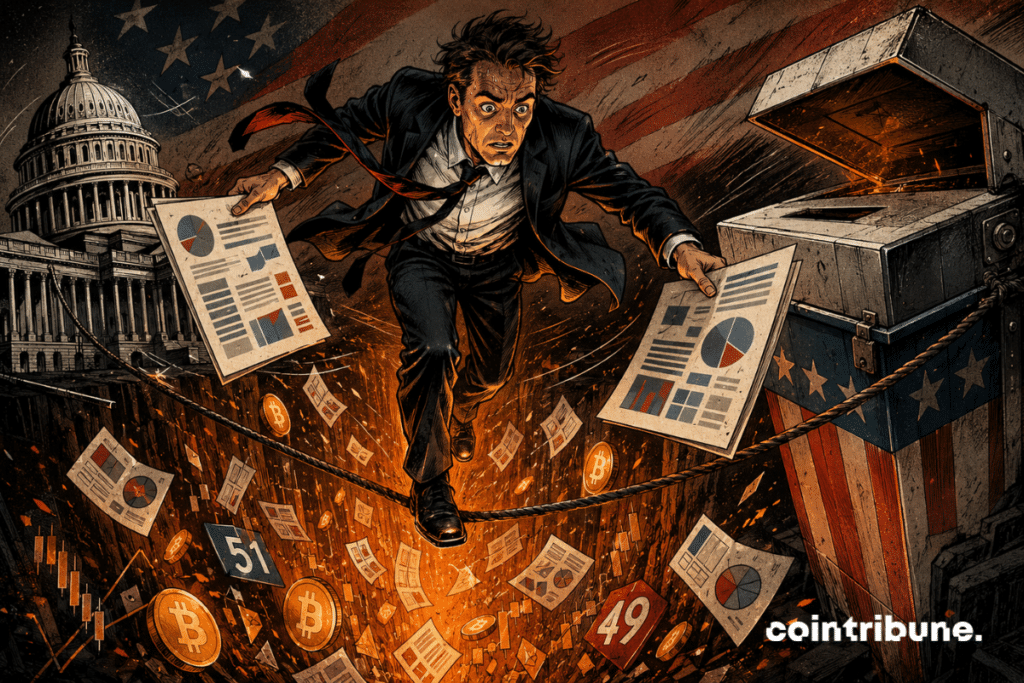
American crypto is entering a fragile zone. After the GENIUS Act, the advances of the CLARITY Act, and the regulated rise of prediction markets, the 2026 midterms could decide whether this sequence becomes a true regulatory turning point or just a political parenthesis.
In brief
- American crypto has gained ground, but the midterms can reshuffle the cards.
- The GENIUS Act is secured, while the CLARITY Act remains politically vulnerable.
- Prediction markets reinforce the urgency of a clear framework, but complicate the sector’s image.
Crypto has won Washington, but not yet longevity
Crypto secured its first real legislative gains in the United States, but these gains remain exposed to the electoral calendar. As also shown by the political deadline weighing on the CLARITY Act, the sector is moving fast but within a narrow window. This is the core warning issued by Jesse Spiro, head of government affairs at Tether, during Consensus Miami 2026.
According to him, the midterms will be a key test to see if the recent political support will survive the next balance of power in Congress. Crypto is thus no longer just a market matter. It becomes an electoral issue.
The GENIUS Act marked a break. Signed in July 2025, it provided a federal framework for dollar-backed stablecoins. For the crypto industry, this text served as an institutional passport.
The CLARITY Act becomes the real battlefield
The CLARITY Act is now the most sensitive piece. The White House aims for adoption by Congress around July 4, 2026, with a Senate banking committee vote expected in May, followed by a very short window in June. This text must clarify the structure of the American crypto market. In short, it must better define which assets fall under the SEC, which under the CFTC, and how platforms must register.
The most concrete blockage concerns returns on stablecoins. A compromise seems to have emerged: ban returns comparable to bank interest, but preserve certain usage-reward programs. Banks still find this too permissive. Crypto players see it as a vital minimum. Prediction markets add a trickier layer. They fascinate investors because they turn real events into priced probabilities. But they also blur the lines between information, speculation, and betting.
The SEC recently delayed the launch of more than two dozen ETFs linked to real events, including elections, recessions, or tech layoffs. This brake shows that Washington does not want to open all doors at once. This caution can become a political problem for crypto. Stablecoins seem easy to defend as a payment tool. Tokenization is marketed as market modernization. Prediction markets, however, awaken a more explosive imagination.
The midterms can slow everything down
The real threat is thus not only regulatory. It is electoral. If Congress flips or becomes more fragmented, crypto texts can get stuck in committees. Priorities change quickly after midterms.
The industry knows this. It is investing massively in the political battle. But this strategy has a downside. The more crypto becomes visible in elections, the more it becomes attackable.
In the end, crypto gains will only survive the midterms if they stop appearing as a handout to the industry. They will have to be sold as a useful architecture: better supervised stablecoins, more transparent markets, innovation repatriated to the United States. Without this narrative, the current wave could fall quickly. With it, 2026 could become the year when American crypto regulation finally finds its balance point.
Maximize your Cointribune experience with our "Read to Earn" program! For every article you read, earn points and access exclusive rewards. Sign up now and start earning benefits.

Enseignante et ingénieure IT, Lydie découvre le Bitcoin en 2022 et plonge dans l’univers des cryptomonnaies. Elle vulgarise des sujets complexes, décrypte les enjeux du Web3 et défend une vision d’un futur numérique ouvert, inclusif et décentralisé.
The views, thoughts, and opinions expressed in this article belong solely to the author, and should not be taken as investment advice. Do your own research before taking any investment decisions.