In Iran, cryptocurrency withdrawals soar 700% after US and Israeli strikes
As geopolitical tension intensifies in the Middle East, the Iranian digital economy is experiencing an unprecedented upheaval. Following the US and Israeli strikes aimed at Tehran, cryptocurrency withdrawals in Iran have recorded a spectacular surge of 700% on the largest Iranian exchange platform.
In brief
- Cryptocurrency withdrawals in Iran climbed 700% after the strikes on Tehran, reaching up to 3 million dollars transferred within an hour on Nobitex.
- Analyses from Elliptic and TRM Labs reveal a mix of panic, transfers abroad, and simple internal security movements.
- Internet outages severely disrupted exchanges, compressing liquidity and further weakening the Iranian crypto market.
Cryptocurrency withdrawals in Iran accelerate after the strikes
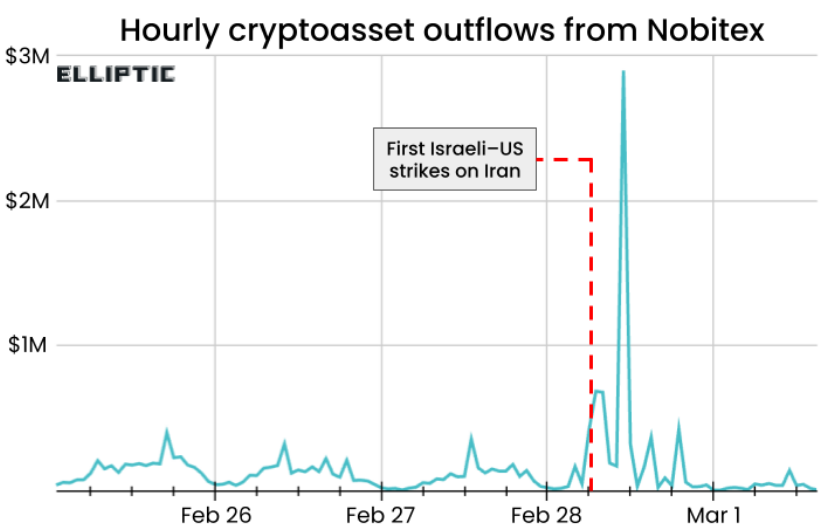
Last Saturday, US and Israeli strikes hit the capital, Tehran. Immediately, the cryptocurrency market reacted very strongly. Investors in Iran sought to protect their savings. Nobitex users reacted. The blockchain analysis company Elliptic studied these financial movements. Thus, outflows skyrocketed by a spectacular 700%. This considerable figure represents 500,000 dollars transferred very quickly.
Then, the total volume reached 3 million dollars in one hour. Users sent these amounts to foreign exchanges. Consequently, Elliptic experts suspect a real capital flight. The uncertain geopolitical context undoubtedly urges citizens to act quickly. Moreover, cryptocurrency avoids control by the global banking system. Transactions thus escape the oversight of traditional financial institutions.
Crypto exchanges and restrictions: the impact of network outages
According to an analysis by TRM Labs, this massive flight encountered a major technical obstacle. Local authorities likely disrupted web access by about 99% following restrictive measures implemented by the regime at the start of the conflict. This widespread outage, according to the company, blocked many money transfers. The market showed three distinct trends.
First, analysts observed a simultaneous decrease in cryptocurrency inflows and outflows. Then, they notice a clear fragmentation in the size of each transfer. Finally, the order book depth decreased upon reopening.
These elements reveal a very clear compression of overall liquidity. Investors split operations to avoid a banking panic. Moreover, the lack of a stable connection greatly limits local crypto exchanges. Digital stability remains essential to keep these platforms operational.
Internal liquidity movements: a credible alternative hypothesis
However, TRM Labs data adds a very important nuance. Analysts scrutinized transactions made around February 28. They identified an internal movement of about 3 million dollars. These digital assets circulated on the famous Polygon blockchain. Nobitex transferred these funds from a hot wallet to a cold wallet.
Moreover, TRM spotted another transfer of 35 million dollars in cryptocurrencies. This massive transaction also connected two internal wallets in Iran. Thus, the analysis firm greatly tempers the capital flight hypothesis. They consider these transfers as normal and security management. Nobitex remains the main hub of the Iranian crypto ecosystem. The exchange has handled about 5 billion dollars since 2025 according to the same report. Therefore, these volume variations are not necessarily anomalies.
Cold storage to secure cryptocurrencies
The exchange platform anticipates risks linked to the conflict. Nobitex leaders actively secure their clients’ holdings. They use offline wallets to better protect the funds. Cold storage protects cryptocurrencies against possible hacks. Thus, a substantial part of the activity reflects technical precaution. This security method remains an industry standard in cryptocurrencies.
In summary, recent military operations provoke an immediate financial reaction. Iran is going through a particularly strong period of economic uncertainty currently. In the short term, citizens will surely look for decentralized safe-havens. Crypto withdrawals will serve as a barometer to measure geopolitical tension. Local exchanges will need to adapt their infrastructure to face various challenges. Internet outages will always hinder the full freedom of transactions. The Iranian digital asset sector will experience persistent volatility soon. Experts will closely monitor the overall evolution of surrounding regional markets.
Maximize your Cointribune experience with our "Read to Earn" program! For every article you read, earn points and access exclusive rewards. Sign up now and start earning benefits.

Journaliste et rédacteur web passionné par l’univers des cryptomonnaies et des technologies Web3. J’y traite les dernières tendances et actualités afin de proposer un contenu de haute qualité à un large public du secteur.
The views, thoughts, and opinions expressed in this article belong solely to the author, and should not be taken as investment advice. Do your own research before taking any investment decisions.