Iran closes Hormuz, 20% of global oil immediately threatened
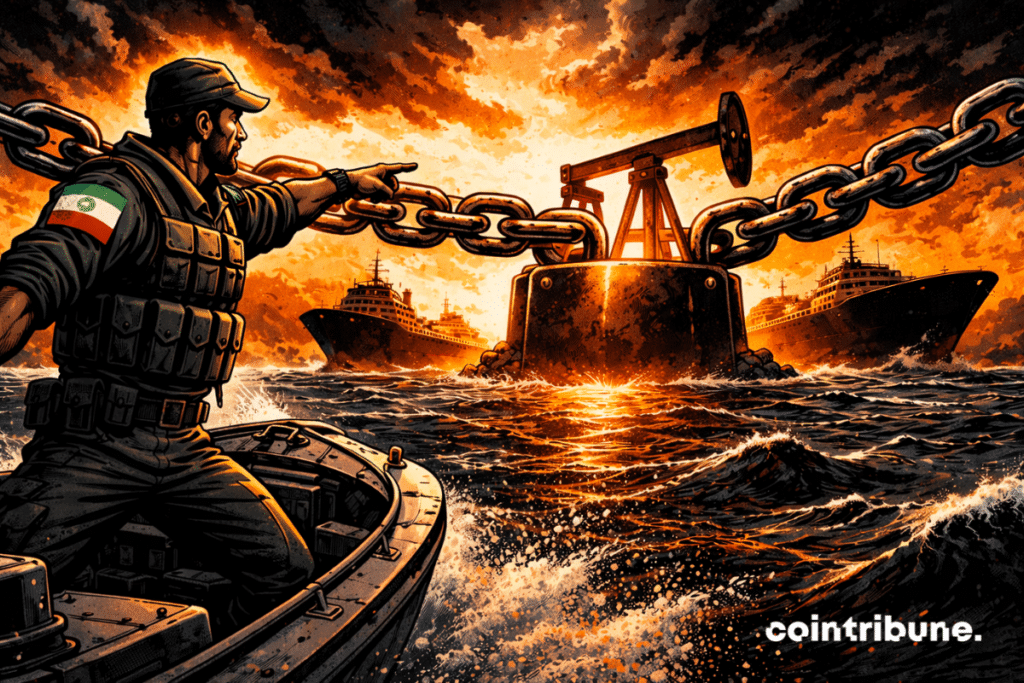
This Saturday, February 28, 2026 marks a major turning point in the escalation in the Middle East. After US-Israeli airstrikes against the Iranian regime and its military capabilities, Tehran retaliated by effectively blocking the Strait of Hormuz. On VHF maritime waves, the Guardians of the Revolution broadcast a clear message: “No ship is allowed to pass.” The major oil companies are already suspending their shipments. Will the Brent barrel cross the symbolic threshold of 100 dollars?
In brief
- Iran warns by radio that passage through the Strait of Hormuz is prohibited.
- 20 to 21 million barrels of oil transit every day through this bottleneck, or 20% of global consumption.
- Oil companies suspend their shipments as a safety measure.
- Markets anticipate a surge in Brent prices as soon as Monday’s opening.
Iran closes the Strait of Hormuz
Saturday morning, the United States and Israel launch the “Epic Fury” operation. Strikes target Tehran, Isfahan, and several strategic facilities. From Florida, Donald Trump calls on the Iranian people to “take back power”.
The timing choice was no accident: by striking on a Saturday, Washington avoids an immediate reaction from Wall Street. Markets are closed. The shock is contained, at least temporarily.
The Iranian response was swift. Missiles target Israel and American bases in Bahrain, Qatar, and the United Arab Emirates. However, the strongest signal comes from the sea.
On VHF channel 16, the Iranian authorities announce the prohibition of passage through the Strait of Hormuz. The British maritime agency UKMTO and the European naval mission confirm the alerts.
No official decree has yet been published. Yet, the effect is immediate. Tankers slow down, some remain at the dock. Several trading houses and oil companies halt their operations as a safety measure. This maritime corridor only 33 kilometers at its narrowest point becomes an area of extreme tension.
Iran has already threatened to close Hormuz in the past. During the Iran-Iraq war in the 1980s, attacks on tankers had driven crude prices up by more than 50%. In 2019, sabotage already strained the markets. But never had the threat been so direct in a context of direct confrontation with Washington.
Oil at the center of the economic storm
Why does this strait matter so much? It concentrates exports from Saudi Arabia, Iraq, the Emirates, and Kuwait. Without it, more than 20% of the world’s oil remains stuck. The only available bypass pipelines, Saudi and Emirati, cap at 2.6 million barrels per day. A ridiculously insufficient capacity compared to the 20 million that normally flow through the strait.
Friday evening, Brent had already closed at 72.87 dollars, up nearly 3% for the day and 8% for the month, driven by initial fears of attack. On Monday, traders expect an upward gap of 5 to 10 dollars at minimum.
The darkest scenarios, mentioned by Barclays and Rystad Energy, talk about 100 dollars if the chaos lasts several days, some experts even mentioning 150 dollars in case of prolonged escalation.
For the United States, the impact will be direct and painful. Gas pump prices could rise 20 to 30 cents per gallon within weeks. Inflation, already noticeable, would rise again, placing the Fed in an impossible position: fight price increases or support an economy weakened by the shock.
Conversely, energy giants like Exxon or Chevron could record record profits… but at what cost?
In sum, this Saturday, February 28, 2026 will remain a pivotal date. Trump triggered a war by carefully choosing his weekend, but on Monday morning, markets will open and present the bill. The real test will not be played in the Gulf sky, but on Wall Street screens and at the pump of millions of Americans.
Maximize your Cointribune experience with our "Read to Earn" program! For every article you read, earn points and access exclusive rewards. Sign up now and start earning benefits.

Passionné par le Bitcoin, j'aime explorer les méandres de la blockchain et des cryptos et je partage mes découvertes avec la communauté. Mon rêve est de vivre dans un monde où la vie privée et la liberté financière sont garanties pour tous, et je crois fermement que Bitcoin est l'outil qui peut rendre cela possible.
The views, thoughts, and opinions expressed in this article belong solely to the author, and should not be taken as investment advice. Do your own research before taking any investment decisions.