Iran Explores Bitcoin For Oil Payments
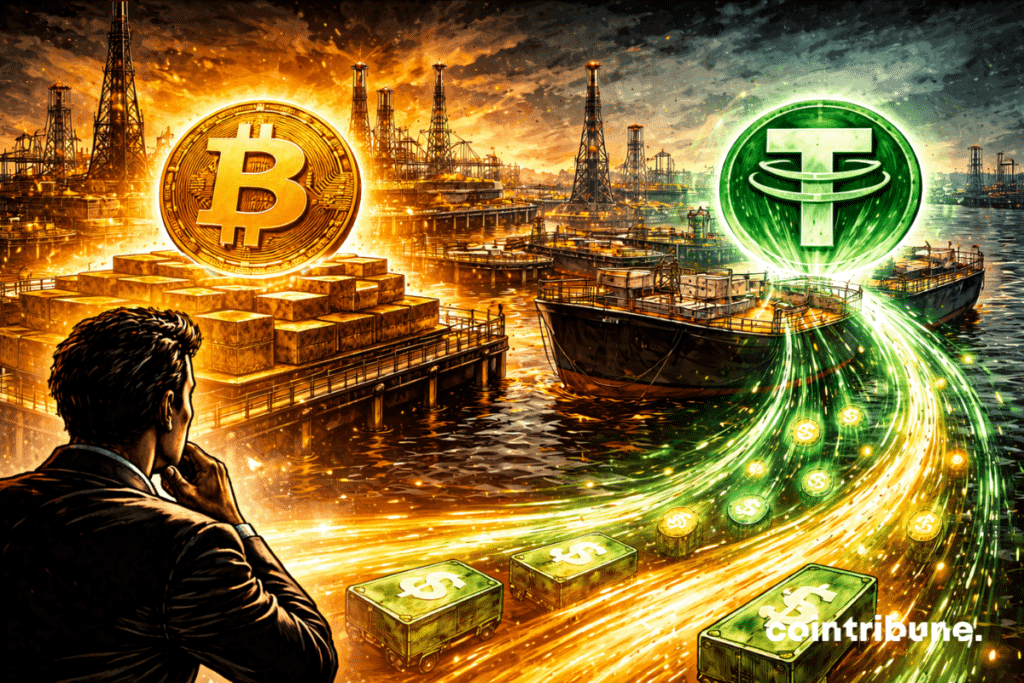
Iran introduces bitcoin into its oil-related mechanisms. Under the effect of international sanctions, the country explores this asset as a strategic lever for its energy transactions. This direction marks a significant evolution, even if, in fact, flows still largely rely on other digital instruments, notably stablecoins. Between political display and operational constraints, a hybrid strategy is emerging.
In brief
- Iran integrates Bitcoin as a strategic asset for its oil-related transactions.
- This decision is part of a desire to circumvent international sanctions and strengthen its financial sovereignty.
- Despite this adoption, no oil transaction in Bitcoin has been observed on the blockchain.
- In practice, payments mainly rely on stablecoins, especially USDT, as well as the Chinese yuan.
Bitcoin, a strategic tool against sanctions
Iran takes a step forward by integrating bitcoin (BTC) into its payment mechanisms related to oil tolls, notably in the Strait of Hormuz. This decision fits within a logic of bypassing international financial sanctions, with a clear vision carried by sector actors :
- Bitcoin is considered a strategic asset in Iranian policy ;
- It is seen as a tool resistant to financial censorship ;
- It is part of a crypto strategy initiated since 2018 ;
- It aims to reduce dependence on traditional financial systems.
Sam Lyman, director of public policy at the Bitcoin Policy Institute, summarizes this approach bluntly: “no one can freeze bitcoin. No one can stop the Bitcoin network”. This statement illustrates BTC’s core promise in this context: offering an alternative to banking infrastructures exposed to geopolitical pressures.
Such an orientation fits within a global financial sovereignty strategy. Iran seeks to secure its critical flows by relying on decentralized technologies, capable of escaping traditional control mechanisms. Thus, bitcoin becomes a political lever as much as a technological tool.
USDT, a discreet pillar of Iranian oil flows
Despite this official recognition of bitcoin, on-chain data shows a very different reality on the ground. No transaction related to these oil payments has been identified in BTC.
In practice, flows mostly go through more stable alternatives, notably dollar-pegged stablecoins such as USDT, as well as the Chinese yuan. This dominance is explained by operational considerations: price stability, immediate liquidity, and acceptance in international trade.
The volumes involved confirm this trend. Since 2022, about 3 billion dollars are said to have transited via crypto channels related to Iran, of which only 600 million were frozen by US authorities. The rest, nearly 2.4 billion dollars, escaped restrictions. Despite the inherent risks of stablecoins, some players appear willing to take this bet. As Lyman points out: “they’re all in”.
As these mechanisms develop, a hybrid dynamic emerges. Bitcoin embodies a strategic long-term vision, based on resistance to censorship, while stablecoins dominate concrete short-term uses. This duality could foreshadow an evolution of international trade, where different cryptos coexist according to their respective advantages. It remains to be seen whether bitcoin will surpass its symbolic role to establish itself as a true payment infrastructure in global energy exchanges.
Maximize your Cointribune experience with our "Read to Earn" program! For every article you read, earn points and access exclusive rewards. Sign up now and start earning benefits.

Diplômé de Sciences Po Toulouse et titulaire d'une certification consultant blockchain délivrée par Alyra, j'ai rejoint l'aventure Cointribune en 2019. Convaincu du potentiel de la blockchain pour transformer de nombreux secteurs de l'économie, j'ai pris l'engagement de sensibiliser et d'informer le grand public sur cet écosystème en constante évolution. Mon objectif est de permettre à chacun de mieux comprendre la blockchain et de saisir les opportunités qu'elle offre. Je m'efforce chaque jour de fournir une analyse objective de l'actualité, de décrypter les tendances du marché, de relayer les dernières innovations technologiques et de mettre en perspective les enjeux économiques et sociétaux de cette révolution en marche.
The views, thoughts, and opinions expressed in this article belong solely to the author, and should not be taken as investment advice. Do your own research before taking any investment decisions.