New Research Raises Concerns Over Polymarket Bitcoin Contracts
Decentralized prediction markets are experiencing a meteoric rise, to the point of becoming true barometers of market expectations. However, this growth hides a major flaw. A university study reveals that sophisticated actors manage to manipulate certain very short-term contracts to influence the price of the leading crypto. These findings highlight the limits of a booming sector, even as prediction platforms attract the attention of regulators and establish themselves as a new battleground between financial innovation and state oversight.
In Brief
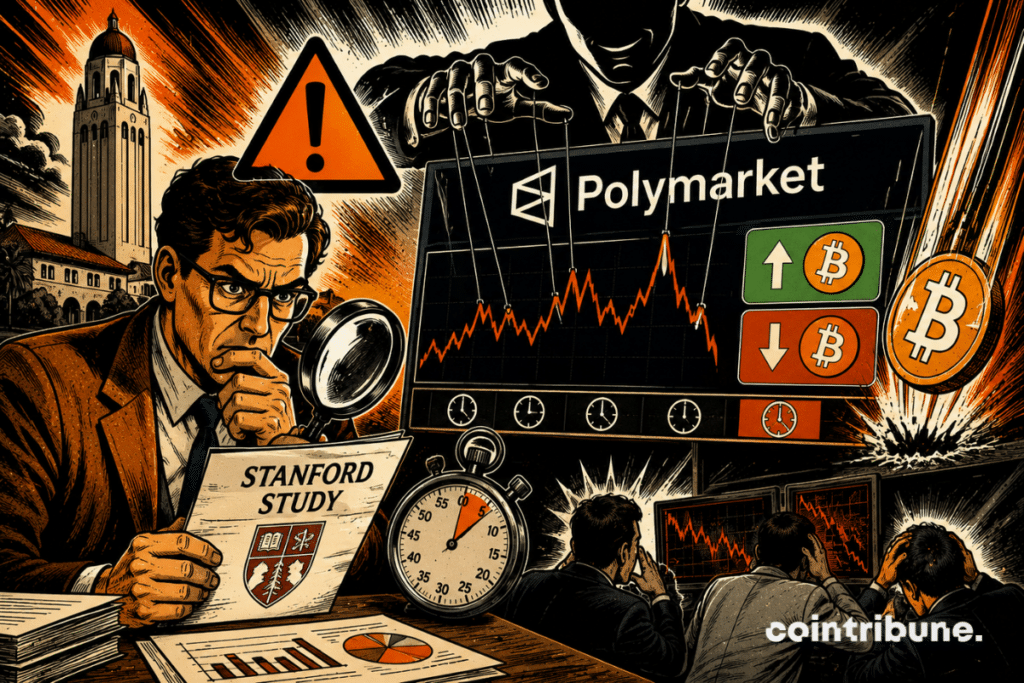
- Stanford University demonstrates that 5-minute Bitcoin prediction markets on Polymarket encourage spot price manipulation.
- Sophisticated traders manipulated physical order books just before contract settlement, to the detriment of retail investors.
- The manipulation targets the exact second of contract settlement, whose reference price is provided by Chainlink.
- Extending contract durations to 15 minutes or using price averages (TWAP) almost entirely eliminates this risk.
A University Study Reveals Systematic Misappropriation of Short-Term Contracts on Polymarket
A joint study conducted by researchers from Stanford University and Singapore Management University (SMU) has just revealed that Polymarket predictions related to bitcoin over a five-minute horizon create perverse financial incentives.
Launched in July 2024, these financial instruments allow users to bet whether the bitcoin price will be above or below a predetermined threshold at the end of a five-minute window, a mechanism presenting major risks :
- An incentive to manipulate : according to the findings of this academic paper, these contracts “create incentives for traders to manipulate spot prices at settlement, allowing sophisticated participants to profit at the expense of retail traders” ;
- A flaw linked to oracle instantaneity : the settlement of these contracts relies on Chainlink price streams accurate to the second of expiration; researchers observed a statistical anomaly characterized by a sharp rise in order flow on the bitcoin spot market immediately before closure, followed by a rapid and systematic price reversal after settlement ;
- A quantified financial harm : the analysis reveals that this opportunistic behavior resulted in a net wealth transfer estimated at about “1.28 million dollars from ordinary traders to manipulators” during the studied sampling period.
By acting directly on the physical exchange platform order books to artificially shift the spot price by a few fractions of a percent during the final contract seconds, manipulators ensure they win their bets on Polymarket.
On this platform, volumes and implicit leverage offer gains far exceeding spot manipulation costs. This factual observation indicates a clear asymmetry of information and financial power detrimental to retail traders.
Toward a Necessary Redesign of Prediction Contract Structures
To address this problem without condemning the prediction market model itself, researchers from Stanford and SMU recommend precise technical adjustments when designing smart contracts. They emphasize that their results “do not indicate that prediction markets are inherently vulnerable to manipulation”, but rather that “the settlement structure can reduce this risk”.
The study notably shows that simply extending the contract validity from “five minutes to fifteen minutes” largely eliminates the manipulation effect. Additionally, adopting alternative pricing methods, such as time-weighted average prices (TWAP) instead of an instantaneous price at the exact expiration moment, would render spot manipulation costly and statistically unprofitable.
This transition to more robust settlement architectures now appears essential to preserve retail investors’ trust against increasingly aggressive high-frequency trading algorithms.
In the absence of structural reforms by protocol designers, the economic viability of these very short-term stock option markets could be compromised by the withdrawal of individual investors tired of fueling the profits of algorithmic traders. Implementing strong technical barriers is the only way to guarantee fair transactions on these decentralized markets, particularly Polymarket.
Explosive Growth Under the Watchful Eye of Regulators
This necessary technical evolution takes place in a context of unprecedented commercial activity, which inevitably attracts the attention of federal oversight authorities. Driven by massive enthusiasm around the FIFA World Cup 2026, trading volumes reached historic highs in June, with the regulated platform Kalshi processing approximately “9.4 billion dollars” in volume that month, compared to “4.3 billion dollars” for Polymarket International.
This volume explosion is accompanied by increasing judicial and regulatory scrutiny in the United States, where several states question the legality of these platforms, while the Commodity Futures Trading Commission (CFTC) claims its “exclusive jurisdiction” over these event contracts against state gambling laws.
These university revelations could well act as a catalyst in ongoing legal battles, which threaten to escalate to the United States Supreme Court. Providing empirical proof of small investors’ vulnerability to market manipulation, the study offers weighty arguments for regulators keen to tighten investor protection rules.
In the future, the legitimacy of prediction markets will depend directly on their ability to integrate more robust settlement mechanisms and pricing models, thus ensuring speculation relies on genuine collective forecasts rather than the capacity of a few insiders to temporarily distort the reality of physical prices.
Maximize your Cointribune experience with our "Read to Earn" program! For every article you read, earn points and access exclusive rewards. Sign up now and start earning benefits.

Diplômé de Sciences Po Toulouse et titulaire d'une certification consultant blockchain délivrée par Alyra, j'ai rejoint l'aventure Cointribune en 2019. Convaincu du potentiel de la blockchain pour transformer de nombreux secteurs de l'économie, j'ai pris l'engagement de sensibiliser et d'informer le grand public sur cet écosystème en constante évolution. Mon objectif est de permettre à chacun de mieux comprendre la blockchain et de saisir les opportunités qu'elle offre. Je m'efforce chaque jour de fournir une analyse objective de l'actualité, de décrypter les tendances du marché, de relayer les dernières innovations technologiques et de mettre en perspective les enjeux économiques et sociétaux de cette révolution en marche.
The views, thoughts, and opinions expressed in this article belong solely to the author, and should not be taken as investment advice. Do your own research before taking any investment decisions.