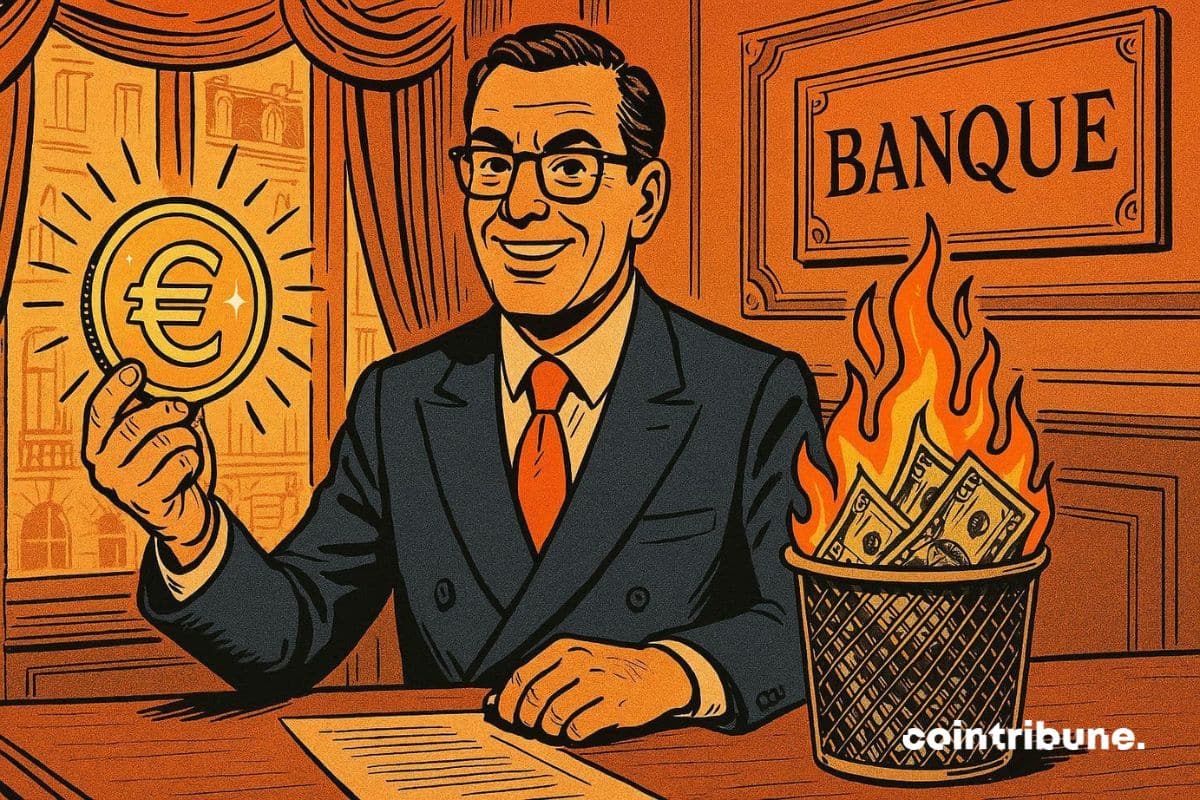
JPMorgan and Citigroup are stepping into the stablecoin space as fintech competition intensifies and U.S. lawmakers push ahead with new crypto regulations under the GENIUS Act, signaling a broader shift in traditional banking.
While some are watching for the slightest sign of a pullback, Bitcoin and Ether-backed ETFs continue their triumphant march. In a single day, these financial products attracted nearly $600 million, a sign of institutional appetite that shows no sign of weakening. This wave of enthusiasm outlines the contours of an increasingly assertive adoption of cryptocurrencies within traditional portfolios.
Ethereum climbs 20% amid Bitcoin's decline. Is the crypto market changing its leader? Full analysis here.
Europe is not backing down. After MiCA, crypto companies must face a new wave of regulation driven by the European Anti-Money Laundering Authority (AMLA). Anonymous wallets banned, direct access to data, cross-border controls... Brussels clearly shows its intention to go further. Is the sector ready to absorb this new shock?
Tether is doing well with 160 billion USDT, but beneath the stablecoin surface, audits are glaringly absent... and American senators are sharpening their legislative blades.
While the crypto market remains torn between economic uncertainties and regulatory tensions, XRP is making a comeback. The asset from Ripple Labs has just achieved a double feat: a six-month high in its price and an all-time record in derivatives contracts. This dynamic is not merely a speculative surge. The figures reflect a deep mobilization, driven by strong technical signals and a renewed institutional interest. This atypical trajectory could well herald a change of phase.
Ethereum suddenly emerges from its lethargy. By breaking through a strategic price zone, the asset marks one of its sharpest movements in weeks. Increased volumes, aligned technical signals, and a resurgence of volatility: all the markers of a market awakening are present. This unexpected sequence repositions Ethereum at the center of attention, amidst the liquidation of short positions and the return of speculative appetite. Such a surge raises as many questions as it intrigues, as the ecosystem still struggles to regain a clear direction.
While Pi Network mobilizes millions of users worldwide, its absence on Binance raises questions. Why does the largest exchange platform ignore such a popular project? While Gate.io and Bitget already allow the exchange of PI tokens, Binance remains inflexible. This strategic silence in the face of community enthusiasm does not go unnoticed and reignites debates about the project's credibility, security, and maturity. A decision that, by itself, could reshape the future of cryptocurrency.
Bitcoin and key altcoins rallied following June’s inflation report, as investors eye a possible Fed rate cut and increased crypto demand.
Donald Trump has just avoided a major political setback by rallying dissenters from his own camp. Thanks to a direct intervention in the Oval Office, he is back on track for the adoption of the flagship laws of Crypto Week. However, internal tensions regarding central bank digital currencies (CBDCs) hint at a battle that is far from over.
Standard Chartered has taken a major step in crypto by launching a fully regulated spot trading service for Bitcoin and Ethereum, specifically targeting institutional clients. This move makes it the first globally systemically important bank to offer direct access to dollar-paired crypto spot trading, opening the door for corporates, investors, and asset managers to gain exposure to digital assets under the umbrella of a trusted banking institution.
Independence Day for the United States, July 4th embodies more than just a national holiday. It is an ode to audacity, vision, and innovation. This symbolic date has been chosen by Credefi to mark a decisive turning point: its official entry into the American market. From Silicon Valley, the European DeFi protocol asserts its commitment to anchoring decentralized finance in the real economy. Far from being a mere publicity stunt, this expansion reflects a thoughtful strategy, an engaging dialogue with traditional finance, and a clear ambition: to connect the worlds of blockchain and tangible assets, from Sofia to Wall Street.
The market for tokenized real-world assets (RWA) is experiencing a spectacular redistribution in 2025. Solana has shown a growth of 218% since January, eclipsing the progress of Ethereum which is limited to 81%. Could this rise redefine the hierarchy of blockchains in this strategic sector?
Digital asset exchange Bitfinex has spotted an interesting trend: grassroots demand for Bitcoin has outpaced supply. Bitfinex’s recent findings come at a time when the apex asset continues to carve strong upward price trajectories amid interest from top industry players. More so, this supply shock indicates the growing appeal of the OG crypto among new market participants despite its high value.
On Tuesday, in a turn as unexpected as it is symbolic, the United States House of Representatives canceled crucial votes on two major cryptocurrency bills. This setback, occurring during the height of "Crypto Week," follows a procedural failure that exposes the deep political divisions surrounding the regulation of digital assets. While attention was focused on the imminent adoption of the "Clarity" and "GENIUS" texts, discussions are now stalled, casting uncertainty on the future of the U.S. crypto framework.
In a crypto market waiting for new strong signals, XRP has just caught everyone off guard. While Bitcoin and Ethereum stagnate below their resistances, Ripple's crypto is asserting itself as the most dynamic asset of the moment, driven by decisive legal and technical news. With a jump beyond $2.90, it reconnects with forgotten highs and finds itself at the heart of discussions, amidst speculation about an ETF, renewed institutional interest, and the end of a historic conflict with the SEC.
While Bitcoin played the star at $123,000, whales discreetly offloaded their cargo. Result: panic, a gaping technical gap, and altcoins hanging by the breath of the king.
From geek to chosen one, Bitcoin is making its revolution. Wall Street sings its praises, Washington is stocking it up... What if gold had found something shinier than itself, but without the bars?
While Ethereum is often touted as a potentially deflationary asset, the reality of the protocol tells a different story. Nearly 4.6 million ETH have been burned since 2021, the equivalent of $13.5 billion, yet this has not stymied the growth of supply. This anomaly raises questions about the coherence and effectiveness of the economic model established since the London upgrade, and challenges certain certainties regarding the programmed scarcity of the asset.
Bitcoin's current price is seen as a buying opportunity by experts like CZ and Kiyosaki, with long-term growth still expected.
While the United States bets on open regulation of stablecoins with the GENIUS Act, China takes a more discreet approach. In Shanghai, a closed-door meeting among regulators reveals a willingness to experiment, without easing control.
For a long time, bitcoin reigned supreme as the uncontested master of the cryptocurrency realm, particularly in the area of exchange-traded funds (ETFs). But today, a turning point is taking place. Discreetly, methodically, Ethereum is beginning to nibble away at market shares and is capturing the attention of institutional investors. A recent report from CoinShares highlights this astonishing dynamic: ether is no longer just following; it is asserting itself. Behind the numbers lies a reality taking hold: the dominance of bitcoin in crypto ETFs is no longer so evident.
The crypto market has just crossed a symbolic threshold: $3.8 trillion in capitalization. This is more than Amazon's valuation, almost as much as the GDP of the United Kingdom. Far from a simple bullish cycle, this surge propels cryptocurrencies to the status of systemic players. A turning point that reshuffles the cards: this market is no longer peripheral; it now competes with major economic powers. While financial capitals observe, the cryptosphere sets its own pace and redraws the contours of the global economy.
Bitcoin climbs, falters, then retreats: behind the glitz of $123,000, invisible hands are at work. Should one flee or hold firm? Experts are hesitant... and so are the traders.
The decentralized finance giant Aave has just crossed a symbolic threshold by surpassing 50 billion dollars in net deposits. This historic achievement solidifies the protocol's position as the undisputed leader in DeFi lending. A major milestone that reflects both the maturity of the sector and its growing attractiveness to institutions.
Eric Jackson of EMJ Capital predicts Ethereum could surge to $10,000 soon and even $1.5 million long-term. He highlights the potential impact of staking-enabled ETFs, shrinking ETH supply, and growing institutional demand as key drivers behind this bullish outlook.
It feels like 2021 again. Cardano is one of the best performers among blue chip coins, and the 10th largest cryptocurrency by market cap has surged 29% in just seven days, reaching $0.747 at the time of writing. In the past 24 hours alone, it added nearly 4%, driven by a wave of bullish momentum across the altcoin market.
In an ecosystem dominated by major global platforms, it was a regional player that surprised the entire market. In just a few hours, XRP skyrocketed from $2.60 to $3.00, propelled by a massive influx of orders on Upbit, the leading South Korean exchange. While Binance and Coinbase usually control the weather, it is Seoul that, this time, took hold of the fate of one of the oldest altcoins in the market.
He does not speak. He does not sell anything. Yet, Satoshi Nakamoto has just shaken the top of the financial pyramid. Thanks to a bitcoin that has risen to 122,500 dollars, the creator of cryptocurrency has amassed an estimated fortune of 134.26 billion dollars. Without ever having moved a single one of his tokens.
Stablecoins have become a widely used medium of cross-border transactions, especially for retail payments and other overseas remittances. Despite the growing adoption, some within the banking circles have expressed skepticism about these digital fiat-pegged assets. A prominent banking personality even warned the world's largest banks against issuing their own stablecoins.