Ondo Ditches Its Layer-1 Blockchain, Bets on Offchain Execution Instead
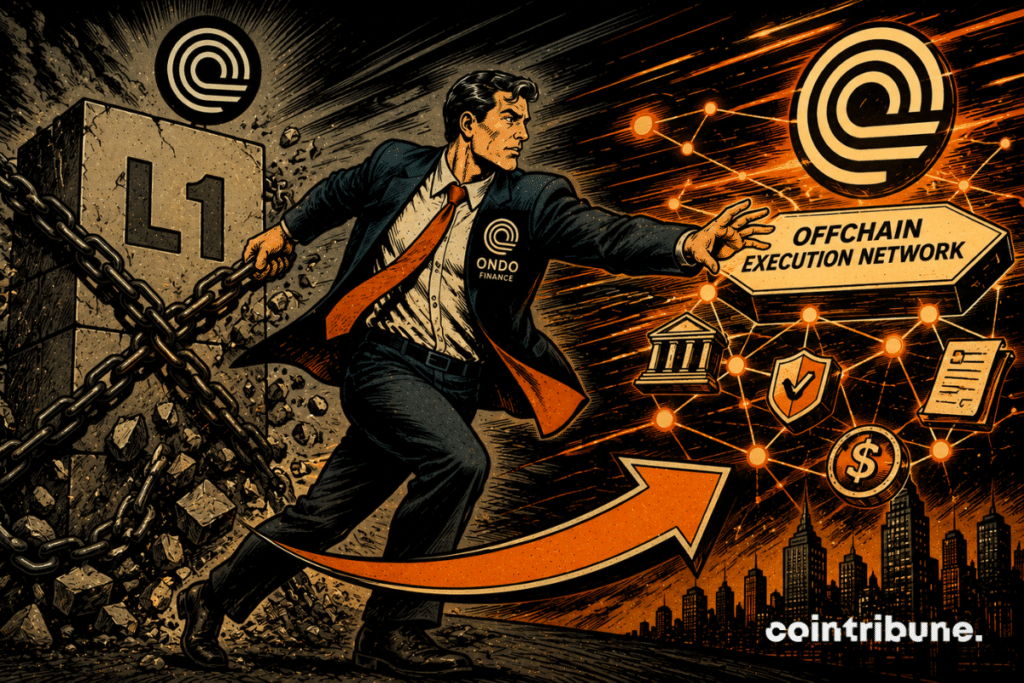
Ondo Finance launched Ondo Network on Monday, July 27, an offchain execution network that replaces the L1 blockchain announced in 2025. The real asset tokenization platform believes that a dedicated blockchain is no longer necessary today. A shift that reignites the debate about the real utility of on-chain infrastructure for traditional finance.
In brief
- Ondo Network takes the place of Ondo Chain, the L1 blockchain for institutional investors unveiled in February 2025
- Transactions go through secure enclaves (TEE) and not distributed validating nodes
- JPMorgan and Chainlink had completed the first transaction of the Ondo Chain testnet, a settlement of tokenized Treasury bills
A pivot nobody anticipated
Ondo Finance had made a big splash in February 2025 by unveiling Ondo Chain, a layer 1 blockchain designed to host traditional financial assets in tokenized form. A few months later, the platform reached the testnet and completed a significant inaugural transaction: a settlement of tokenized US Treasury bills, orchestrated by JPMorgan via its subsidiary Kinexys and the decentralized oracle Chainlink.
On Monday, July 27, 2026, Ondo Finance unveils Ondo Network, a system that abandons the classic blockchain architecture for secure computing enclaves, the Trusted Execution Environments. The company doesn’t mince words: “It is not a blockchain today, and it is not necessary“, Ondo stated.
A classic blockchain mobilizes a network of computers that collectively validate transactions and maintain a shared state. Ondo Network operates differently. The trading software runs inside protected enclaves, environments where data remains encrypted even against the host operating system.
Transfers still end up on public blockchains in the final stage. But Ondo did not specify the identity of the operators of these enclaves, nor their number. This silence on governance raises questions about the real decentralization of the network.
Ondo Network is already running Ondo Perps, the company’s perpetual futures platform. Hedging and speculation on tokenized assets thus use this offchain circuit, with final settlement on-chain.
Do institutional investors really need dedicated blockchains?
Ondo Finance’s turnaround is not just an isolated case. It challenges the idea that institutional investors will massively adopt tailor-made blockchains. Ondo Chain illustrates a dilemma: on-chain infrastructures offer transparency and decentralization, but their operational complexity drives the search for lighter alternatives.
That JPMorgan, Chainlink, and Ondo successfully conducted a test transaction in 2025 makes the episode more notable. The testnet was solid, the technology worked. Yet Ondo chose to call it quits.
Other institutional tokenization projects might recalibrate their ambitions if a player of this caliber concludes that a dedicated L1 isn’t worth its complexity. The promise of a blockchain per financial asset class recedes, in favor of a more pragmatic logic: off-chain execution, on-chain settlement.
In short, Ondo Finance prioritizes operational efficiency over blockchain orthodoxy. Real asset tokenization continues to attract finance giants, the US regulator refines its framework for stablecoins, and on-chain derivative volumes rise month after month. Three trends that, if they converge, will vindicate Ondo faster than expected.
Maximize your Cointribune experience with our "Read to Earn" program! For every article you read, earn points and access exclusive rewards. Sign up now and start earning benefits.

Passionné par le Bitcoin, j'aime explorer les méandres de la blockchain et des cryptos et je partage mes découvertes avec la communauté. Mon rêve est de vivre dans un monde où la vie privée et la liberté financière sont garanties pour tous, et je crois fermement que Bitcoin est l'outil qui peut rendre cela possible.
The views, thoughts, and opinions expressed in this article belong solely to the author, and should not be taken as investment advice. Do your own research before taking any investment decisions.