SEC Launches 5-Year Pilot for Tokenized US Stocks
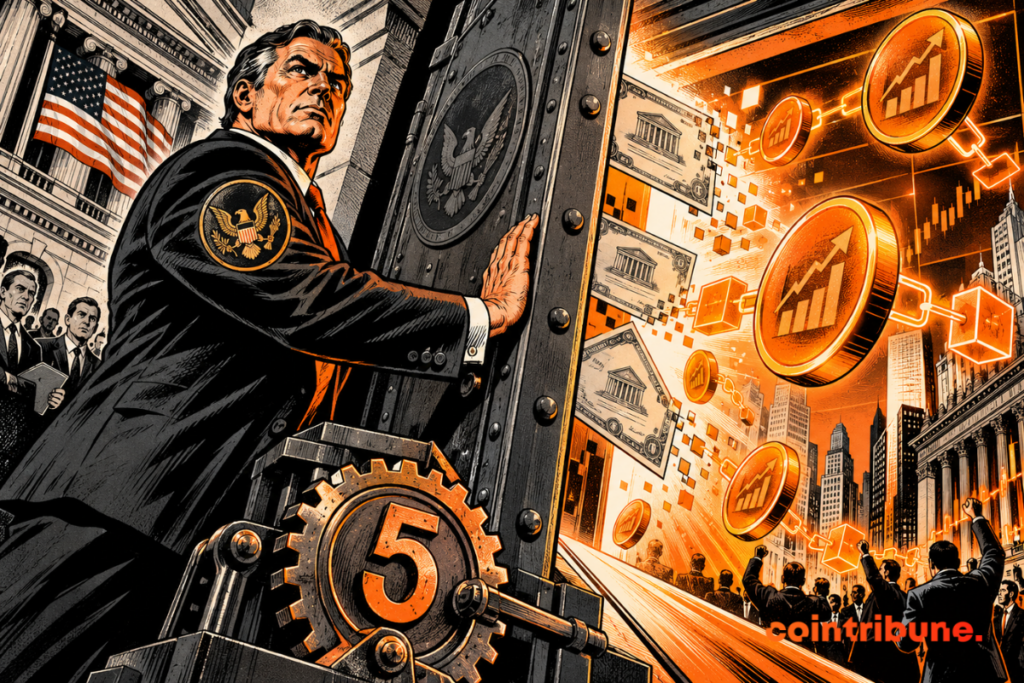
A door finally opens for onchain finance! On September 17, 2026, the SEC announces an unprecedented 5-year exemption allowing the trading of tokenized US stocks. Indeed, tokenization has just passed a major regulatory milestone in the United States. Nevertheless, the American regulator’s decision raises a major question: does the tokenization of traditional stocks represent a revolution or a risk for investors? Full analysis.
In brief
- The SEC launches a five-year exemption for the tokenization of US stocks.
- Platforms must guarantee the same rights as a traditional stock, under penalty of blockage.
- An issuer has 30 days to oppose the tokenization of its security.
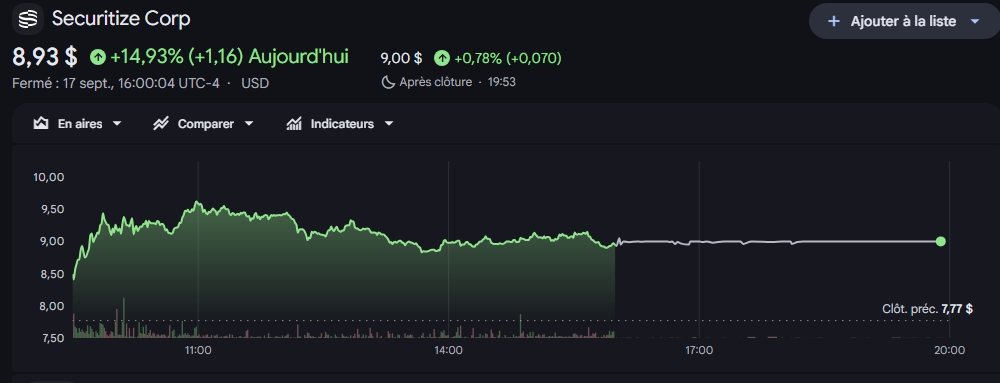
- Securitize jumps 14% and Bullish 10%, after the US regulator’s announcement.
- Robinhood and Kraken remain excluded as long as their tokens do not give real shareholder rights.
Tokenization of stocks: what the exemption announced by the SEC really changes
After a postponement announced in May, the SEC finally launches with a clear goal: to bring the tokenization of stocks into US law without disrupting everything all at once. On September 17, 2026, it publishes the “Innovation Exemption” order. It exempts certain platforms called Tokenized Securities Venues (TSV) from registering as traditional exchanges. These TSVs will be able to trade tokenized stocks via automated liquidity pools (or AMMs) for five years.
Specifically, the tokenization framework involves two relaxations:
- one concerns the exchange qualification for eligible platforms;
- the other concerns dealer qualification for certain liquidity providers.
However, rules against fraud and manipulation continue to fully apply. Tokenization thus benefits from a targeted regulatory exemption.
What rights must tokenization guarantee to shareholders?
According to the SEC’s official statement, eligible tokenized stocks must offer the same rights as the corresponding traditional stocks. This includes:
- dividends;
- voting rights.
Synthetic products that only replicate a price remain excluded.
To understand the stakes of tokenization, imagine two tokens showing the same price:
- the first transmits the rights associated with the security;
- the second only provides financial exposure.
Their appearance may seem identical in an application. However, their legal scope differs. This distinction places tokenization against a concrete requirement: to explain how the buyer receives dividends and exercises voting rights. The fact is that the interface alone is not enough to inform about the nature of the investment.
Despite the new rule, companies retain control over US tokenization
When an independent third party tokenizes a stock, the platform must notify the company concerned and give it the opportunity to object. According to the SEC’s official statement, the prior notice period is 30 days. Tokenization thus also depends on the issuers’ position. This condition could favor tokenization projects built directly with companies.
Moreover, the market did not wait to react. Securitize’s stock jumped 14% right after the announcement. It recently made its debut on the NYSE. Bullish, the parent company of CoinDesk which just acquired the transfer agent Equiniti for $4.25 billion, rose 10%. Coinbase gained about 5% and Robinhood nearly 2.8%.
Carlos Domingo, head of Securitize, summarizes the stake:
This is extremely positive, as it provides a way to trade real tokenized stocks.
Thomas Cowan, global head of tokenization at Bullish, calls it a step in the right direction. However, he reminds that it is not truly the broad opening the crypto ecosystem had hoped for.
The winners of this tokenization framework are thus models that tokenize real stocks with real attached rights. Conversely, synthetic products remain outside the framework. This is notably the case for:
- Robinhood’s Stock Tokens;
- Kraken’s xStocks;
- some offshore products from Ondo Finance.
They only provide price exposure, without shareholder status. To enter the US tokenization market, these players will therefore have to revise their model.
How to measure the results of this experimental framework?
Platforms remain subject to volume caps and limits on the number of securities. They must regularly publish data in dollars:
- price;
- quantity;
- trade time;
- daily volumes…
This information will allow to evaluate tokenization with observable results. Specifically, this means that the number of tokens issued will indicate less about market quality than about:
- the depth of the liquidity pools;
- execution conditions;
- the functioning of safeguards.
The SEC also requires coordinating trading halts with those of the underlying security. Tokenization therefore does not eliminate halt mechanisms. As for DeFi, this regulatory exemption mainly offers a supervised testing ground.
In any case, the SEC lays the foundation for a regulated and experimental stock tokenization market. It remains to be seen how companies, investors, and platforms will adapt to this new reality. The tokenization of US stocks could well be the next major project for DeFi.
Maximize your Cointribune experience with our "Read to Earn" program! For every article you read, earn points and access exclusive rewards. Sign up now and start earning benefits.

My name is Ariela, and I am 31 years old. I have been working in the field of web writing for 7 years now. I only discovered trading and cryptocurrency a few years ago, but it is a universe that greatly interests me. The topics covered on the platform allow me to learn more. A singer in my spare time, I also cultivate a great passion for music and reading (and animals!)
The views, thoughts, and opinions expressed in this article belong solely to the author, and should not be taken as investment advice. Do your own research before taking any investment decisions.