CLARITY Act: The Senate Can Revive the Crypto Bill—Time Is Short
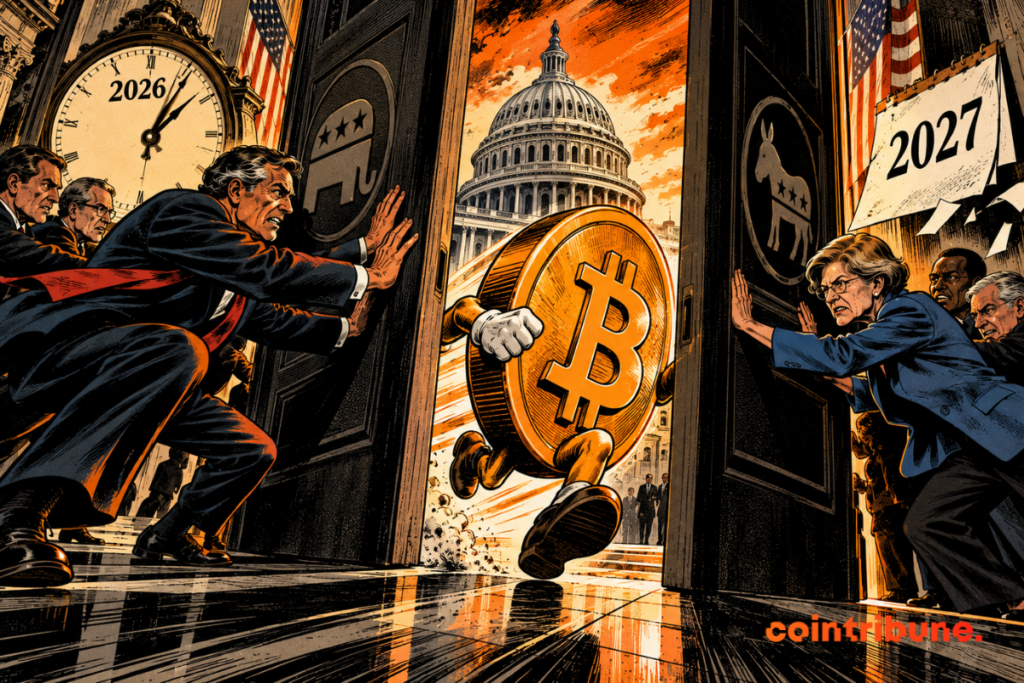
The CLARITY Act just failed its first procedural vote in the US Senate. 49 votes for and 50 against, while 60 were needed to open the debate. However, crypto analysts have not lost hope. According to them, the US crypto regulation bill is not officially dead. The Capitol still has a few weeks of parliamentary session left to pass it. Enough to keep crypto investors on edge!
In brief
- The CLARITY Act fails in the Senate with 49 votes for and 50 against, far from the 60 required.
- The bill remains on the calendar: John Thune may attempt a cloture vote again.
- 126 concessions made to Democrats were not enough to unblock crypto regulation.
- Bitcoin trades below $76,000 just after the announcement of the result.
- Without an agreement before the end of 2026, everything restarts from zero in January 2027.
CLARITY Act: a procedural vote that already kills hope for quick crypto regulation
On Tuesday, September 15, 2026, the Senate did not vote on the substance of the CLARITY Act. The vote was mainly about authorizing debate. With 40 votes for and 50 against, bill H.R. 3633 remains blocked before even being discussed on the merits.
Those closely following negotiations agree on one point: the result is not so surprising. Before the vote, prediction markets had already anticipated the rejection of this crypto bill. On Polymarket, for example, the probability of success dropped from 83% in February to only 13% in August.
The Democratic camp voted en bloc against progressing the bill, joined by three Republicans:
- Susan Collins;
- Josh Hawley;
- Jerry Moran.
Two independents did the same: Angus King and Bernie Sanders. Furthermore, two Democratic lawmakers who had supported the crypto bill in the banking committee in May switched sides at the decisive moment. They are Ruben Gallego (Arizona) and Angela Alsobrooks (Maryland).
To defend the Democratic position, Senator Elizabeth Warren said on X:
This ethics-centered angle obviously weighed heavily in the final negotiations.
Why does US crypto regulation stumble over 126 concessions?
The question deserves to be asked: how can a crypto bill with so many compromises like the CLARITY Act still fail? Direct answer: because political trust cannot be negotiated line by line, unlike the bill itself.
The Republican senators had nevertheless incorporated 126 changes demanded by the Democrats before the vote. The final package included an ethics framework targeting:
- the president;
- the vice president;
- members of Congress;
- federal judges.
Added to this are:
- an enforcement right given to state attorneys general;
- protections for non-custodial developers, crypto miners and validators;
- a Treasury mechanism supposed to prevent stablecoin yields from draining small bank deposits.
The Democrats made a counteroffer Monday night. The Republicans rejected it Tuesday morning. Result: back to square one, despite months of back-and-forth.
Another notable detail: the return of Mitch McConnell, 84, after three months absence due to a fall and hospitalization in June. The Kentucky senator voted for advancing the bill. A strong political gesture given Republicans only hold 53 seats in the Senate. They therefore mechanically depend on Democratic votes to reach 60.
US regulation: Tillis’ gesture opens a door, without bringing votes
Thom Tillis, Republican Senator from North Carolina, voted against the crypto bill CLARITY Act in order to request a reconsideration. He filed this motion at 3:01 PM, according to the Senate press service. This detail therefore changes the reading of the vote: his negative vote followed a procedural logic.
Indeed, the reconsideration request allows for a new attempt. However, it neither proves the existence of a sufficient coalition nor sets a new vote date.
Thus, the CLARITY Act remains technically alive. It keeps its place on the calendar, under number 423. This allows Majority Leader John Thune to try a cloture vote at any time. Moreover, a transitional parliamentary session after the midterm elections remains theoretically possible. However, it promises to be busy: budget, pending files, and the same tensions that sunk the bill Tuesday.
If nothing succeeds before the end of the 119th Congress, everything will restart from scratch in January 2027:
- reintroduced bill;
- new committee review;
- new coalition to rebuild in the Senate.
Meanwhile, the SEC and CFTC continue to operate under the existing legal framework. These US crypto regulators each pursue their own regulatory agenda on digital assets. The GENIUS Act, for its part, remains completely unchanged. Decoding: US crypto regulation progresses in a scattered manner rather than through a single coherent bill.
Following the vote, the bitcoin price fell back below $76,000. This erased the previous day’s gains. Worse, the flagship cryptocurrency approached a nearly four-week low.
In any case, one thing is certain: US crypto regulation is currently undergoing its most critical turbulence. If the Senate misses this window of opportunity, innovation will definitively settle outside the United States. Above all, the US crypto industry will have to continue dealing with a patchwork of rules and uncertainty for a long time.
Maximize your Cointribune experience with our "Read to Earn" program! For every article you read, earn points and access exclusive rewards. Sign up now and start earning benefits.

My name is Ariela, and I am 31 years old. I have been working in the field of web writing for 7 years now. I only discovered trading and cryptocurrency a few years ago, but it is a universe that greatly interests me. The topics covered on the platform allow me to learn more. A singer in my spare time, I also cultivate a great passion for music and reading (and animals!)
The views, thoughts, and opinions expressed in this article belong solely to the author, and should not be taken as investment advice. Do your own research before taking any investment decisions.