Solana: Yakovenko estimates that AI cannot forge a public key
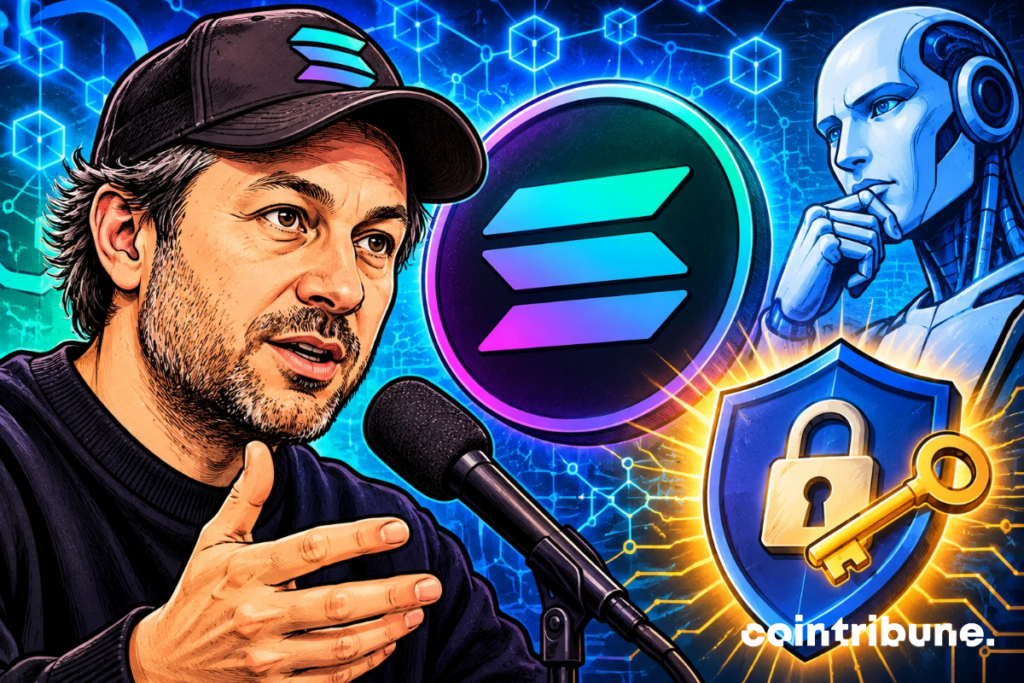
Artificial intelligence challenges several benchmarks of finance, notably the classic identity verification methods. Facing this evolution, Anatoly Yakovenko advocates an approach based on cryptography and public keys. The co-founder of Solana believes that AI cannot forge this identifier. This position is among four axes presented in the network’s long-term vision, at Breakpoint 2026, in London, from November 15 to 17, in front of many actors of the blockchain ecosystem.
In brief
- Anatoly Yakovenko believes that artificial intelligence cannot forge a public key.
- The co-founder of Solana advocates cryptography as an alternative to traditional identity controls.
- He views AI as a powerful tool to develop smart contracts and reduce bugs.
- Yakovenko wants to build a global index fund based on productive assets and low fees.
Solana relies on the public key, facing the limits of identity
The official Solana account summarized on Sunday on X Yakovenko’s ideas at Breakpoint 2026. The conference was held in London from November 15 to 17. On Solana, he contrasts two trust models. Traditional finance relies on identity, but AI could soon replicate it.
Yakovenko believes this evolution pushes financial actors to rethink their controls. He advocates the public key as another way to establish trust. “We simply need to know your public key. And that AI cannot forge,” he declared. This phrase sums up one of the network’s four axes.
In May, Yakovenko had discussed on X the risks of AI for cryptographic signatures. He feared this technology could compromise post-quantum schemes. According to him, developers still ignore some mathematical or technical flaws. This reservation nuances his stance on the public key and highlights security challenges.
Solana sees AI as a lever for smart contracts
The co-founder views AI as a powerful tool to develop smart contracts. At Breakpoint, he estimated that the number of bugs in code remains finite. He predicts this number will quickly tend toward zero. This perspective concerns teams who design and verify decentralized applications.
This evolution does not mean that all risks disappear. The remarks on post-quantum signatures remind that flaws may persist. Developers will need to examine systems beyond their ability to produce code. The Solana network thus combines automation with strong cryptographic foundations.
Yakovenko defends low fees as a factor for institutional adoption. “An excellent L1 is a cheap L1“, he stated. According to him, fees on Solana reach half a basis point during growth periods, i.e., 0.005%. He considers this level negligible for financial institutions.
A global index fund and low-cost infrastructure
Yakovenko describes the ultimate financial product as a “really boring” set of productive assets. He wants to build a global index fund representing the economy. On November 18, he proposed smart contracts to track global activity. He envisions a diversified asset, with as little risk as possible.
He cited the “Magnificent Seven,” SpaceX, and Unitree, Chinese robot manufacturers. These examples illustrate its diversity. The project therefore is not limited to major American companies. It could gather several sectors and markets into a single set.
On November 16, Yakovenko debated with Mert Mumtaz, head of Helius, on SOL as currency. Austin Federa, co-founder of DoubleZero, moderated the discussion. Yakovenko described SOL as a spam-resistant engine for the global economy, but the vote favored Mumtaz. He recalled that the Nasdaq speed was already in his first presentation.
Yakovenko advocates continuous blockchain evolution. In January, he opposed Vitalik Buterin on protocol hardening. He believes a network must evolve to remain useful. For ten years, he has opted for IBRL, increasing bandwidth and reducing latency. This priority could guide Solana’s developments.
The statements of Solana’s co-founder associate AI, public keys, and tokenized assets. What follows will depend on the teams’ ability to translate these principles into concrete tools and to address the cryptographic risks mentioned. Solana will thus have to reconcile reduced costs, speed, and security in the face of upcoming technical challenges.
Maximize your Cointribune experience with our "Read to Earn" program! For every article you read, earn points and access exclusive rewards. Sign up now and start earning benefits.

Journaliste et rédacteur web passionné par l’univers des cryptomonnaies et des technologies Web3. J’y traite les dernières tendances et actualités afin de proposer un contenu de haute qualité à un large public du secteur.
The views, thoughts, and opinions expressed in this article belong solely to the author, and should not be taken as investment advice. Do your own research before taking any investment decisions.