S&P and Pantera Launch a Crypto Index Without Bitcoin
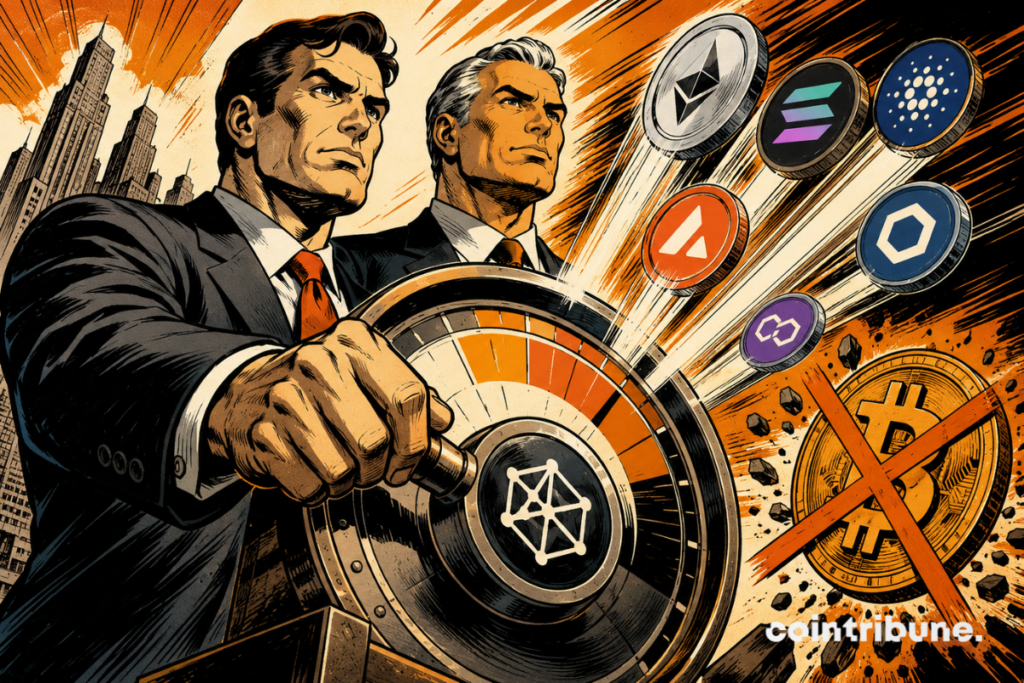
The digital asset market continues to mature with the arrival of new tools intended for institutional investors. In this context, S&P Dow Jones Indices and Pantera Capital unveil a benchmark index that favors projects generating real economic activity rather than the popularity of cryptocurrencies. This new approach aims to offer an analytical framework closer to the standards of traditional financial markets. It is also distinguished by a striking choice: the exclusion of bitcoin, whose operation does not meet the criteria retained by the two companies.
In brief
- S&P and Pantera launch a crypto index based on the revenue and economic activity of protocols.
- The initial portfolio includes 18 assets, including Ether, Solana, BNB, Tron, and Hyperliquid.
- Bitcoin is excluded because it does not meet the criteria of a revenue-generating protocol.
- The index targets institutional investors and could serve as a benchmark for future financial products.
- This methodology breaks with the major crypto indices, largely dominated by bitcoin.
S&P and Pantera Bet on the Fundamentals of Digital Assets
S&P Dow Jones Indices has partnered with Pantera Capital to launch the S&P Pantera Digital Asset Index. This benchmark index is based on a methodology that favors digital assets showing concrete adoption and revenues from their protocol. Unlike many existing products, it does not rank assets by their price evolution, notoriety, or market attention. This approach thus seeks, according to the two companies, to highlight economic fundamentals rather than speculative movements around bitcoin or altcoins.
According to the index introduction, the selection is based on clearly defined criteria. Smart contract platforms and decentralized finance protocols occupy an important place as they are evaluated according to the revenues generated in the last two quarters. Each asset must also present a minimum market capitalization of $500 million to be included in the index. Finally, it will be rebalanced every quarter, and the weighting of the same asset cannot exceed 35% to limit excessive concentrations.
The index was launched with a portfolio composed of 18 tokens. Among them are notably Ether, Binance Coin, Solana, Tron, and Hyperliquid. Conversely, memecoins and projects whose economic activity remains limited are not a priority. Thus, this methodology brings this index closer to the practices used in traditional financial markets.
An Index Designed for Institutional Investors
This index primarily targets institutional investors seeking diversified exposure to blockchain networks, digital infrastructures, and various protocols. It could also serve as a benchmark for the creation of future investment products. Asset managers could use it as a reference index to build portfolios or evaluate actively managed strategies.
In the press release published by S&P Global, the two partners state that “this initiative reflects a broader evolution of the digital asset market.” Blockchain applications continue to develop, while regulatory frameworks gradually become clearer in several jurisdictions. At the same time, institutional investors now have broader access to the sector, even if many current products still offer global exposure without distinguishing projects by their real economic activity.
Dan Morehead, founder and managing partner of Pantera Capital, believes asset allocation remains one of the main challenges facing global investors. According to him, the difficulty lies not in the lack of opportunities but in how to select the most relevant projects.
The main friction point in the cryptocurrency field hasn’t changed: it is about knowing how to allocate assets.
Dan Morehead, founder and managing partner of Pantera. Source: S&P Global press release.
He adds that the two companies developed this index to identify assets and infrastructures that present real economic value, favoring networks capable of demonstrating sustainable activity.
Why Bitcoin Was Excluded From This Index
One of the main particularities of this index lies in the exclusion of bitcoin. Cathy Clay, CEO of S&P Dow Jones Indices, explains that BTC exclusion results exclusively from the methodology used to build this new index:
Bitcoin does not meet the applied criteria because it is not a revenue-generating protocol. The goal is primarily to measure the economic activity produced by blockchain networks rather than their market valuation.
Cathy Clay, CEO of S&P Dow Jones Indices. Source: S&P Global press release.
This approach is based on a logic different from that adopted by most traditional crypto indices. Rather than ranking assets by capitalization or stock performance, S&P and Pantera favor protocols capable of generating revenues and demonstrating measurable economic activity.
During an interview given to CNBC, Cathy Clay explained that this methodology is directly inspired by standards used in traditional financial markets:
What we are trying to apply to digital assets are the same principles we have in our stock indices.
Cathy Clay, CEO of S&P Dow Jones Indices. Source: CNBC.
For the executive, this approach brings more rigor to the evaluation of digital assets and helps investors focus on economic fundamentals rather than noise generated by market fluctuations.
Bitcoin Remains the Primary Benchmark for Investors
What is certain is that excluding bitcoin does not mean its role in the digital asset market is diminishing. The queen of cryptocurrencies retains a dominant position in most institutional indices, which primarily aim to reflect the overall market capitalization rather than revenues generated by protocols. This difference in methodology explains why the choice of S&P and Pantera stands out from the references already used by investors.
By comparison, the Nasdaq CME Crypto Index is composed of about 77% bitcoin and nearly 13% ether. On the other hand, the FTSE Digital Asset All Cap Index also devotes nearly 75% of its portfolio to bitcoin. These two indices illustrate the considerable weight of the first cryptocurrency in portfolios intended to represent the digital asset market as a whole.
This dominant position is explained by the place occupied by bitcoin since its launch. It remains the first crypto by its capitalization, estimated at about 57% of the total market according to CoinGecko data, and remains the main entry point for institutional investors in the market. The numerous financial products developed around this asset also testify to its status as a reference for a large part of the industry.
However, the S&P Pantera Digital Asset Index pursues a different objective. Instead of reproducing the market structure, it favors protocols capable of demonstrating measurable economic activity through the revenues they generate. Investors thus have two complementary approaches: one reflects the weight of assets in the market, while the other emphasizes the economic fundamentals of blockchain networks.
This initiative illustrates the growing desire to apply to digital assets methods inspired by major financial indices. If this approach meets the expectations of institutional investors, it could serve as a basis for new products built around measurable economic criteria. Bitcoin, which remains the main cryptocurrency by capitalization and the reference of major market indices, follows a logic different from that adopted by S&P and Pantera. As the sector continues to structure itself, investors should thus have several complementary benchmarks, adapted to distinct allocation and analysis objectives.
Maximize your Cointribune experience with our "Read to Earn" program! For every article you read, earn points and access exclusive rewards. Sign up now and start earning benefits.

Journaliste et rédacteur web passionné par l’univers des cryptomonnaies et des technologies Web3. J’y traite les dernières tendances et actualités afin de proposer un contenu de haute qualité à un large public du secteur.
The views, thoughts, and opinions expressed in this article belong solely to the author, and should not be taken as investment advice. Do your own research before taking any investment decisions.